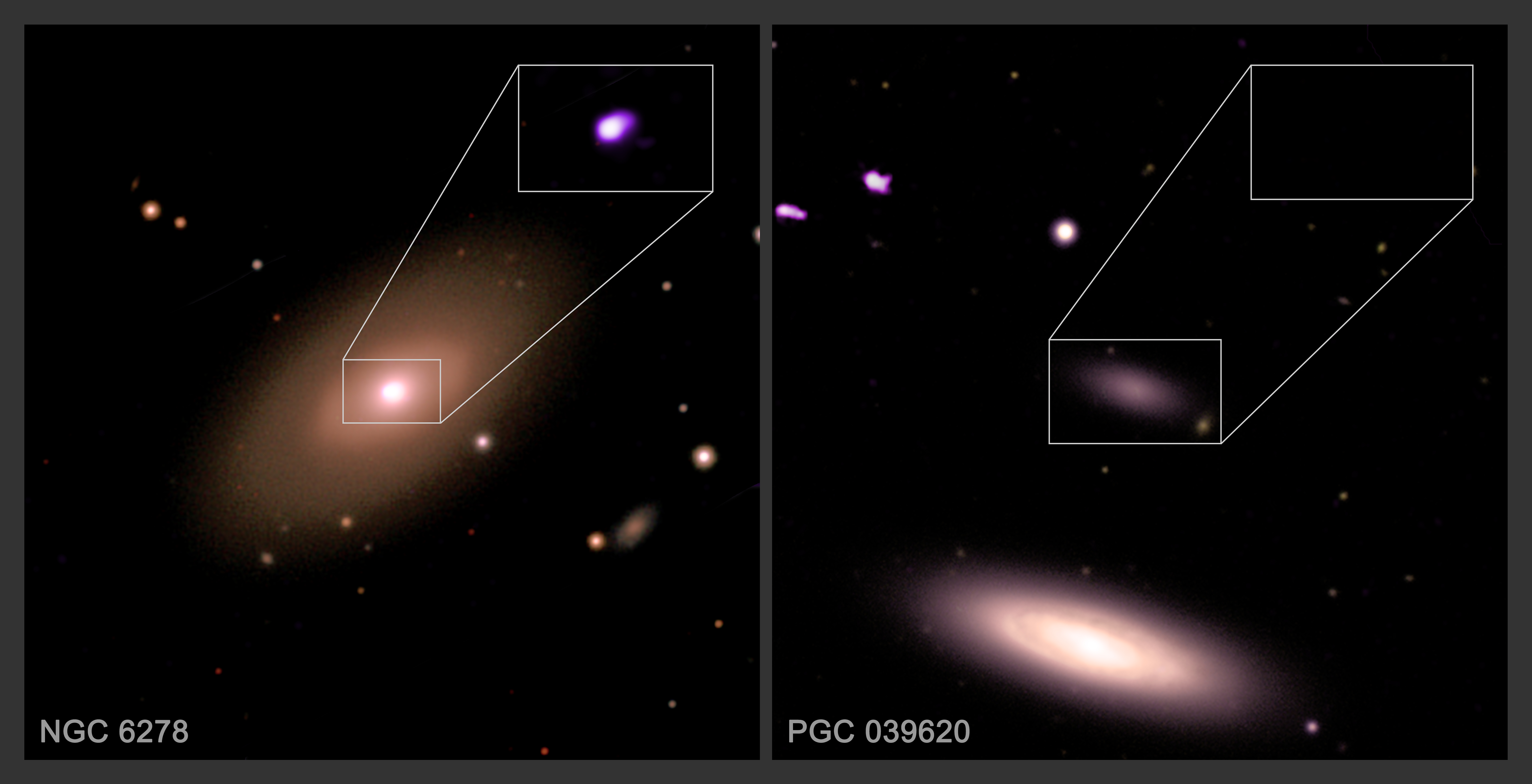
NGC 6278 and PGC 039620 are two galaxies from a sample of 1,600 that were searched for the presence of supermassive black holes. These images represent the results of a study that suggests that smaller galaxies do not contain supermassive black holes nearly as often as larger galaxies do. The study analyzed over 1,600 galaxies that have been observed with Chandra over two decades. Certain X-ray signatures indicate the presence of supermassive black holes. The study indicates that most smaller galaxies like PGC 03620, shown here in both X-rays from Chandra and optical light images from the Sloan Digital Sky Survey, likely do not have supermassive black holes in their centers. In contrast, NGC 6278, which is roughly the same size as the Milky Way, and most other large galaxies in the sample show evidence for giant black holes within their cores.
X-ray: NASA/CXC/SAO/F. Zou et al.; Optical: SDSS; Image Processing: NASA/CXC/SAO/N. Wolk
Most smaller galaxies may not have supermassive black holes in their centers, according to a recent study using NASA’s Chandra X-ray Observatory. This contrasts with the common idea that nearly every galaxy has one of these giant black holes within their cores, as NASA leads the world in exploring how our universe works.
A team of astronomers used data from over 1,600 galaxies collected in more than two decades of the Chandra mission. The researchers looked at galaxies ranging in heft from over ten times the mass of the Milky Way down to dwarf galaxies, which have stellar masses less than a few percent of that of our home galaxy. A paper describing these results has been published in The Astrophysical Journal and is available here https://arxiv.org/abs/2510.05252.
The team has reported that only about 30% of dwarf galaxies likely contain supermassive black holes.
“It’s important to get an accurate black hole head count in these smaller galaxies,” said Fan Zou of the University of Michigan in Ann Arbor, who led the study. “It’s more than just bookkeeping. Our study gives clues about how supermassive black holes are born. It also provides crucial hints about how often black hole signatures in dwarf galaxies can be found with new or future telescopes.”
As material falls onto black holes, it is heated by friction and produces X-rays. Many of the massive galaxies in the study contain bright X-ray sources in their centers, a clear signature of supermassive black holes in their centers. The team concluded that more than 90% of massive galaxies – including those with the mass of the Milky Way – contain supermassive black holes.
However, smaller galaxies in the study usually did not have these unambiguous black hole signals. Galaxies with masses less than three billion Suns – about the mass of the Large Magellanic Cloud, a close neighbor to the Milky Way – usually do not contain bright X-ray sources in their centers.
The researchers considered two possible explanations for this lack of X-ray sources. The first is that the fraction of galaxies containing massive black holes is much lower for these less massive galaxies. The second is the amount of X-rays produced by matter falling onto these black holes is so faint that Chandra cannot detect it.
“We think, based on our analysis of the Chandra data, that there really are fewer black holes in these smaller galaxies than in their larger counterparts,” said Elena Gallo, a co-author also from the University of Michigan.
To reach their conclusion, Zou and his colleagues considered both possibilities for the lack of X-ray sources in small galaxies in their large Chandra sample. The amount of gas falling onto a black hole determines how bright or faint they are in X-rays. Because smaller black holes are expected to pull in less gas than larger black holes, they should be fainter in X-rays and often not detectable. The researchers confirmed this expectation.
However, they found that an additional deficit of X-ray sources is seen in less massive galaxies beyond the expected decline from decreases in the amount of gas falling inwards. This additional deficit can be accounted for if many of the low-mass galaxies simply don’t have any black holes at their centers. The team’s conclusion was that the drop in X-ray detections in lower mass galaxies reflects a true decrease in the number of black holes located in these galaxies.
This result could have important implications for understanding how supermassive black holes form. There are two main ideas: In the first, a giant gas cloud directly collapses into a black hole, which contains thousands of times the Sun’s mass from the start. The other idea is that supermassive black holes instead come from much smaller black holes, created when massive stars collapse.
“The formation of big black holes is expected to be rarer, in the sense that it occurs preferentially in the most massive galaxies being formed, so that would explain why we don’t find black holes in all the smaller galaxies,” said co-author Anil Seth of the University of Utah.
This study supports the theory where giant black holes are born already weighing several thousand times the Sun’s mass. If the other idea were true, the researchers said they would have expected smaller galaxies to likely have the same fraction of black holes as larger ones.
This result also could have important implications for the rates of black hole mergers from the collisions of dwarf galaxies. A much lower number of black holes would result in fewer sources of gravitational waves to be detected in the future by the Laser Interferometer Space Antenna. The number of black holes tearing stars apart in dwarf galaxies will also be smaller.
NASA’s Marshall Space Flight Center in Huntsville, Alabama, manages the Chandra program. The Smithsonian Astrophysical Observatory’s Chandra X-ray Center controls science operations from Cambridge, Massachusetts, and flight operations from Burlington, Massachusetts.
Google is updating its AI try-on feature to let you virtually try on clothes using just a selfie, the company announced on Thursday. In the past, users had to upload a full-body picture of themselves to virtually try on a piece of clothing. Now they can use a selfie and Nano Banana, Google’s Gemini 2.5 Flash Image model, to generate a full-body digital version of themselves for virtual try-ons.
Users can select their usual clothing size, and the feature will then generate several images. From there, users can choose one to make it their default try-on photo.
If desired, users still have the option to use a full-body photo or select from a range of models with diverse body types.
The new capability is launching in the United States today.
Image Credits:Google
Google first launched the try-on feature in July, allowing users to try on apparel items from its Shopping Graph across Search, Google Shopping, and Google Images. To use the feature, users need to tap on a product listing or apparel product result and select the “try it on” icon.
The move comes as Google has been investing in the virtual AI try-on space, as the company has a separate app dedicated specifically to that purpose. The app, called Doppl, is designed to help visualize how different outfits might look on you using AI.
Earlier this week, the tech giant updated it with a shoppable discovery feed that displays recommendations so users can discover and virtually try on new items. Nearly everything in the feed is shoppable, with direct links to merchants.
The discovery feed features AI-generated videos of real products and suggests outfits based on your personalized style. While some may not be fond of an AI-generated feed, Google likely views it as a way to showcase products in a format that people are already familiar with, thanks to platforms like TikTok and Instagram.
OpenAI launched its latest frontier model, GPT-5.2, on Thursday amid increasing competition from Google, pitching it as its most advanced model yet and one designed for developers and everyday professional use.
OpenAI’s GPT-5.2 is coming to ChatGPT paid users and developers via the API in three flavors: Instant, a speed-optimized model for routine queries like information-seeking, writing, and translation; Thinking, which excels at complex structured work like coding, analyzing long documents, math, and planning; and Pro, the top-end model aimed at delivering maximum accuracy and reliability for difficult problems.
“We designed 5.2 to unlock even more economic value for people,” Fidji Simo, OpenAI’s chief product officer, said Thursday during a briefing with journalists. “It’s better at creating spreadsheets, building presentations, writing code, perceiving images, understanding long context, using tools and then linking complex, multi-step projects.”
GPT-5.2 lands in the middle of an arms race with Google’s Gemini 3, which is topping LMArena’s leaderboard across most benchmarks (apart from coding — which Anthropic’s Claude Opus-4.5 still has on lock).
Early this month, The Information reported that CEO Sam Altman released an internal “code red” memo to staff amid ChatGPT traffic decline and concerns that it is losing consumer market share to Google. The code red called for a shift in priorities, including stalling on commitments like introducing ads and instead focusing on creating a better ChatGPT experience.
GPT-5.2 is OpenAI’s push to reclaim leadership, even as some employees reportedly asked for the model release to be pushed back so the company could have more time to improve it. And despite indications that OpenAI would focus its attention on consumer use cases by adding more personalization and customization to ChatGPT, the launch of GPT-5.2 looks to beef up its enterprise opportunities.
The company is specifically targeting developers and the tooling ecosystem, aiming to become the default foundation for building AI-powered applications. Earlier this week, OpenAI released new data showing enterprise usage of its AI tools has surged dramatically over the past year.
Techcrunch event
Join the Disrupt 2026 Waitlist
Add yourself to the Disrupt 2026 waitlist to be first in line when Early Bird tickets drop. Past Disrupts have brought Google Cloud, Netflix, Microsoft, Box, Phia, a16z, ElevenLabs, Wayve, Hugging Face, Elad Gil, and Vinod Khosla to the stages — part of 250+ industry leaders driving 200+ sessions built to fuel your growth and sharpen your edge. Plus, meet the hundreds of startups innovating across every sector.
Join the Disrupt 2026 Waitlist
Add yourself to the Disrupt 2026 waitlist to be first in line when Early Bird tickets drop. Past Disrupts have brought Google Cloud, Netflix, Microsoft, Box, Phia, a16z, ElevenLabs, Wayve, Hugging Face, Elad Gil, and Vinod Khosla to the stages — part of 250+ industry leaders driving 200+ sessions built to fuel your growth and sharpen your edge. Plus, meet the hundreds of startups innovating across every sector.
This comes as Gemini 3 has become tightly integrated into Google’s product and cloud ecosystem for multimodal and agentic workflows. Google this week launched managed MCP servers that make its Google and Cloud services like Maps and BigQuery easier for agents to plug into. (MCPs are the connectors between AI systems and data and tools.)
OpenAI says GPT-5.2 sets new benchmark scores in coding, math, science, vision, long-context reasoning, and tool use, which the company claims could lead to “more reliable agentic workflows, production-grade code, and complex systems that operate across large contexts and real-world data.”
Those capabilities put it in direct competition with Gemini 3’s Deep Think mode, which has been touted as a major reasoning advancement targeting math, logic, and science. On OpenAI’s own benchmark chart, GPT-5.2 Thinking edges out Gemini 3 and Anthropic’s Claude Opus 4.5 in nearly every listed reasoning test, from real-world software engineering tasks (SWE-Bench Pro) and doctoral-level science knowledge (GPQA Diamond) to abstract reasoning and pattern discovery (ARC-AGI suites).
Research lead Aidan Clark said that stronger math scores aren’t just about solving equations. Mathematical reasoning, he explained, is a proxy for whether a model can follow multi-step logic, keep numbers consistent over time, and avoid subtle errors that could compound over time.
“These are all properties that really matter across a wide range of different workloads,” Clark said. “Things like financial modeling, forecasting, doing an analysis of data.”
During the briefing, OpenAI product lead Max Schwarzer said GPT-5.2 “makes substantial improvements to code generation and debugging” and can walk through complex math and logic step by step. Coding startups like Windsurf and CharlieCode, he added, report “state-of-the-art agent coding performance” and measurable gains on complex multi-step workflows.
Beyond coding, Schwarzer said that GPT-5.2 Thinking responses contain 38% fewer errors than its predecessor, making the model more dependable for day-to-day decision-making, research, and writing.
GPT-5.2 appears to be less a reinvention and more of a consolidation of OpenAI’s last two upgrades. GPT-5, which dropped in August, was a reset that laid the groundwork for a unified system with a router to toggle the model between a fast default model and a deeper “Thinking” mode. November’s GPT-5.1 focused on making that system warmer, more conversational, and better suited to agentic and coding tasks. The latest model, GPT-5.2, seems to turn up the dial on all of those advancements, making it a more reliable foundation for production use.
For OpenAI, the stakes have never been higher. The company has made commitments to the tune of $1.4 trillion for AI infrastructure buildouts over the next few years to support its growth — commitments it made when it still had the first-mover advantage among AI companies. But now that Google, which lagged behind at the start, is pushing ahead, that bet might be what’s driving Altman’s “code red.”
OpenAI’s renewed focus on reasoning models is also a risky flex. The systems behind its Thinking and Deep Research modes are more expensive to run than standard chatbots because they chew through more compute. By doubling down on that kind of model with GPT-5.2, OpenAI may be setting up a vicious cycle: spend more on compute to win the leaderboard, then spend even more to keep those high-cost models running at scale.
OpenAI is already reportedly spending more on compute than it had previously let on. As TechCrunch reported recently, most of OpenAI’s inference spend — the money it spends on compute to run a trained AI model — is being paid in cash rather than through cloud credits, suggesting the company’s compute costs have grown beyond what partnerships and credits can subsidize.
During the call, Simo suggested that as OpenAI scales, it is able to offer more products and services to generate more revenue to pay for additional compute.
“But I think it’s important to place that in the grand arc of efficiency,” Simo said. “You are getting, today, a lot more intelligence for the same amount of compute and the same amount of dollars as you were a year ago.”
For all its focus on reasoning, one thing that’s absent from today’s launch is a new image generator. Altman reportedly said in his code red memo that image generation would be a key priority moving forward, particularly after Google’s Nano Banana (the nickname for Google’s Gemini 2.5 Flash Image model) had a viral moment following its August release.
Last month, Google launched Nano Banana Pro (aka Gemini 3 Pro Image), an upgraded version with even better text rendering, world knowledge, and an eerie, real-life, unedited vibe to its photos. It also integrates better across Google’s products, as demonstrated over the past week as it pops up in tools and workflows like Google Labs Mixboard for automated presentation generation.
OpenAI reportedly plans to release another new model in January with better images, improved speed, and better personality, though the company didn’t confirm these plans Thursday.
OpenAI also said Thursday it’s rolling out new safety measures around mental health use and age verification for teens, but didn’t spend much of the launch pitching those changes.
This article has been updated with more information about OpenAI’s compute efficiency status.
Got a sensitive tip or confidential documents? We’re reporting on the inner workings of the AI industry — from the companies shaping its future to the people impacted by their decisions. Reach out to Rebecca Bellan at rebecca.bellan@techcrunch.comor Russell Brandom at russell.brandom@techcrunch.com. For secure communication, you can contact them via Signal at @rebeccabellan.491and russellbrandom.49.
Google on Thursday introduced a new AI experiment for the web browser: the Gemini-powered product Disco, which helps to turn your open tabs into custom applications. With Disco, you can create what Google is calling “GenTabs,” a tool that proactively suggests interactive web apps that can help you complete tasks related to what you’re browsing and allows you to build your own apps via written prompts.
For instance, if you’re studying a particular subject, GenTabs might suggest building a web app to visualize the information, which could help you better understand the core principles.
Image Credits:Google
Or, in a less academic scenario, you could use GenTabs to help you create a meal plan from a series of online recipes or help you plan a trip when you’re researching travel.
These are things that you can already do today with some AI-powered chatbots, but GenTabs builds these custom experiences on the fly using Gemini 3, using the information in your browser and in your Gemini chat history. After the app is built, you can also continue to refine it using natural language commands.
The resulting generative elements in the GenTabs experience will link back to the original sources, Google notes.
Image Credits:Google
Like others in the AI market, Google has been experimenting with bringing AI deeper into the web-browsing experience. Instead of building its own stand-alone AI browser, like Perplexity’s Comet or ChatGPT Atlas, Google integrated its AI assistant Gemini into the Chrome browser, where it can optionally be used to ask questions about the web page you’re on.
With GenTabs, the focus is not only on what you’re currently viewing, but also on your overall browsing, spanning multiple tabs — whether that’s research, learning, or something else.
Techcrunch event
Join the Disrupt 2026 Waitlist
Add yourself to the Disrupt 2026 waitlist to be first in line when Early Bird tickets drop. Past Disrupts have brought Google Cloud, Netflix, Microsoft, Box, Phia, a16z, ElevenLabs, Wayve, Hugging Face, Elad Gil, and Vinod Khosla to the stages — part of 250+ industry leaders driving 200+ sessions built to fuel your growth and sharpen your edge. Plus, meet the hundreds of startups innovating across every sector.
Join the Disrupt 2026 Waitlist
Add yourself to the Disrupt 2026 waitlist to be first in line when Early Bird tickets drop. Past Disrupts have brought Google Cloud, Netflix, Microsoft, Box, Phia, a16z, ElevenLabs, Wayve, Hugging Face, Elad Gil, and Vinod Khosla to the stages — part of 250+ industry leaders driving 200+ sessions built to fuel your growth and sharpen your edge. Plus, meet the hundreds of startups innovating across every sector.
However, the feature is only initially going to be available to a small number of testers through Google Labs, who will offer feedback about the experience. The company says that interesting ideas that are developed through Disco may one day find their way into other, larger Google products.
It also suggests that GenTabs will be one of many Disco features to come over time, noting that GenTabs is the “first feature” being tested.
To access Disco, users will need to join a waitlist to download the app, starting on macOS.
Rivian’s two-year effort to build its own AI assistant will launch in early 2026. And when it does, the AI assistant will roll out to every existing EV in its lineup, not just the next-generation versions of its R1T truck and R1S SUV.
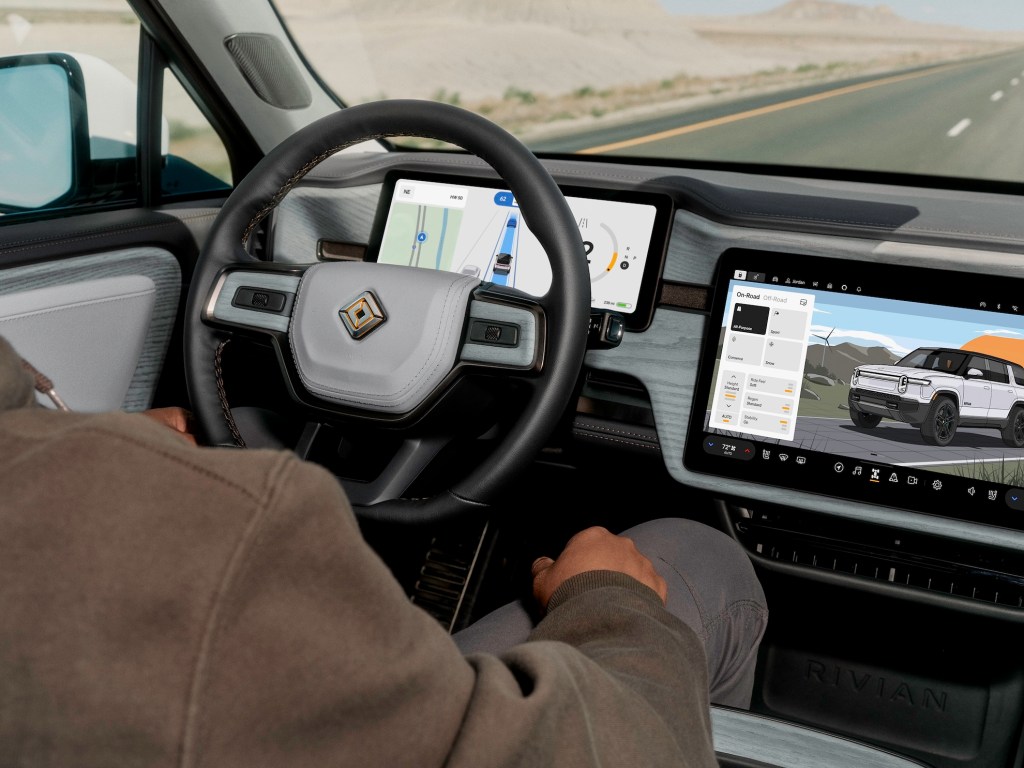
Drivers and passengers will be able to use the AI assistant to operate climate controls and handle other tasks contained within the vehicle’s infotainment system. It will also connect vehicle systems with third-party apps using an agentic framework built by Rivian engineers. Google Calendar will be the first third-party app to launch within the AI assistant, Rivian said Thursday.
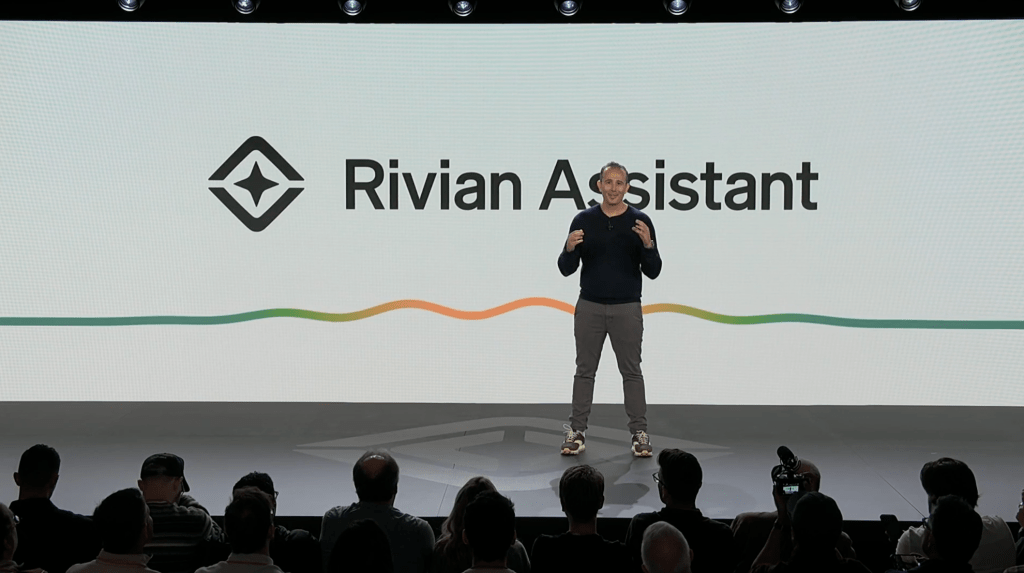
“The beauty here is we can integrate third-party agents, and this is completely redefining how apps in the future will integrate in our cars,” software development chief Wassym Bensaid said Thursday during the company’s AI & Autonomy event in Palo Alto, California.
The AI assistant will be augmented by frontier large language models — for instance, the Google Vertex AI and Gemini — for grounded data, natural conversation, and reasoning, according to Rivian.
Image Credits:Rivian
The AI assistant program, which TechCrunch first reported this week, reflects Rivian CEO RJ Scaringe’s push to become more vertically integrated. And that commitment was on full display at its AI & Autonomy event in Palo Alto, California. Beyond the AI assistant, the company detailed how it has developed a software and new hardware, including a custom 5nm processor built in collaboration with both Arm and TSMC, that will expand its hands-free driving assistance system and eventually let drivers take their eyes off the road.
This vertical integration work has been underway for years. In 2024, the EV maker completely reworked the guts of its flagship R1T truck and R1S SUV, changing everything from the battery pack and suspension system to the electrical architecture, sensor stack, and software user interface.
The company’s software team led by Bensaid has continued to work on building out the software stack. A smaller group — the size of which Rivian won’t disclose — focused on the AI assistant, which is designed to be model and platform agnostic, according to Bensaid.
Techcrunch event
Join the Disrupt 2026 Waitlist
Add yourself to the Disrupt 2026 waitlist to be first in line when Early Bird tickets drop. Past Disrupts have brought Google Cloud, Netflix, Microsoft, Box, Phia, a16z, ElevenLabs, Wayve, Hugging Face, Elad Gil, and Vinod Khosla to the stages — part of 250+ industry leaders driving 200+ sessions built to fuel your growth and sharpen your edge. Plus, meet the hundreds of startups innovating across every sector.
Join the Disrupt 2026 Waitlist
Add yourself to the Disrupt 2026 waitlist to be first in line when Early Bird tickets drop. Past Disrupts have brought Google Cloud, Netflix, Microsoft, Box, Phia, a16z, ElevenLabs, Wayve, Hugging Face, Elad Gil, and Vinod Khosla to the stages — part of 250+ industry leaders driving 200+ sessions built to fuel your growth and sharpen your edge. Plus, meet the hundreds of startups innovating across every sector.
To power this AI assistant, Rivian developed what it has described as a model- and platform-agnostic architecture that uses custom large language models and is branded as Rivian Unified Intelligence, or RUI. This hybrid software stack includes its own custom models and the “orchestration layer,” the conductor that makes sure the various AI models work together. Rivian said it has used other companies for specific agentic AI functions.
“The Riven Unified Intelligence is the connective tissue that runs through the very heart of Rivian’s digital ecosystem,” Bensaid said at the event. “This platform enables targeted agent solutions that drive value across our entire operation and our entire vehicle life cycle.”
For instance, RUI will be used for more than just providing an AI assistant, according to the company. It will also be used to improve vehicle diagnostics, which Rivian describes as “an expert assistant for technicians, scanning telemetry and history to pinpointing complex issues.”
The article was updated to clarify that the AI assistant will be augmented by frontier large language models.
Rivian detailed Thursday how it plans to make its electric vehicles increasingly autonomous — an ambitious effort that includes new hardware, including lidar and custom silicon, and eventually, a potential entry into the self-driving ride-hail market, according to CEO RJ Scaringe.
The announcements at the company’s first “Autonomy & AI Day” event in Palo Alto, California, shed fresh light on Rivian’s technology development, much of which has been kept undercover as it pushes to begin production of its more affordable R2 SUV in the first half of 2026. Rivian’s event is also a very public signal to shareholders that it’s keeping pace, or even exceeding, the automated-driving capabilities of industry rivals like Tesla, Ford, General Motors, as well as automakers from Europe and China.
Rivian said it will expand the hands-free version of its driver-assistance software to “over 3.5 million miles of roads across the USA and Canada” and will eventually expand beyond highways to surface streets (with clearly painted road lines). This expanded access will be available on the company’s second-generation R1 trucks and SUVs. It’s calling the expanded capabilities “Universal Hands-Free” and will launch in early 2026. Rivian says it will charge a one-time fee of $2,500 or $49.99 per month.
“What that means is you can get into the vehicle at your house, plug in the address to where you’re going, and the vehicle will completely drive you there,” Scaringe said Thursday, describing a point-to-point navigation feature.
After that, Rivian plans to allow drivers to take their eyes off the road. “This gives you your time back. You can be on your phone, or reading a book, no longer needing to be actively involved in the operation of vehicle.”
Rivian’s driver assistance software won’t stop there; the EV maker laid out plans on Thursday to enhance its capabilities all the way up to what it’s calling “personal L4,” a nod to the level set by the Society of Automotive Engineers that means a car can operate in a particular area with no human intervention.
After that, Scaringe hinted that Rivian will be looking at competing with the likes of Waymo. “While our initial focus will be on personally owned vehicles, which today represent a vast majority of the miles driven in the United States, this also enables us to pursue opportunities in the ride-share space,” he said.
Techcrunch event
Join the Disrupt 2026 Waitlist
Add yourself to the Disrupt 2026 waitlist to be first in line when Early Bird tickets drop. Past Disrupts have brought Google Cloud, Netflix, Microsoft, Box, Phia, a16z, ElevenLabs, Wayve, Hugging Face, Elad Gil, and Vinod Khosla to the stages — part of 250+ industry leaders driving 200+ sessions built to fuel your growth and sharpen your edge. Plus, meet the hundreds of startups innovating across every sector.
Join the Disrupt 2026 Waitlist
Add yourself to the Disrupt 2026 waitlist to be first in line when Early Bird tickets drop. Past Disrupts have brought Google Cloud, Netflix, Microsoft, Box, Phia, a16z, ElevenLabs, Wayve, Hugging Face, Elad Gil, and Vinod Khosla to the stages — part of 250+ industry leaders driving 200+ sessions built to fuel your growth and sharpen your edge. Plus, meet the hundreds of startups innovating across every sector.
To help accomplish these lofty goals, Rivian has been building a “large driving model” (think: an LLM but for real-world driving), part of a move away from a rules-based framework for developing autonomous vehicles that has been led by Tesla. The company also showed off its own custom 5nm processor, which it says will be built in collaboration with both Arm and TSMC.
That custom chip powers what Rivian is referring to as its third-generation “autonomy computer,” or ACM3. The new computer can process 5 billion pixels per second and will start showing up on Rivian’s upcoming mass-market R2 SUV in late 2026.
Rivian will couple the ACM3 with a lidar sensor at the top of the windshield (from an undisclosed supplier) to provide “three-dimensional spatial data and redundant sensing,” which it says will help with “real-time detection for the edge cases of driving.”
“We expect that at launch in late 2026 this will be the most powerful combination of sensors and inference compute in consumer vehicles in North America,” senior vice president of electrical hardware Vidya Rajagopalan said at the event.
The R2 is set to start shipping in the first half of 2026, meaning the launch versions of the SUV will not have ACM3 or the lidar sensor. That means early versions of the R2 without the ACM3 and lidar hardware will most likely plateau at hands-free driving. Anyone hoping to do eyes-off or, later, unsupervised driving in a Rivian will need a vehicle with a lidar sensor.
“Adding lidar creates the ultimate sensing combination. It gives the most comprehensive 3D model of the space the vehicle is traveling through,” vice president of autonomy and AI James Philbin said Thursday. “The goal for our onboard sensing stack isn’t just human level, it’s superhuman level.”
This story has been updated to reflect that Rivian will not offer eyes-off driving in vehicles without lidar sensors.
The race to release world models is on as AI image and video generation company Runway joins an increasing number of startups and BigTech companies by launching its first one. Dubbed GWM-1, the model works through frame-by-frame prediction, creating a simulation with an understanding of physics and how the world actually behaves over time, the company said.
A world model is an AI system that learns an internal simulation of how the world works so it can reason, plan, and act without needing to be trained on every scenario possible in real life.
Runway, which earlier this month launched its Gen 4.5 video model that surpassed both Google and OpenAI on the Video Arena leaderboard, said its GWM-1 world model is more “general” than Google’s Genie-3 and other competitors. The firm is pitching it as a model that can create simulations to train agents in different domains like robotics and life sciences.
“To build a world model, we first needed to build a really great video model. We believe that the right path to building a world model is teaching models to predict pixels directly is the best way to achieve general-purpose simulation. At sufficient scale and with the right data, you can build a model that has sufficient understanding of how the world works,” the company’s CTO, Anastasis Germanidis, said during the livestream.
Runway released specific slants or versions to the new world model called GWM-Worlds, GWM-Robotics, and GWM-Avatars.
Image Credits:Runway
GWM-Worlds is an app for the model that lets you create an interactive project. Users can set a scene through a prompt or an image reference, and as you explore the space, the model generates the world with an understanding of geometry, physics, and lighting. The company mentioned that the simulation runs at 24 fps and 720p resolution. Runway said that while Worlds could be useful for gaming, it’s also well-positioned to teach agents how to navigate and behave in the physical world.
With GWM-Robotics, the company aims to use synthetic data enriched with new parameters like changing weather conditions or obstacles. Runway says this method could also reveal when and how robots might violate policies and instructions in different scenarios.
Techcrunch event
Join the Disrupt 2026 Waitlist
Add yourself to the Disrupt 2026 waitlist to be first in line when Early Bird tickets drop. Past Disrupts have brought Google Cloud, Netflix, Microsoft, Box, Phia, a16z, ElevenLabs, Wayve, Hugging Face, Elad Gil, and Vinod Khosla to the stages — part of 250+ industry leaders driving 200+ sessions built to fuel your growth and sharpen your edge. Plus, meet the hundreds of startups innovating across every sector.
Join the Disrupt 2026 Waitlist
Add yourself to the Disrupt 2026 waitlist to be first in line when Early Bird tickets drop. Past Disrupts have brought Google Cloud, Netflix, Microsoft, Box, Phia, a16z, ElevenLabs, Wayve, Hugging Face, Elad Gil, and Vinod Khosla to the stages — part of 250+ industry leaders driving 200+ sessions built to fuel your growth and sharpen your edge. Plus, meet the hundreds of startups innovating across every sector.
Runway is also building realistic avatars under GWM-Avatars to simulate human behavior. Companies like D-ID, Synthesia, Soul Machines, and even Google have worked on creating human avatars that look real and work in areas like communication and training.
The company noted that technically Worlds, Robotics, and Avatars are separate models, but eventually it plans to merge all these into one model.
Besides releasing a new world model, the company is also updating its foundational Gen 4.5 model released earlier in the month. The new update brings native audio and long-form, multi-shot generation capabilities to the model. The company said that with this model, users can generate one-minute videos with character consistency, native dialogue, background audio, and complex shots from various angles. The company said that you can also edit existing audio and add dialogues. Plus, you can edit multi-shot videos of any length.
The Gen 4.5 update nudges Runway closer to competitor Kling’s all-in-one video suite, which also launched earlier this month, particularly around native audio and multi-shot storytelling. It also signals that video generation models are moving from prototype to production-ready tools. Runway’s updated Gen 4.5 model is available to all paid plan users.
Image Credits:Runway
The company said that it will make GWM-Robotics available through an SDK. It added that it is in active conversation with several robotics firms and enterprises for the use of GWM-Robotics and GWM-Avatars.
Four years ago, Ford and South Korean battery maker SK On struck a deal to form a joint venture and spend $11.4 billion to build factories in Tennessee and Kentucky that would produce batteries for the next generation of electric F-Series trucks.
The factories live on; the joint venture will not.
SK On, a subsidiary of SK Innovation, said Thursday it reached an agreement with Ford to end the joint venture. The two companies will divide the assets: Ford will take ownership and operation of the twin battery plants in Kentucky, while SK On will operate the factory at the massive BlueOval SK campus in Tennessee.
SK On said it will maintain a strategic partnership with Ford centered on the Tennessee plant, according to Bloomberg.
When reached for comment, a Ford spokesperson told TechCrunch the company was aware of SK’s disclosure and had nothing further to share at this time.
The joint venture was created when the industry was investing billions of dollars to ramp up electric vehicle production. While EV sales have risen over the past several years, demand has not kept up with the industry’s lofty projections. The end of the federal EV tax credit has also dampened the pace of sales.
Techcrunch event
Join the Disrupt 2026 Waitlist
Add yourself to the Disrupt 2026 waitlist to be first in line when Early Bird tickets drop. Past Disrupts have brought Google Cloud, Netflix, Microsoft, Box, Phia, a16z, ElevenLabs, Wayve, Hugging Face, Elad Gil, and Vinod Khosla to the stages — part of 250+ industry leaders driving 200+ sessions built to fuel your growth and sharpen your edge. Plus, meet the hundreds of startups innovating across every sector.
Join the Disrupt 2026 Waitlist
Add yourself to the Disrupt 2026 waitlist to be first in line when Early Bird tickets drop. Past Disrupts have brought Google Cloud, Netflix, Microsoft, Box, Phia, a16z, ElevenLabs, Wayve, Hugging Face, Elad Gil, and Vinod Khosla to the stages — part of 250+ industry leaders driving 200+ sessions built to fuel your growth and sharpen your edge. Plus, meet the hundreds of startups innovating across every sector.
Images captured by NASA’s Parker Solar Probe as the spacecraft made its record-breaking closest approach to the Sun in December 2024 have now revealed new details about how solar magnetic fields responsible for space weather escape from the Sun — and how sometimes they don’t.
Like a toddler, our Sun occasionally has disruptive outbursts. But instead of throwing a fit, the Sun spews magnetized material and hazardous high-energy particles that drive space weather as they travel across the solar system. These outbursts can impact our daily lives, from disrupting technologies like GPS to triggering power outages, and they can also imperil voyaging astronauts and spacecraft. Understanding how these solar outbursts, called coronal mass ejections (CMEs), occur and where they are headed is essential to predicting and preparing for their impacts at Earth, the Moon, and Mars.
Images taken by Parker Solar Probe in December 2024, and published Thursday in the Astrophysical Journal Letters, have revealed that not all magnetic material in a CME escapes the Sun — some makes it back, changing the shape of the solar atmosphere in subtle, but significant, ways that can set the course of the next CME exploding from the Sun. These findings have far-reaching implications for understanding how the CME-driven release of magnetic fields affects not only the planets, but the Sun itself.
These images from the Wide-Field Imager for Solar Probe on NASA’s Parker Solar Probe show a phenomenon that occurs in the Sun’s upper atmosphere called an inflow. Inflows are the result of stretched magnetic field lines reconfiguring and causing material trapped along the lines to rain back toward the solar surface.
NASA
“These breathtaking images are some of the closest ever taken to the Sun and they’re expanding what we know about our closest star,” said Joe Westlake, heliophysics division director at NASA Headquarters in Washington. “The insights we gain from these images are an important part of understanding and predicting how space weather moves through the solar system, especially for mission planning that ensures the safety of our Artemis astronauts traveling beyond the protective shield of our atmosphere.”
Parker Solar Probe reveals solar recycling in action
As Parker Solar Probe swept through the Sun’s atmosphere on Dec. 24, 2024, just 3.8 million miles from the solar surface, its Wide-Field Imager for Solar Probe, or WISPR, observed a CME erupt from the Sun. In the CME’s wake, elongated blobs of solar material were seen falling back toward the Sun.
This type of feature, called “inflows”, has previously been seen from a distance by other NASA missions including SOHO (Solar and Heliospheric Observatory, a joint mission with ESA, the European Space Agency) and STEREO (Solar Terrestrial Relations Observatory). But Parker Solar Probe’s extreme close-up view from within the solar atmosphere reveals details of material falling back toward the Sun and on scales never seen before.
“We’ve previously seen hints that material can fall back into the Sun this way, but to see it with this clarity is amazing,” said Nour Rawafi, the project scientist for Parker Solar Probe at the Johns Hopkins Applied Physics Laboratory, which designed, built, and operates the spacecraft in Laurel, Maryland. “This is a really fascinating, eye-opening glimpse into how the Sun continuously recycles its coronal magnetic fields and material.”
Insights on inflows
For the first time, the high-resolution images from Parker Solar Probe allowed scientists to make precise measurements about the inflow process, such as the speed and size of the blobs of material pulled back into the Sun. These previously hidden details provide scientists with new insights into the physical mechanisms that reconfigure the solar atmosphere.
The Walt Disney Company announced on Thursday that it has signed a three-year partnership with OpenAI that will bring its iconic characters to the company’s Sora AI video generator. Disney is also making a $1 billion equity investment in OpenAI.
Launched in September, Sora allows users to create short videos using simple prompts. With this new agreement, users will be able to draw on more than 200 animated, masked, and creature characters from Disney, Marvel, Pixar, and Star Wars, including costumes, props, vehicles, and more.
These characters include iconic faces like Mickey Mouse, Ariel, Belle, Cinderella, Baymax, and Simba, as well as characters from Encanto, Frozen, Inside Out, Moana, Monsters, Inc., Toy Story, Up, and Zootopia. Users will also be able to draw on animated or illustrated versions of Marvel and Lucasfilm characters like Black Panther, Captain America, Deadpool, Groot, Iron Man, Darth Vader, Han Solo, Stormtroopers, and more.
Users will also be able to draw on these characters while using ChatGPT Images, the feature in ChatGPT that allows users to create visuals using text prompts.
The agreement does not include any talent likenesses or voices, Disney says.
“The rapid advancement of artificial intelligence marks an important moment for our industry, and through this collaboration with OpenAI we will thoughtfully and responsibly extend the reach of our storytelling through generative AI, while respecting and protecting creators and their works,” said Disney CEO Bob Iger in a statement.
Disney says that alongside the agreement, it will “become a major customer of OpenAI,” as it will use its APIs to build new products, tools, and experiences, including for Disney+.
Techcrunch event
Join the Disrupt 2026 Waitlist
Add yourself to the Disrupt 2026 waitlist to be first in line when Early Bird tickets drop. Past Disrupts have brought Google Cloud, Netflix, Microsoft, Box, Phia, a16z, ElevenLabs, Wayve, Hugging Face, Elad Gil, and Vinod Khosla to the stages — part of 250+ industry leaders driving 200+ sessions built to fuel your growth and sharpen your edge. Plus, meet the hundreds of startups innovating across every sector.
Join the Disrupt 2026 Waitlist
Add yourself to the Disrupt 2026 waitlist to be first in line when Early Bird tickets drop. Past Disrupts have brought Google Cloud, Netflix, Microsoft, Box, Phia, a16z, ElevenLabs, Wayve, Hugging Face, Elad Gil, and Vinod Khosla to the stages — part of 250+ industry leaders driving 200+ sessions built to fuel your growth and sharpen your edge. Plus, meet the hundreds of startups innovating across every sector.
“Disney is the global gold standard for storytelling, and we’re excited to partner to allow Sora and ChatGPT Images to expand the way people create and experience great content,” said Sam Altman, co-founder and CEO of OpenAI, in a statement. “This agreement shows how AI companies and creative leaders can work together responsibly to promote innovation that benefits society, respect the importance of creativity, and help works reach vast new audiences.”
On Me, a digital gift card startup founded by former Google employees, is aiming to redefine the gift card industry with its mobile-first gifting platform that lets users purchase digital gift cards categorized by interests rather than being restricted to specific retailers.
The company on Thursday said it had raised $6 million in a seed funding round, which it will use to expand its gift categories to include things like horseback riding lessons, wine tastings, and theme park trips.
Image Credits:On Me
On Me touts its flexibility. So if you have a friend who is passionate about tennis, you can send them a digital card that lets them shop for outfits and gear from popular brands like Wilson, On, Prince, and more.
The platform offers gift cards across 72 categories that range from running and reading to camping, gardening, gaming, and concerts.
You can also attach video messages, photos, and GIFs to gift cards, which is a nice touch as it lets you add a layer of personalization. You can use On Me via its website as well as iOS and Android apps.
Image Credits:On Me
The startup’s CEO and co-founder Darragh Meaney pointed out the environmental issues with the traditional gift card industry, which rely heavily on plastic.
The International Card Manufacturers Association (ICMA) reports that approximately 30 billion plastic cards are manufactured globally each year, and that over 70% of gift cards are discarded within six months, resulting in an estimated 53 million tons of plastic waste.
Techcrunch event
Join the Disrupt 2026 Waitlist
Add yourself to the Disrupt 2026 waitlist to be first in line when Early Bird tickets drop. Past Disrupts have brought Google Cloud, Netflix, Microsoft, Box, Phia, a16z, ElevenLabs, Wayve, Hugging Face, Elad Gil, and Vinod Khosla to the stages — part of 250+ industry leaders driving 200+ sessions built to fuel your growth and sharpen your edge. Plus, meet the hundreds of startups innovating across every sector.
Join the Disrupt 2026 Waitlist
Add yourself to the Disrupt 2026 waitlist to be first in line when Early Bird tickets drop. Past Disrupts have brought Google Cloud, Netflix, Microsoft, Box, Phia, a16z, ElevenLabs, Wayve, Hugging Face, Elad Gil, and Vinod Khosla to the stages — part of 250+ industry leaders driving 200+ sessions built to fuel your growth and sharpen your edge. Plus, meet the hundreds of startups innovating across every sector.
“It is an environmentally wasteful practice that feels totally disconnected from how we live today,” Meaney said.
On Me’s digital cards also integrate with Apple Pay and Google Wallet.
Image Credits:On Me
With the global gift card market projected to reach $2.3 trillion by 2030, On Me believes it is well-positioned for growth. Since its launch, the company says it has facilitated over $2.5 million in gifts for more than 26,000 users, and has grown 50% every month.
The seed round was led by NFX, with participation from Lerer Hippeau and Focal.
The funding comes a year after the company launched its platform and raised $1.7 million in a pre-seed round.
Each December, TIME Magazine names a person of the year — someone who has most influenced the news and world, for good or ill. Last year, TIME chose President Donald Trump for the second time. The year before that, it was Taylor Swift, who many claimed saved the economy from a recession with her Eras Tour. In 1938, the magazine chose Adolf Hitler.
This year, TIME has chosen to bestow its award on not just one person, but a group of people: the so-called “Architects of AI,” comprising the CEOs shaping the global AI race from the U.S. With AI on everyone’s minds, embodying hope for a small minority and economic anxiety for a majority, per recent Edelman data, this tracks.
“For decades, humankind steeled itself for the rise of thinking machines,” the article reads. “Leaders striving to develop the technology, including Sam Altman and Elon Musk, warned that the pursuit of its powers could create unforeseen catastrophe […] This year, the debate about how to wield AI responsibly gave way to a sprint to deploy it as fast as possible.”
Based on one of TIME’s two cover photos, some of those people appear to be Nvidia’s Jensen Huang, Tesla’s Elon Musk, OpenAI’s Sam Altman, Meta’s Mark Zuckerberg, AMD’s Lisa Su, Anthropic’s Dario Amodei, Google DeepMind’s Demis Hassabis, and World Labs’ Fei-Fei Li — all individuals who raced “both beside and against each other.”
TIME writes that these individuals, through their multibillion-dollar bets on “one of the biggest physical infrastructure projects of all time,” have reshaped government policy, turned up the heat on geopolitical competition, and pushed AI adoption forward.
This is the story of how AI changed our world in 2025, in new and exciting and sometimes frightening ways. It is the story of how Huang and other tech titans grabbed the wheel of history, developing technology and making decisions that are reshaping the information landscape, the climate, and our livelihoods… AI emerged as arguably the most consequential tool in great-power competition since the advent of nuclear weapons.
TIME only announced the news on Thursday morning, but images of the cover photo were leaked on prediction market Polymarket on Wednesday evening.
Messaging app Freedom Chat has fixed a pair of security flaws: one that allowed a security researcher to guess registered users’ phone numbers, and another that exposed user-set PINs to others on the app.
Freedom Chat, released in June, bills itself as a secure messaging app, and claims on its website that users’ phone numbers stay private.
But security researcher Eric Daigle told TechCrunch that users’ phone numbers and PIN codes, used for locking the app, could be easily obtained by exploiting vulnerabilities.
Daigle found the vulnerabilities last week and shared their details with TechCrunch, as Freedom Chat does not provide a public way to report security flaws, like a vulnerability disclosure program. TechCrunch then alerted Freedom Chat founder Tanner Haas to the security flaws by email.
Haas confirmed to TechCrunch that the app has now reset user PINs and released a new version. Haas added that the company is removing instances where users’ phone numbers were occasionally visible, and has notched up rate-limiting on its servers to prevent mass-guess attempts.
Daigle, who published his findings in a blog post, told TechCrunch it was possible to enumerate the phone numbers of close to 2,000 users who had signed up to use Freedom Chat since it launched. Daigle said Freedom Chat’s servers allowed anyone to flood it with millions of phone number guesses to determine if a user’s phone number was stored on the servers.
Per Daigle, this technique is identical to one described by the University of Vienna in research last month, where academics scraped data on some 3.5 billion user accounts who signed up to WhatsApp by matching billions of phone numbers against WhatsApp’s servers.
Daigle also found Freedom Chat was leaking users’ PIN codes. Using an open source network traffic inspection tool to analyze the data going in and out of the app, Daigle saw that the app would respond with the PIN codes of every other user in the same public channel — even if the PINs weren’t visible to users within the app itself.
According to Daigle, anyone who was in the default Freedom Chat channel, which users are automatically subscribed to when they first sign up, had their PIN broadcast to everyone else in the channel. Daigle told TechCrunch that knowledge of a person’s PIN could allow someone to open the app from a user’s stolen device.
In an app store update published Sunday, Freedom Chat noted: “A critical reset: A recent backend update inadvertently exposed user PINs in a system response. No messages were ever at risk, and because Freedom Chat does not support linked devices, your conversations were never accessible; however, we’ve reset all user PINs to ensure your account stays secure. Your privacy remains our top priority.”
Freedom Chat is Haas’ second messaging app, after Converso, which was delisted from app stores following the disclosure of security flaws that exposed users’ private messages and content.
Up to 3 million abandoned oil and gas wells litter the U.S. alone, and while many still contain oil or natural gas, the owners decided it wasn’t worth it to keep pumping.
“They’ve tried everything,” Prab Sekhon, CEO of Eclipse Energy, told TechCrunch. “There’s still a ton of oil left behind.”
Eclipse doesn’t have a way to recover that oil, but it does have a way to squeeze some of the energy they embody up to the surface. Rather than pump harder or inject something to force oil to the surface, Eclipse sends down microbes to munch on the oil molecules and liberate their hydrogen.
Instead of viscous oil, companies only have to deal with hydrogen gas. “Hydrogen flows a lot easier,” Sekhon said, making it easier to extract it from the well.
The Houston-based startup, which was spun out of Cemvita, demonstrated the technology at an oilfield in California’s San Joaquin Basin last summer. Now, it’s partnering with oilfield services company Weatherford International to deploy the technology around the world, the startup exclusively told TechCrunch. The first projects will begin in January.
“They’re an extension of our team,” Sekhon said to characterize the relationship with Weatherford. “They’ll be our operational arm.”
Eclipse, which was previously known as Gold H2, has been developing the technology over the last several years. It has been sampling microbes that naturally occur in oil wells, which live at the interface between oil and water held in aquifers, to find those that are best suited to the job.
Techcrunch event
Join the Disrupt 2026 Waitlist
Add yourself to the Disrupt 2026 waitlist to be first in line when Early Bird tickets drop. Past Disrupts have brought Google Cloud, Netflix, Microsoft, Box, Phia, a16z, ElevenLabs, Wayve, Hugging Face, Elad Gil, and Vinod Khosla to the stages — part of 250+ industry leaders driving 200+ sessions built to fuel your growth and sharpen your edge. Plus, meet the hundreds of startups innovating across every sector.
Join the Disrupt 2026 Waitlist
Add yourself to the Disrupt 2026 waitlist to be first in line when Early Bird tickets drop. Past Disrupts have brought Google Cloud, Netflix, Microsoft, Box, Phia, a16z, ElevenLabs, Wayve, Hugging Face, Elad Gil, and Vinod Khosla to the stages — part of 250+ industry leaders driving 200+ sessions built to fuel your growth and sharpen your edge. Plus, meet the hundreds of startups innovating across every sector.
As the microbes consume the oil, they break it down into hydrogen and carbon dioxide. Both then flow to the surface, where Eclipse and its partners will eventually separate the two. About half of the carbon dioxide is likely to stay in the reservoir, while the other half could be captured using specialized equipment and either sequestered or used.
The goal, Sekhon said, is to produce low-carbon hydrogen for around 50 cents per kilogram, or the same price as hydrogen obtained by breaking down natural gas in an industrial plant, a process that releases more carbon dioxide.
The resulting hydrogen could be used in petrochemical plants or burned for energy.
“It’s taking a liability and turning it into a clean energy asset,” Sekhon said.
Spoor launched in 2021 with the goal of using computer vision to help reduce the impact of wind turbines on local bird populations. Now the startup has proven its technology works and is seeing demand from wind farms and beyond.
Oslo, Norway-based Spoor has built software that uses computer vision to track and identify bird populations and migration patterns. The software can detect birds within a 2.5-kilometer radius (about 1.5 miles) and can work with any off-the-shelf high-resolution camera.
Wind farm operators can use this information to better plan where wind farms should be located and to help them better navigate migration patterns. For example, a wind farm could slow down its turbines, or even stop them entirely, during heavy periods of local migration.
Ask Helseth (pictured above left), the co-founder and CEO of Spoor, told TechCrunch last year that he got interested in this space after learning that wind farms lacked effective tracking methods, despite many countries having strict rules around where wind farms can be built and how they can operate due to local bird populations.
“The expectations from the regulators are growing but the industry doesn’t have a great tool,” Helseth said at the time. “A lot of people [go out] in the field with binoculars and trained dogs to find out how many birds are colliding with the turbines.”
Helseth told TechCrunch last week that since then, the company has proven the need for this technology and worked to make it better.
Image Credits:Spoor
At the time of its seed raise in 2024, Spoor was able to track birds in a 1-kilometer range, which has since doubled. As the company has collected more data to feed into its AI model, it has been able to improve its bird identification accuracy to about 96%.
Techcrunch event
Join the Disrupt 2026 Waitlist
Add yourself to the Disrupt 2026 waitlist to be first in line when Early Bird tickets drop. Past Disrupts have brought Google Cloud, Netflix, Microsoft, Box, Phia, a16z, ElevenLabs, Wayve, Hugging Face, Elad Gil, and Vinod Khosla to the stages — part of 250+ industry leaders driving 200+ sessions built to fuel your growth and sharpen your edge. Plus, meet the hundreds of startups innovating across every sector.
Join the Disrupt 2026 Waitlist
Add yourself to the Disrupt 2026 waitlist to be first in line when Early Bird tickets drop. Past Disrupts have brought Google Cloud, Netflix, Microsoft, Box, Phia, a16z, ElevenLabs, Wayve, Hugging Face, Elad Gil, and Vinod Khosla to the stages — part of 250+ industry leaders driving 200+ sessions built to fuel your growth and sharpen your edge. Plus, meet the hundreds of startups innovating across every sector.
“Identifying the species of the bird for some of the clients, you add another layer,” Helseth said. “Is it a bird or not a bird? We have an in-house ornithologist to help train the model to train the new types of birds or a new type of species. Having deployment in other countries [means] having rare species in the database.”
Spoor now works across three continents and with more than 20 of the world’s largest energy companies. It has also started to see interest from other industries such as airports and aquaculture farms. Spoor has a partnership with Rio Tinto, a London-based mining giant, to track bats.
The company has also received interest in using its tech to track other objects of similar size — but Helseth said they aren’t thinking of pivoting into those areas quite yet.
“Drones are of course a plastic bird in our mind,” Helseth joked. “They move in a different way and have a different shape and size. Currently we are discarding that data but we are getting interest in it.”
Spoor recently raised an €8 million ($9.3 million) Series A round led by SET Ventures with participation from Ørsted Ventures and Superorganism in addition to strategic investors.
Helseth predicts that interest in this type of technology will only grow as regulators continue to crack down on wind farms. For example, French regulators shut down a wind farm in April due to its impact on the local bird population and imposed hundreds of millions of fines.
“Our mission is to enable industry and nature to coexist,” Helseth said. “We have started on that journey, but we are still a small startup with a lot to prove. In the coming years, we want to really cement our position in the wind industry and become a global leader to tackle these challenges. At the same time, we want to build some proof points that this technology has value beyond that main category.”
Become a driving force behind WordPress innovation by joining the Global Community Sponsorship Program: a comprehensive initiative that supports the events and people powering our open source mission. As a Global Sponsor, your organization gains meaningful visibility across the international WordPress ecosystem while helping to fund events that foster growth, collaboration, and community.
Why Choose Global Sponsorship?
Instead of managing multiple individual sponsorships, this streamlined program consolidates your efforts into one efficient and impactful partnership.
Efficiency and Simplified Administration
Skip the complexity of coordinating invoice payments with numerous volunteer teams. Our centralized approach saves time and resources. In 2026, sponsors will benefit from:
A dedicated Slack channel for direct communication with the WordPress Community Support team and Community Program Managers
Monthly updates listing upcoming WordPress events, their current planning stages, and scheduled dates
Expanded Reach and Impact
Your sponsorship amplifies your presence worldwide, ensuring consistent visibility across global WordPress community events.
Stability and Reliability
Your commitment strengthens locally organized events by providing predictable funding that supports venues, logistics, and growth.
Flexible Branding Options
Adapt across your portfolio—Global Sponsors can represent different brands at different events (subject to approval and advance notice).
Program Benefits
Global Leader
Regional Powerhouse
Community Builder
Best for:
Established brands seeking global reach and year-round visibility.
Companies aiming for regional dominance and strong brand recognition.
Organizations supporting the next generation of WordPress education.
Sponsorship payable in full or through quarterly installments
$180,000
$110,000
$60,000
Top tier sponsorship benefits at all local WordCamp events (excludes flagships) with priority access to claim a sponsor table at in-person WordPress events
✔️
Option to feature multiple brands across events
✔️
Dedicated sponsor landing page
✔️
✔️
Complimentary WordPress event tickets for your team
Local WordPress events worldwide (venue rental, catering, A/V, and more)
Meetup.com license fees for over 671 WordPress Meetup groups globally
Administrative costs like insurance, banking, and annual financial audits that ensure transparent operations
Your partnership helps sustain the community that powers more than 43% of the web. Together, we can keep the WordPress project thriving and expanding for years to come.
If your company is interested in joining the Global Sponsorship program or you would like to know more, please reach out.
If you’d like to go one step further, please consider donating directly to the WordPress Foundation. We operate lean—every dollar goes toward keeping WordPress free, supporting education, and funding the community that makes the web a better place. In short, your donation helps us keep the lights on and the mission alive.
State of the Word 2025 brought the WordPress community together for an afternoon that felt both reflective and forward-moving, blending stories of global growth with technical milestones and glimpses of the future. This year also marked the twentieth State of the Word since the first address in 2006, a milestone noted in the WordPress history book Milestones: The Story of WordPress as the beginning of a tradition that has helped the project tell its own story.
From the outset, the keynote carried a sense of momentum shaped by thousands of contributors, educators, students, and creators whose steady participation continues to define the open web. It was a reminder that WordPress is more than software. It is a community writing its future together.
What we have is more than code. It’s momentum, it’s culture, and it’s a system that lets people learn by doing and lead by showing up. — Mary Hubbard, WordPress Executive Director
Mary opened the evening by reflecting on her first full year as Executive Director, a year spent listening deeply and seeing firsthand how people across regions learn, contribute, and lead. Her remarks grounded the keynote in the lived reality of a community that grows because people invest in one another, teach openly, and build trust through contribution.
I’ve met people using WordPress to unlock new careers. I’ve met contributors who started a single translation or forum post and are now leading major pieces of the project. In LatAm, Europe, and the States, I’ve seen students get access to WordPress tools and start building faster than we could have ever imagined. I’ve watched communities build in public, resolve disagreements in the open, and collaborate across languages and time zones.
That reflection offered a clear reminder of what makes WordPress resilient through change: a culture of showing up, learning by doing, and supporting others along the way. The project moves forward because people choose to participate in ways both large and small, strengthening the foundation that has carried WordPress for more than two decades.
With that foundation in place, the keynote moved through a series of stories and demonstrations that highlighted where WordPress stands today and where it is headed next — from a historic live release of WordPress 6.9 to expanding global education pathways, emerging AI capabilities, and deeper collaboration across the entire ecosystem.
WordPress by the Numbers
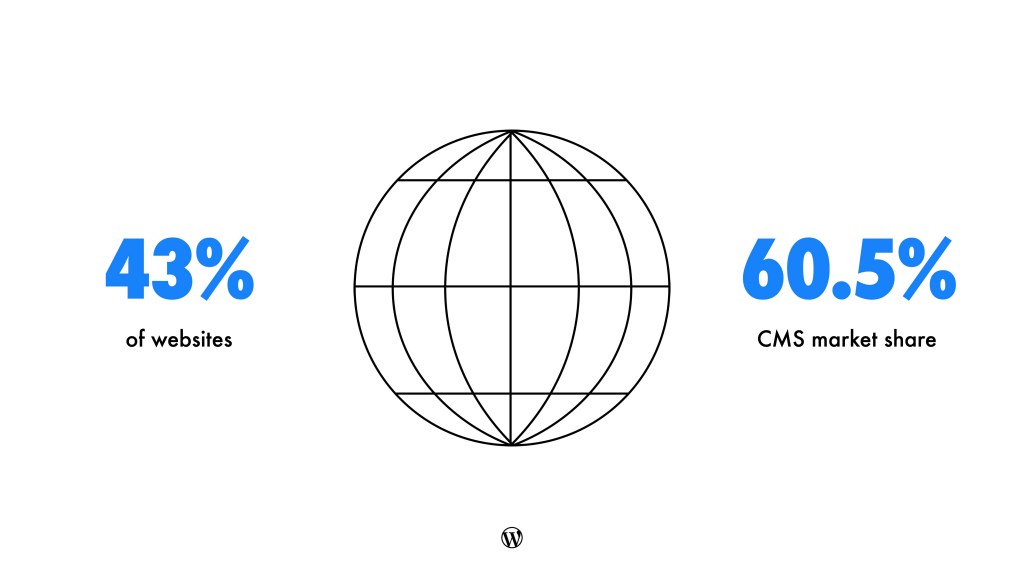
Project Cofounder Matt Mullenweg began with a wide-angle view of the project’s growth. WordPress powers over 43% of the web, with 60.5% of the CMS market. Shopify, its nearest competitor, holds 6.8%. Among the top 1,000 websites, WordPress’s share climbed to 49.4%, up 2.3% from the previous year.
Multilingual usage continued its strong rise. Over 56% of WordPress sites now run in languages other than English. Japan stood out, with WordPress powering 58.5% of all Japanese websites and 83% of the CMS market. Japanese became the second most-used language on WordPress at 5.82%. Spanish followed, then German, French, and Brazilian Portuguese.
The plugin ecosystem saw explosive growth. The directory surpassed 60,000 plugins, and plugin downloads were on pace to reach 2.1 billion by year-end. Over 1,500 themes have been released this year as well.
Contributors also hit new highs. The 6.8 release included 921 contributors, the largest group yet. WordPress 6.8 saw 79.5 million downloads, up 13%, and WordPress 6.9 included contributions from 230 first-time contributors and more than 340 enhancements and fixes.
A Release Moment to Remember
This year’s keynote delivered something WordPress had never attempted before: a live on-stage release of WordPress 6.9.
Mary set the moment up earlier in the program, calling WordPress 6.9 “fast, polished, and built for collaboration.” She explained that it reflected a year of intentional iteration, improved workflows, and deeper cross-team participation.
Matt took the stage with some of the release leads, the release button in hand. The room counted down, and then WordPress 6.9 shipped live, instantly updating millions of sites around the world. It was both a celebration and a testament to the reliability and trust the WordPress community has built into its release processes. Shipping a major version of WordPress in real time, on stage, without drama, is something the early contributors could hardly have imagined.
That reflection connected back to WordPress’s origin story. Matt talked about discovering the B2 forums, asking questions, and eventually reaching the point where he could answer someone else’s. That transition from learner to contributor remains at the heart of the project today. Two decades later, WordPress has grown from those early interactions into a platform that can ship a major release in front of the world, powered by thousands of contributors building together.
WordPress and the Future of AI
As the keynote shifted toward the future, Matt acknowledged what has become an essential truth of the moment: it would be impossible to talk about the next chapter of WordPress without talking about AI. He reminded the audience that in 2022, long before ChatGPT entered global conversation, he encouraged the community to “learn AI deeply.” The speed of change since then, he said, has exceeded every expectation, and WordPress has been preparing for it in ways both visible and behind the scenes.
Matt introduced one of the most important architectural developments of the year: the Abilities API and the MCP adapter. The Abilities API defines what WordPress can do in a structured way that AI systems can interpret, while the MCP adapter exposes those abilities through a shared protocol. This means AI agents — whether built by individuals, companies, or larger platforms — can understand and interact with WordPress safely and predictably. Instead of relying on one-off integrations or brittle interfaces, WordPress now participates in a broader ecosystem of tools that can query its capabilities and perform tasks using a standard, governed approach.
Matt then highlighted how developers are already using AI in their everyday work through tools like Cursor, Claude Code, and next-generation CLIs. These tools can explore entire codebases, generate documentation, produce tests, refactor large components, and even coordinate sequences of WP-CLI commands. For many developers, they expand what a single person can accomplish in an afternoon. They don’t eliminate the need for human judgment — they amplify it.
With that foundation laid, Matt turned the audience’s attention to Telex, the experimental environment designed to turn natural-language prompts into Gutenberg Blocks. Telex has already moved beyond experimentation and into real use. Matt showed examples from community creator Nick Hamze, who uses Telex to power micro-business tools that represent practical, revenue-generating workflows that previously required custom engineering.
Matt then widened the lens to show what companies across the ecosystem are building with AI. Hostinger’s Kodee can generate a complete WordPress site from a single description. Elementor AI demonstrated similarly rapid creation inside its own editor, producing full sections and layouts in seconds. WordPress.com showcased how its AI tools help users draft, rewrite, and refine content while keeping language aligned with the site’s voice. Yoast demonstrated how AI can support SEO workflows by generating structured suggestions and improving readability. Together, these examples illustrated that AI is not arriving in one place — it is arriving everywhere.
Experimental browsers can navigate WP Admin autonomously, performing tasks such as clicking buttons, opening menus, changing settings, and performing multi-step tasks without requiring any custom plugins or APIs. This raised a key question that Matt encouraged the community to consider: Which AI capabilities should live inside WordPress itself, and which should remain external, operating through the browser or operating system?
Matt closed the section by discussing WordPress-specific AI benchmarks and evaluation suites. These shared tests will measure how well AI systems understand and execute WordPress tasks, from enabling plugins to navigating WP Admin to modifying content and settings. The goal is to create a foundation where future AI tools behave predictably and responsibly across the entire ecosystem, giving creators confidence that intelligent tools understand the platform deeply.
A Global Community Growing Together
Mary then returned to the stage to celebrate the ecosystem that supports WordPress’s growth. Across continents, diverse groups of people have hosted WordPress events, training new contributors and welcoming newcomers into the project. WordCamp growth in 2025 reflected that: more than 81 WordCamps across 39 countries, powered by over 5,000 volunteers and attended by nearly 100,000 people, with sixteen more events still underway.
Education played a major role in this community expansion. Learn.WordPress.org served over 1.5 million learners this year, with clearer pathways into more structured programs like Campus Connect and WordPress Credits. This bridging was deliberate. Many learners arrive through tutorials or workshops but need clearer guidance on how to deepen their skills. By reshaping navigation and improving wayfinding across WordPress.org, the project began closing that gap.
She spotlighted Costa Rica’s Universidad Fidélitas, where WordPress moved beyond extracurricular interest into formal academic integration. Long before signing an agreement with the WordPress Foundation, their students were hosting WordCamp San José, forming student clubs, and treating WordPress as a crucial part of digital literacy and professional development.
Students of the WordPress Fidélitas Club
Wapuu appeared across events as a familiar companion and a cultural thread running through contributor tools and community projects. Its presence was a reminder that creativity and playfulness are as essential to open source as documentation or code.
Matt highlighted the story of Youth Day in Managua, Nicaragua. Seventy-five young people spent a full day building their first WordPress sites. Sessions were taught by teenagers, for teenagers. They learned to pick themes, customize layouts, create contact forms, and publish content. Contribution often starts with a simple moment of confidence, and those early sparks can shape entire careers.
Together, these moments illustrated a project expanding not just in numbers, but in depth, diversity, and global reach. WordPress is growing because communities are finding their own ways to embrace it.
What’s New in WordPress 6.9
Joining virtually, WordPress Lead Architect, Matías Ventura, shifted the keynote from vision to practice. Matías offered a detailed walkthrough of what makes WordPress 6.9 one of the most refined, collaborative, and forward-looking releases the project has shipped in years. He returned to the four familiar lenses of creation — writing, designing, building, and developing — and showed how each evolved in this release cycle.
He began with notes in the Block Editor, one of the most anticipated features. Notes allow collaborators to comment directly on individual blocks in a post or page. When a note is selected, the surrounding content subtly fades, helping contributors stay focused on context. Because notes are built on WordPress’s native comment system, they integrate seamlessly with existing communication workflows, including email notifications. Matías highlighted that notes development exemplified collaboration at its best, with contributors from various companies working together to bring the feature to life.
From there, he turned to refinements across the writing and design experience. Editor interactions feel smoother and more consistent. Patterns behave more predictably. Spacing and typography controls are clearer, more organized, and more intuitive. Together these capabilioties make the experience of writing and designing inside WordPress calmer, more reliable, and more empowering.
Block bindings now provide a more intuitive, visual way to connect blocks to dynamic data sources. Users can switch or remove bindings with a single click, and developers can register additional sources to support custom workflows. This work lays the foundation for a future where dynamic data flows more naturally through blocks, enabling site creators to build richer interfaces without writing code.
On the developer front, Matías focused on three foundational upgrades that represent major steps forward in how WordPress will evolve over the coming years.
The first was the Abilities API, a unified registry that describes what WordPress can do — across PHP, REST endpoints, the command palette, and future AI-driven interactions.
The HTML API introduces new ways of working with and modifying HTML server-side. The API ensures safer, more reliable handling, lowering the barrier for theme and block developers who work with dynamic or structured markup.
The Interactivity API delivers smoother, faster interactions without requiring heavy JavaScript frameworks. Improved routing, better state management, and clearer conventions help developers create rich, modern interfaces without leaving the WordPress philosophy of simplicity and flexibility.
After Matías wrapped his presentation, Matt stepped back in to highlight several developments that build on the foundations of 6.9 and strengthen the overall WordPress ecosystem. He pointed first to the Plugin Check Plugin, a tool designed to help developers align with current WordPress standards and catch common issues early, making plugins more reliable for users and easier to maintain over time. Matt then spoke about ongoing progress in Data Liberation, noting improvements to the WordPress importer that make it easier for people to bring their content into WordPress without disruption or loss, an important step toward ensuring the open web remains portable and resilient. He also highlighted advances across the Playground ecosystem, including WordPress Studio, the Playground CLI, and an expanding set of Blueprints. These allow developers and learners to spin up complete WordPress environments in seconds, test ideas, and experiment without servers or configuration. Matt closed this portion by emphasizing work on safer updates, which help WordPress avoid partial installs and ensure that updates complete smoothly even in less predictable hosting conditions, reinforcing WordPress’s commitment to stability as the platform continues to grow.
Matt emphasized that WordPress 6.9 is not defined by any single headline feature, but by a broad spectrum of refinements across the entire experience. It is a release that deepens reliability, expands capability, and sets the stage for future innovation.
Insights from the AI Panel
The keynote transitioned into a live AI panel moderated by Mary Hubbard. The panel brought together four perspectives from across the ecosystem: James LePage (Automattic), Felix Arntz (Google), and Jeff Paul (Fueled, FKA 10up), and Matt Mullenweg. Their conversation touched on the philosophy, practice, and future of AI inside WordPress — not as a distant trend, but as an active part of the project’s evolution.
A central theme was AI’s ability to amplify human creativity. James LePage put it plainly:
It’s not that we’re going to just add sparkle buttons everywhere. We’re going to do some crazy stuff here — things we’re going to build into the way you interact with creating content, with expressing yourself digitally. We want to give you more power, more control, and make you more effective at creating.
Jeff Paul echoed this sentiment, emphasizing that AI should make developers more productive by handling repetitive work and freeing them to focus on higher-level decisions. Felix Arntz expanded the idea further, describing how Google sees AI as a way to make the web more accessible and intuitive, especially for new creators who may not have formal technical training.
From left to right: Mary Hubbard, Matt Mullenweg, Jeff Paul, Felix Arntz, James LePage
Looking ahead, the panelists predicted deeper contextual integrations, AI-assisted debugging and scaffolding for developers, and workflows where agents can take on sequences of tasks while remaining directed by human decisions. They also highlighted the importance of standards, shared protocols, and privacy-focused design as essential components of WordPress’s long-term approach.
The next 20 years looks like WordPress remaining what it is today, which is the center of the open web.
The panel closed on a forward-looking but steady note. AI is accelerating, but WordPress is designing its foundations with flexibility and values that endure. The tools may change, but the commitment to openness, agency, and creative freedom remains the compass.
Questions That Push Us Forward
Matt introduced the Q&A as one of his favorite parts of State of the Word because it reveals what people are imagining, struggling with, or eager to build.
The first question addressed the growing interconnectedness of today’s web. What happens, a participant asked, when a major provider like Cloudflare goes down? As tools and agents rely more heavily on external services, failures can cascade. Matt acknowledged that outages are increasingly visible, but also argued that each one strengthens the system.
“Every failure, every edge case, everything that you never imagined is just another opportunity to find that new edge case,” he said. Resilience is not avoidance of failure, but the ability to grow stronger after it.
Another question focused on the longevity of web content. With platforms shutting down or links breaking over time, how can creators ensure their work endures? Matt pointed to the Internet Archive as one of the great stabilizers of the open web. He highlighted a new plugin that automatically scans posts and replaces dead links with archived versions, helping preserve the historical fabric of the web even as individual services come and go.
The next question turned to real-time collaboration inside WordPress. A participant asked how co-editing fits into the future of WordPress and how these tools might help creators work more confidently. Matt talked about how collaboration tools can support people who are just starting their creative journeys — whether they are entrepreneurs, students, or first-time site builders. He described real-time editing as part of a broader vision of WordPress “just doing the work for you” in high-pressure or early-stage creative moments.
The final question considered long-term decision-making. Matt noted that predicting what will change is difficult, but identifying what will remain the same is much easier. For WordPress, he said, the invariant is clear: people will always want agency, openness, and the ability to publish on their own terms. These values guide decisions not only in the present, but across decades of future evolution.
TBPN Podcast Appearance
After the Q&A, the keynote shifted gears with a live crossover segment featuring TBPN (the Technology Business Programming Network), a tech-focused podcast. The segment introduced a lively, unscripted energy into the room.
The hosts kicked things off by asking Matt what the “word of the year” should be. He chose “freedom”, connecting it directly to the core philosophy of open source. He described open source licenses as a kind of “bill of rights for software,” giving users inalienable rights that no company can revoke. In a world increasingly shaped by software platforms and digital ecosystems, these freedoms form the heart of what keeps the web open and accessible.
Conversation then moved to Beeper, the multi-network messaging client. Asked whether Beeper aims to “tear down walled gardens,” Matt rejected that framing. Instead, he offered a more collaborative metaphor: bringing gardens together. Most people have friends and colleagues scattered across WhatsApp, Instagram, LinkedIn, Messenger, and SMS. Beeper doesn’t replace those apps — it brings messages together into a unified interface..
The conversation eventually returned to publishing. Matt referenced the same principle he noted earlier: the importance of identifying what won’t change. For WordPress, he said, that means doubling down on freedom, agency, and the ability to publish without gatekeepers. Even as AI evolves, even as platforms shift, even as new tools emerge, these are the values that will guide the project forward.
Building the Web We Believe In
As the keynote drew to a close, Matt returned to a message that had threaded through every section of the evening. The future of WordPress is not arriving from outside forces — it is being crafted, questioned, tested, and expanded by the people who show up. Contributors, students, educators, community organizers, designers, developers, business owners, and first-time site builders all play a role in shaping the platform.
He spoke about the opportunities ahead: new tools that expand what creators can build, collaborative features that make teamwork feel natural, and AI systems that enhance creativity rather than diminish it. Across continents, generations, and skill levels, people are discovering WordPress as a path to learning, empowerment, and expression.
The values that brought the project this far remain the ones that will carry it forward: freedom, participation, learning, and community. These aren’t abstract principles. They are lived every day in the decisions contributors make, the ideas they pursue, and the care they bring to the work.
Future Events
If you’re feeling inspired to revisit past moments from the project’s annual address, the State of the Word YouTube playlist offers a look back at years of community milestones and product progress. The excitement continues into 2026, with major WordPress events already on the horizon: WordCamp Asia in Mumbai, India,WordCamp Europe in Kraków, Poland, and WordCamp US in Phoenix. We hope to see you there as the community continues building what comes next.
Each WordPress release celebrates an artist who has made an indelible mark on the world of music. WordPress 6.9, code-named “Gene,” honors the American Jazz pianist Gene Harris.
A piano veteran, self taught at the age of six, Harris infused mainstream jazz with elements of soul, blues, and gospel, creating a warm, signature sound that is both elegant and iconic. Harris’ bluesy jazz lived at the intersection of worlds, weaving a rich landscape of texture and mood, with a thread of soulfulness that ignited listeners.
Welcome to WordPress 6.9
WordPress 6.9 brings major upgrades to how teams collaborate and create. The new Notes feature introduces block-level commenting when writing posts and pages that streamlines reviews, while the expanded Command Palette makes it faster for power users to navigate and operate across the entire dashboard. The new Abilities API provides a standardized, machine-readable permissions system that opens the door for next generation AI-powered and automated workflows. This release also delivers notable performance improvements for faster page loads and adds several practical new blocks alongside a more visual drag and drop to help creators build richer, more dynamic content.
Collaborate Smarter : Leave Feedback Right Where You’re Working
With notes attached directly to blocks in the post editor, your team can stay aligned, track changes, and turn feedback into action all in one place. Whether you’re working on copy or refining design in your posts or pages, collaboration happens seamlessly on the canvas itself.
Command Palette Throughout the Dashboard
Your tools are always at hand.
Access the Command Palette from any part of the dashboard, whether you’re writing your latest post, deep in design in the Site Editor, or browsing your plugins. Everything you need, just a few keystrokes away.
Fit text to container
Content that adapts.
There’s a new typography option for text-based blocks that’s been added to the Paragraph and Heading blocks. This new option automatically adjusts font size to fill its container perfectly, making it ideal for banners, callouts, and standout moments in your design.
The Abilities API
Unlocking the next generation of site interactions.
WordPress 6.9 lays the groundwork for the future of automation with the unified Abilities API. By creating a standardized registry for site functionality, developers can now register, validate, and execute actions consistently across any context—from PHP and REST endpoints to AI agents—paving the way for smarter, more connected WordPress experiences.
Accessibility Improvements
More than 30 accessibility fixes sharpen the core WordPress experience. These updates improve screen reader announcements, hide unnecessary CSS-generated content from assistive tech, fix cursor placement issues, and make sure typing focus stays put even when users click an autocomplete suggestion.
Performance enhancements
WordPress 6.9 delivers significant frontend performance enhancements, optimizing the site loading experience for visitors. 6.9 boasts an improved LCP (Largest Contentful Paint) through on-demand block styles for classic themes, minifying block theme styles, and increasing the limit for inline styles – removing blockages to page rendering and clearing the rendering path by deprioritizing non-critical scripts. This release comes with many more performance boosts, including optimized database queries, refined caching, improved spawning of WP Cron, and a new template enhancement output buffer that opens the door for more future optimizations.
And much more
For a comprehensive overview of all the new features and enhancements in WordPress 6.9, please visit the feature-showcase website.
Learn WordPress is a free resource for new and experienced WordPress users. Learn is stocked with how-to videos on using various features in WordPress, interactive workshops for exploring topics in-depth, and lesson plans for diving deep into specific areas of WordPress.
Read the WordPress 6.9 Release Notes for information on installation, enhancements, fixed issues, release contributors, learning resources, and the list of file changes.
Explore the WordPress 6.9 Field Guide. Learn about the changes in this release with detailed developer notes to help you build with WordPress.
The 6.9 release squad
Every release comes to you from a dedicated team of enthusiastic contributors who help keep things on track and moving smoothly. The team that has led 6.9 is a cross-functional group of contributors who are always ready to champion ideas, remove blockers, and resolve issues.
WordPress 6.9 reflects the tireless efforts and passion of more than 900+ contributors in countries all over the world. This release also welcomed over 279 first-time contributors!
Their collaboration delivered more than 340 enhancements and fixes, ensuring a stable release for all – a testament to the power and capability of the WordPress open source community.
More than 71 locales have fully translated WordPress 6.9 into their language. Community translators are working hard to ensure more translations are on their way. Thank you to everyone who helps make WordPress available in 200+ languages.
Last but not least, thanks to the volunteers who contribute to the support forums by answering questions from WordPress users worldwide.
Get involved
Participation in WordPress goes far beyond coding. And learning more and getting involved is easy. Discover the teams that come together to Make WordPress and use this interactive tool to help you decide which is right for you.
The third Release Candidate (“RC3”) for WordPress 6.9 is ready for download and testing!
This version of the WordPress software is under development. Please do not install, run, or test this version of WordPress on production or mission-critical websites. Instead, it’s recommended that you evaluate RC3 on a test server and site.
Reaching this phase of the release cycle is an important milestone. While release candidates are considered ready for release, testing remains crucial to ensure that everything in WordPress 6.9 is the highest quality possible.
You can test WordPress 6.9 RC3 in four ways:
Plugin
Install and activate the WordPress Beta Tester plugin on a WordPress install. (Select the “Bleeding edge” channel and “Beta/RC Only” stream.)
Direct Download
Download the RC3 version (zip). and install it on a WordPress website.
Command Line
Use this WP-CLI command: wp core update --version=6.9-RC3
The scheduled final release date for WordPress 6.9 is December 2, 2025. The full release schedule can be found here. Your help testing RC versions is vital to making this release as stable and powerful as possible.
Want to look deeper into the details and technical notes for this release? Take a look at the WordPress 6.9 Field Guide. For technical information related to issues addressed since RC2, you can browse the following links:
WordPress is open source software made possible by a passionate community of people collaborating on and contributing to its development. The resources below outline various ways you can get involved with the world’s most popular open source web platform, regardless of your technical expertise.
Get involved in testing
Testing for issues is crucial to the development of any software. It’s also a meaningful way for anyone to contribute.
Your help testing the WordPress 6.9 RC3 prerelease is key to ensuring that the final release is the best it can be. While testing the upgrade process is essential, trying out new features is equally important. This detailed guide will walk you through testing features in WordPress 6.9. For those new to testing, follow this general testing guide for more details on getting set up.
If you encounter an issue, please report it to the Alpha/Beta/RC area of the support forums or directly to WordPress Trac if you are comfortable writing a reproducible bug report. You can also check your issue against a list of known bugs.
For plugin and theme authors, your products play an integral role in extending the functionality and value of WordPress for all users.
Thanks for continuing to test your themes and plugins with the WordPress 6.9 prereleases. If you haven’t yet, please conclude your testing and update the “Tested up to” version in your theme and plugin readme files to 6.9.
If you find compatibility issues, please post detailed information in the support forum.
Test on your hosting platforms
Web hosts provide vital infrastructure for supporting WordPress and its users. Testing on hosting systems helps inform the development process while ensuring that WordPress and hosting platforms are fully compatible, free of errors, optimized for the best possible user experience, and that updates roll out to customer sites without issue.
The second Release Candidate (“RC2”) for WordPress 6.9 is ready for download and testing!
This version of the WordPress software is under development. Please do not install, run, or test this version of WordPress on production or mission-critical websites. Instead, it’s recommended that you evaluate RC2 on a test server and site.
Reaching this phase of the release cycle is an important milestone. While release candidates are considered ready for release, testing remains crucial to ensure that everything in WordPress 6.9 is the best it can be.
You can test WordPress 6.9 RC2 in four ways:
Plugin
Install and activate the WordPress Beta Tester plugin on a WordPress install. (Select the “Bleeding edge” channel and “Beta/RC Only” stream).
Direct Download
Download the RC2 version (zip) and install it on a WordPress website.
Command Line
Use the following WP-CLI command: wp core update --version=6.9-RC2
The scheduled final release date for WordPress 6.9 is December 2, 2025. The full release schedule can be found here. Your help testing RC versions is vital to making this release as stable and powerful as possible.
Get a recap of WordPress 6.9’s highlighted features in the Beta 1 announcement. For more technical information related to issues addressed since RC1, you can browse the following links:
WordPress is open source software made possible by a passionate community of people collaborating on and contributing to its development. The resources below outline various ways you can help the world’s most popular open source web platform, regardless of your technical expertise.
Get involved in testing
Testing for issues is crucial to the development of any software. It’s also a meaningful way for anyone to contribute.
Your help testing the WordPress 6.9 RC2 version is key to ensuring that the final release is the best it can be. While testing the upgrade process is essential, trying out new features is equally important. This detailed guide will walk you through testing features in WordPress 6.9. For those new to testing, follow this general testing guide for more details on getting set up.
If you encounter an issue, please report it to the Alpha/Beta area of the support forums or directly to WordPress Trac if you are comfortable writing a reproducible bug report. You can also check your issue against a list of known bugs.
For plugin and theme authors, your products play an integral role in extending the functionality and value of WordPress for all users.
Thanks for continuing to test your themes and plugins with the WordPress 6.9 beta releases. If you haven’t yet, make sure to conclude your testing and update the “Tested up to” version in your plugin’s readme file to 6.9.
If you find compatibility issues, please post detailed information to the support forum.
Test on your hosting platforms
Web hosts provide vital infrastructure for supporting WordPress and its users. Testing on hosting systems helps inform the development process while ensuring that WordPress and hosting platforms are fully compatible, free of errors, optimized for the best possible user experience, and that updates roll out to customer sites without issue.