Posted on Leave a comment

Rivian’s AI assistant is coming to its EVs in early 2026 

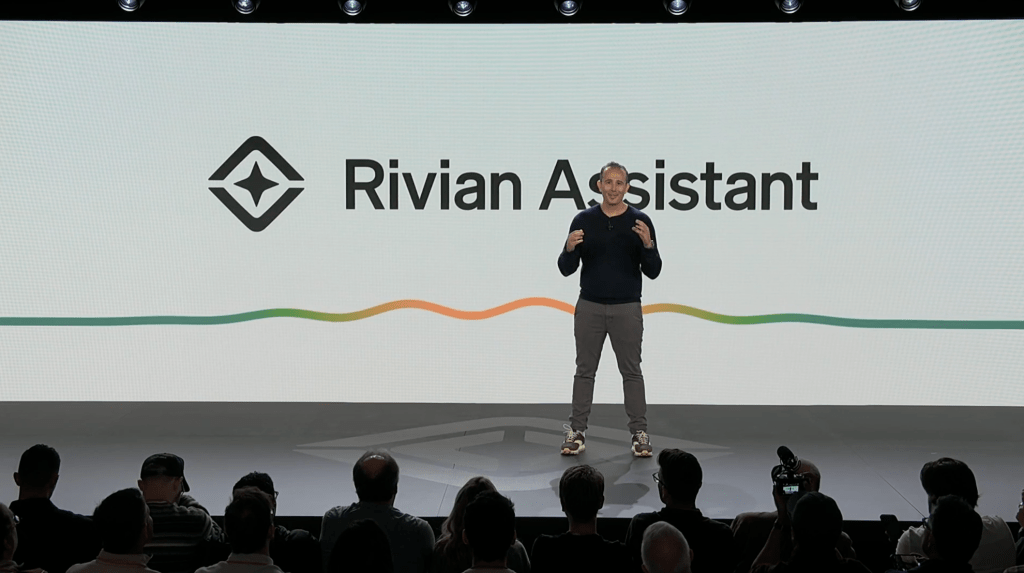
Rivian’s two-year effort to build its own AI assistant will launch in early 2026. And when it does, the AI assistant will roll out to every existing EV in its lineup, not just the next-generation versions of its R1T truck and R1S SUV. 

Drivers and passengers will be able to use the AI assistant to operate climate controls and handle other tasks contained within the vehicle’s infotainment system. It will also connect vehicle systems with third-party apps using an agentic framework built by Rivian engineers. Google Calendar will be the first third-party app to launch within the AI assistant, Rivian said Thursday.

“The beauty here is we can integrate third-party agents, and this is completely redefining how apps in the future will integrate in our cars,” software development chief Wassym Bensaid said Thursday during the company’s AI & Autonomy event in Palo Alto, California.

The AI assistant will be augmented by frontier large language models — for instance, the Google Vertex AI and Gemini — for grounded data, natural conversation, and reasoning, according to Rivian.

Image Credits:Rivian

The AI assistant program, which TechCrunch first reported this week, reflects Rivian CEO RJ Scaringe’s push to become more vertically integrated. And that commitment was on full display at its AI & Autonomy event in Palo Alto, California. Beyond the AI assistant, the company detailed how it has developed a software and new hardware, including a custom 5nm processor built in collaboration with both Arm and TSMC, that will expand its hands-free driving assistance system and eventually let drivers take their eyes off the road.

This vertical integration work has been underway for years. In 2024, the EV maker completely reworked the guts of its flagship R1T truck and R1S SUV, changing everything from the battery pack and suspension system to the electrical architecture, sensor stack, and software user interface.

The company’s software team led by Bensaid has continued to work on building out the software stack. A smaller group — the size of which Rivian won’t disclose — focused on the AI assistant, which is designed to be model and platform agnostic, according to Bensaid.

Techcrunch event

Join the Disrupt 2026 Waitlist

Add yourself to the Disrupt 2026 waitlist to be first in line when Early Bird tickets drop. Past Disrupts have brought Google Cloud, Netflix, Microsoft, Box, Phia, a16z, ElevenLabs, Wayve, Hugging Face, Elad Gil, and Vinod Khosla to the stages — part of 250+ industry leaders driving 200+ sessions built to fuel your growth and sharpen your edge. Plus, meet the hundreds of startups innovating across every sector.

Join the Disrupt 2026 Waitlist

Add yourself to the Disrupt 2026 waitlist to be first in line when Early Bird tickets drop. Past Disrupts have brought Google Cloud, Netflix, Microsoft, Box, Phia, a16z, ElevenLabs, Wayve, Hugging Face, Elad Gil, and Vinod Khosla to the stages — part of 250+ industry leaders driving 200+ sessions built to fuel your growth and sharpen your edge. Plus, meet the hundreds of startups innovating across every sector.

San Francisco
|
October 13-15, 2026

To power this AI assistant, Rivian developed what it has described as a model- and platform-agnostic architecture that uses custom large language models and is branded as Rivian Unified Intelligence, or RUI. This hybrid software stack includes its own custom models and the “orchestration layer,” the conductor that makes sure the various AI models work together. Rivian said it has used other companies for specific agentic AI functions.

“The Riven Unified Intelligence is the connective tissue that runs through the very heart of Rivian’s digital ecosystem,” Bensaid said at the event. “This platform enables targeted agent solutions that drive value across our entire operation and our entire vehicle life cycle.”

For instance, RUI will be used for more than just providing an AI assistant, according to the company. It will also be used to improve vehicle diagnostics, which Rivian describes as “an expert assistant for technicians, scanning telemetry and history to pinpointing complex issues.”

The article was updated to clarify that the AI assistant will be augmented by frontier large language models.

Ref link: Rivian’s AI assistant is coming to its EVs in early 2026 
Posted on Leave a comment

Rivian goes big on autonomy, with custom silicon, lidar, and a hint at robotaxis

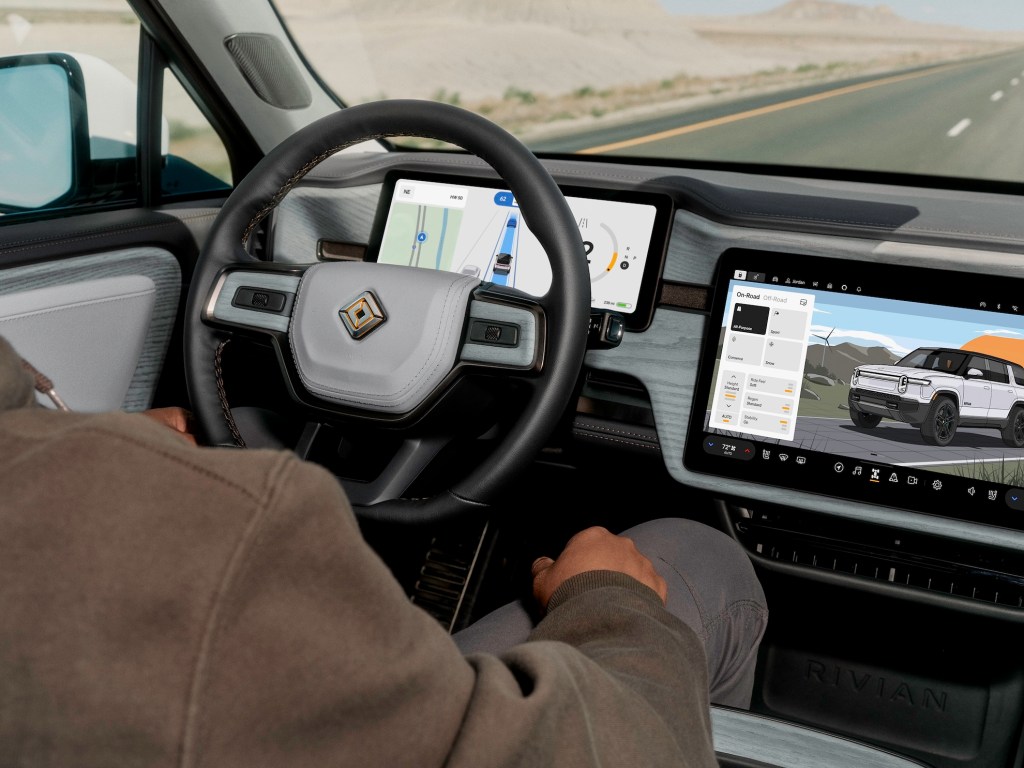
Rivian detailed Thursday how it plans to make its electric vehicles increasingly autonomous — an ambitious effort that includes new hardware, including lidar and custom silicon, and eventually, a potential entry into the self-driving ride-hail market, according to CEO RJ Scaringe.

The announcements at the company’s first “Autonomy & AI Day” event in Palo Alto, California, shed fresh light on Rivian’s technology development, much of which has been kept undercover as it pushes to begin production of its more affordable R2 SUV in the first half of 2026. Rivian’s event is also a very public signal to shareholders that it’s keeping pace, or even exceeding, the automated-driving capabilities of industry rivals like Tesla, Ford, General Motors, as well as automakers from Europe and China.

Rivian said it will expand the hands-free version of its driver-assistance software to “over 3.5 million miles of roads across the USA and Canada” and will eventually expand beyond highways to surface streets (with clearly painted road lines). This expanded access will be available on the company’s second-generation R1 trucks and SUVs. It’s calling the expanded capabilities “Universal Hands-Free” and will launch in early 2026. Rivian says it will charge a one-time fee of $2,500 or $49.99 per month.

“What that means is you can get into the vehicle at your house, plug in the address to where you’re going, and the vehicle will completely drive you there,” Scaringe said Thursday, describing a point-to-point navigation feature.

After that, Rivian plans to allow drivers to take their eyes off the road. “This gives you your time back. You can be on your phone, or reading a book, no longer needing to be actively involved in the operation of vehicle.”

Rivian’s driver assistance software won’t stop there; the EV maker laid out plans on Thursday to enhance its capabilities all the way up to what it’s calling “personal L4,” a nod to the level set by the Society of Automotive Engineers that means a car can operate in a particular area with no human intervention.

After that, Scaringe hinted that Rivian will be looking at competing with the likes of Waymo. “While our initial focus will be on personally owned vehicles, which today represent a vast majority of the miles driven in the United States, this also enables us to pursue opportunities in the ride-share space,” he said.

Techcrunch event

Join the Disrupt 2026 Waitlist

Add yourself to the Disrupt 2026 waitlist to be first in line when Early Bird tickets drop. Past Disrupts have brought Google Cloud, Netflix, Microsoft, Box, Phia, a16z, ElevenLabs, Wayve, Hugging Face, Elad Gil, and Vinod Khosla to the stages — part of 250+ industry leaders driving 200+ sessions built to fuel your growth and sharpen your edge. Plus, meet the hundreds of startups innovating across every sector.

Join the Disrupt 2026 Waitlist

Add yourself to the Disrupt 2026 waitlist to be first in line when Early Bird tickets drop. Past Disrupts have brought Google Cloud, Netflix, Microsoft, Box, Phia, a16z, ElevenLabs, Wayve, Hugging Face, Elad Gil, and Vinod Khosla to the stages — part of 250+ industry leaders driving 200+ sessions built to fuel your growth and sharpen your edge. Plus, meet the hundreds of startups innovating across every sector.

San Francisco
|
October 13-15, 2026

To help accomplish these lofty goals, Rivian has been building a “large driving model” (think: an LLM but for real-world driving), part of a move away from a rules-based framework for developing autonomous vehicles that has been led by Tesla. The company also showed off its own custom 5nm processor, which it says will be built in collaboration with both Arm and TSMC.

That custom chip powers what Rivian is referring to as its third-generation “autonomy computer,” or ACM3. The new computer can process 5 billion pixels per second and will start showing up on Rivian’s upcoming mass-market R2 SUV in late 2026.

Rivian will couple the ACM3 with a lidar sensor at the top of the windshield (from an undisclosed supplier) to provide “three-dimensional spatial data and redundant sensing,” which it says will help with “real-time detection for the edge cases of driving.”

“We expect that at launch in late 2026 this will be the most powerful combination of sensors and inference compute in consumer vehicles in North America,” senior vice president of electrical hardware Vidya Rajagopalan said at the event.

The R2 is set to start shipping in the first half of 2026, meaning the launch versions of the SUV will not have ACM3 or the lidar sensor. That means early versions of the R2 without the ACM3 and lidar hardware will most likely plateau at hands-free driving. Anyone hoping to do eyes-off or, later, unsupervised driving in a Rivian will need a vehicle with a lidar sensor.

“Adding lidar creates the ultimate sensing combination. It gives the most comprehensive 3D model of the space the vehicle is traveling through,” vice president of autonomy and AI James Philbin said Thursday. “The goal for our onboard sensing stack isn’t just human level, it’s superhuman level.”

This story has been updated to reflect that Rivian will not offer eyes-off driving in vehicles without lidar sensors.

Ref link: Rivian goes big on autonomy, with custom silicon, lidar, and a hint at robotaxis

Posted on Leave a comment

Runway releases its first world model, adds native audio to latest video model

The race to release world models is on as AI image and video generation company Runway joins an increasing number of startups and Big Tech companies by launching its first one. Dubbed GWM-1, the model works through frame-by-frame prediction, creating a simulation with an understanding of physics and how the world actually behaves over time, the company said.

A world model is an AI system that learns an internal simulation of how the world works so it can reason, plan, and act without needing to be trained on every scenario possible in real life.

Runway, which earlier this month launched its Gen 4.5 video model that surpassed both Google and OpenAI on the Video Arena leaderboard, said its GWM-1 world model is more “general” than Google’s Genie-3 and other competitors. The firm is pitching it as a model that can create simulations to train agents in different domains like robotics and life sciences.

“To build a world model, we first needed to build a really great video model. We believe that the right path to building a world model is teaching models to predict pixels directly is the best way to achieve general-purpose simulation. At sufficient scale and with the right data, you can build a model that has sufficient understanding of how the world works,” the company’s CTO, Anastasis Germanidis, said during the livestream.

Runway released specific slants or versions to the new world model called GWM-Worlds, GWM-Robotics, and GWM-Avatars.

Image Credits:Runway

GWM-Worlds is an app for the model that lets you create an interactive project. Users can set a scene through a prompt or an image reference, and as you explore the space, the model generates the world with an understanding of geometry, physics, and lighting. The company mentioned that the simulation runs at 24 fps and 720p resolution. Runway said that while Worlds could be useful for gaming, it’s also well-positioned to teach agents how to navigate and behave in the physical world.

With GWM-Robotics, the company aims to use synthetic data enriched with new parameters like changing weather conditions or obstacles. Runway says this method could also reveal when and how robots might violate policies and instructions in different scenarios.

Techcrunch event

Join the Disrupt 2026 Waitlist

Add yourself to the Disrupt 2026 waitlist to be first in line when Early Bird tickets drop. Past Disrupts have brought Google Cloud, Netflix, Microsoft, Box, Phia, a16z, ElevenLabs, Wayve, Hugging Face, Elad Gil, and Vinod Khosla to the stages — part of 250+ industry leaders driving 200+ sessions built to fuel your growth and sharpen your edge. Plus, meet the hundreds of startups innovating across every sector.

Join the Disrupt 2026 Waitlist

Add yourself to the Disrupt 2026 waitlist to be first in line when Early Bird tickets drop. Past Disrupts have brought Google Cloud, Netflix, Microsoft, Box, Phia, a16z, ElevenLabs, Wayve, Hugging Face, Elad Gil, and Vinod Khosla to the stages — part of 250+ industry leaders driving 200+ sessions built to fuel your growth and sharpen your edge. Plus, meet the hundreds of startups innovating across every sector.

San Francisco
|
October 13-15, 2026

Runway is also building realistic avatars under GWM-Avatars to simulate human behavior. Companies like D-ID, Synthesia, Soul Machines, and even Google have worked on creating human avatars that look real and work in areas like communication and training.

The company noted that technically Worlds, Robotics, and Avatars are separate models, but eventually it plans to merge all these into one model.

Besides releasing a new world model, the company is also updating its foundational Gen 4.5 model released earlier in the month. The new update brings native audio and long-form, multi-shot generation capabilities to the model. The company said that with this model, users can generate one-minute videos with character consistency, native dialogue, background audio, and complex shots from various angles. The company said that you can also edit existing audio and add dialogues. Plus, you can edit multi-shot videos of any length.

The Gen 4.5 update nudges Runway closer to competitor Kling’s all-in-one video suite, which also launched earlier this month, particularly around native audio and multi-shot storytelling. It also signals that video generation models are moving from prototype to production-ready tools. Runway’s updated Gen 4.5 model is available to all paid plan users.

Image Credits:Runway

The company said that it will make GWM-Robotics available through an SDK. It added that it is in active conversation with several robotics firms and enterprises for the use of GWM-Robotics and GWM-Avatars.

Ref link: Runway releases its first world model, adds native audio to latest video model

Posted on Leave a comment

Ford and SK On are ending their US battery joint venture

Four years ago, Ford and South Korean battery maker SK On struck a deal to form a joint venture and spend $11.4 billion to build factories in Tennessee and Kentucky that would produce batteries for the next generation of electric F-Series trucks.

The factories live on; the joint venture will not.

SK On, a subsidiary of SK Innovation, said Thursday it reached an agreement with Ford to end the joint venture. The two companies will divide the assets: Ford will take ownership and operation of the twin battery plants in Kentucky, while SK On will operate the factory at the massive BlueOval SK campus in Tennessee.

SK On said it will maintain a strategic partnership with Ford centered on the Tennessee plant, according to Bloomberg.

When reached for comment, a Ford spokesperson told TechCrunch the company was aware of SK’s disclosure and had nothing further to share at this time.

The joint venture was created when the industry was investing billions of dollars to ramp up electric vehicle production. While EV sales have risen over the past several years, demand has not kept up with the industry’s lofty projections. The end of the federal EV tax credit has also dampened the pace of sales.

Techcrunch event

Join the Disrupt 2026 Waitlist

Add yourself to the Disrupt 2026 waitlist to be first in line when Early Bird tickets drop. Past Disrupts have brought Google Cloud, Netflix, Microsoft, Box, Phia, a16z, ElevenLabs, Wayve, Hugging Face, Elad Gil, and Vinod Khosla to the stages — part of 250+ industry leaders driving 200+ sessions built to fuel your growth and sharpen your edge. Plus, meet the hundreds of startups innovating across every sector.

Join the Disrupt 2026 Waitlist

Add yourself to the Disrupt 2026 waitlist to be first in line when Early Bird tickets drop. Past Disrupts have brought Google Cloud, Netflix, Microsoft, Box, Phia, a16z, ElevenLabs, Wayve, Hugging Face, Elad Gil, and Vinod Khosla to the stages — part of 250+ industry leaders driving 200+ sessions built to fuel your growth and sharpen your edge. Plus, meet the hundreds of startups innovating across every sector.

San Francisco
|
October 13-15, 2026

Ref link: Ford and SK On are ending their US battery joint venture

Posted on Leave a comment

Disney signs deal with OpenAI to allow Sora to generate AI videos featuring its characters

The Walt Disney Company announced on Thursday that it has signed a three-year partnership with OpenAI that will bring its iconic characters to the company’s Sora AI video generator. Disney is also making a $1 billion equity investment in OpenAI.

Launched in September, Sora allows users to create short videos using simple prompts. With this new agreement, users will be able to draw on more than 200 animated, masked, and creature characters from Disney, Marvel, Pixar, and Star Wars, including costumes, props, vehicles, and more.

These characters include iconic faces like Mickey Mouse, Ariel, Belle, Cinderella, Baymax, and Simba, as well as characters from Encanto, Frozen, Inside Out, Moana, Monsters, Inc., Toy Story, Up, and Zootopia. Users will also be able to draw on animated or illustrated versions of Marvel and Lucasfilm characters like Black Panther, Captain America, Deadpool, Groot, Iron Man, Darth Vader, Han Solo, Stormtroopers, and more.

Users will also be able to draw on these characters while using ChatGPT Images, the feature in ChatGPT that allows users to create visuals using text prompts.

The agreement does not include any talent likenesses or voices, Disney says.

“The rapid advancement of artificial intelligence marks an important moment for our industry, and through this collaboration with OpenAI we will thoughtfully and responsibly extend the reach of our storytelling through generative AI, while respecting and protecting creators and their works,” said Disney CEO Bob Iger in a statement.

Disney says that alongside the agreement, it will “become a major customer of OpenAI,” as it will use its APIs to build new products, tools, and experiences, including for Disney+.

Techcrunch event

Join the Disrupt 2026 Waitlist

Add yourself to the Disrupt 2026 waitlist to be first in line when Early Bird tickets drop. Past Disrupts have brought Google Cloud, Netflix, Microsoft, Box, Phia, a16z, ElevenLabs, Wayve, Hugging Face, Elad Gil, and Vinod Khosla to the stages — part of 250+ industry leaders driving 200+ sessions built to fuel your growth and sharpen your edge. Plus, meet the hundreds of startups innovating across every sector.

Join the Disrupt 2026 Waitlist

Add yourself to the Disrupt 2026 waitlist to be first in line when Early Bird tickets drop. Past Disrupts have brought Google Cloud, Netflix, Microsoft, Box, Phia, a16z, ElevenLabs, Wayve, Hugging Face, Elad Gil, and Vinod Khosla to the stages — part of 250+ industry leaders driving 200+ sessions built to fuel your growth and sharpen your edge. Plus, meet the hundreds of startups innovating across every sector.

San Francisco
|
October 13-15, 2026

“Disney is the global gold standard for storytelling, and we’re excited to partner to allow Sora and ChatGPT Images to expand the way people create and experience great content,” said Sam Altman, co-founder and CEO of OpenAI, in a statement. “This agreement shows how AI companies and creative leaders can work together responsibly to promote innovation that benefits society, respect the importance of creativity, and help works reach vast new audiences.”

It’s worth noting that Disney has sued the generative AI platform Midjourney for ignoring requests to stop violating its intellectual property rights. Disney also sent a cease-and-desist letter to Character.AI, urging the chatbot company to remove Disney characters from among the millions of AI companions on its platform.

Disney’s agreement with OpenAI indicates the company isn’t fully closing the door on AI platforms.

Ref link: Disney signs deal with OpenAI to allow Sora to generate AI videos featuring its characters

Posted on Leave a comment

On Me raises $6M to shake up the gift card industry

On Me, a digital gift card startup founded by former Google employees, is aiming to redefine the gift card industry with its mobile-first gifting platform that lets users purchase digital gift cards categorized by interests rather than being restricted to specific retailers.

The company on Thursday said it had raised $6 million in a seed funding round, which it will use to expand its gift categories to include things like horseback riding lessons, wine tastings, and theme park trips.

Image Credits:On Me

On Me touts its flexibility. So if you have a friend who is passionate about tennis, you can send them a digital card that lets them shop for outfits and gear from popular brands like Wilson, On, Prince, and more.

The platform offers gift cards across 72 categories that range from running and reading to camping, gardening, gaming, and concerts.

You can also attach video messages, photos, and GIFs to gift cards, which is a nice touch as it lets you add a layer of personalization. You can use On Me via its website as well as iOS and Android apps.

Image Credits:On Me

The startup’s CEO and co-founder Darragh Meaney pointed out the environmental issues with the traditional gift card industry, which rely heavily on plastic. 

The International Card Manufacturers Association (ICMA) reports that approximately 30 billion plastic cards are manufactured globally each year, and that over 70% of gift cards are discarded within six months, resulting in an estimated 53 million tons of plastic waste.

Techcrunch event

Join the Disrupt 2026 Waitlist

Add yourself to the Disrupt 2026 waitlist to be first in line when Early Bird tickets drop. Past Disrupts have brought Google Cloud, Netflix, Microsoft, Box, Phia, a16z, ElevenLabs, Wayve, Hugging Face, Elad Gil, and Vinod Khosla to the stages — part of 250+ industry leaders driving 200+ sessions built to fuel your growth and sharpen your edge. Plus, meet the hundreds of startups innovating across every sector.

Join the Disrupt 2026 Waitlist

Add yourself to the Disrupt 2026 waitlist to be first in line when Early Bird tickets drop. Past Disrupts have brought Google Cloud, Netflix, Microsoft, Box, Phia, a16z, ElevenLabs, Wayve, Hugging Face, Elad Gil, and Vinod Khosla to the stages — part of 250+ industry leaders driving 200+ sessions built to fuel your growth and sharpen your edge. Plus, meet the hundreds of startups innovating across every sector.

San Francisco
|
October 13-15, 2026

“It is an environmentally wasteful practice that feels totally disconnected from how we live today,” Meaney said.

On Me’s digital cards also integrate with Apple Pay and Google Wallet.

Image Credits:On Me

With the global gift card market projected to reach $2.3 trillion by 2030, On Me believes it is well-positioned for growth. Since its launch, the company says it has facilitated over $2.5 million in gifts for more than 26,000 users, and has grown 50% every month. 

The seed round was led by NFX, with participation from Lerer Hippeau and Focal.

The funding comes a year after the company launched its platform and raised $1.7 million in a pre-seed round. 

Ref link: On Me raises $6M to shake up the gift card industry

Posted on Leave a comment

TIME names ‘Architects of AI’ its Person of the Year

Each December, TIME Magazine names a person of the year — someone who has most influenced the news and world, for good or ill. Last year, TIME chose President Donald Trump for the second time. The year before that, it was Taylor Swift, who many claimed saved the economy from a recession with her Eras Tour. In 1938, the magazine chose Adolf Hitler

This year, TIME has chosen to bestow its award on not just one person, but a group of people: the so-called “Architects of AI,” comprising the CEOs shaping the global AI race from the U.S. With AI on everyone’s minds, embodying hope for a small minority and economic anxiety for a majority, per recent Edelman data, this tracks.

“For decades, humankind steeled itself for the rise of thinking machines,” the article reads. “Leaders striving to develop the technology, including Sam Altman and Elon Musk, warned that the pursuit of its powers could create unforeseen catastrophe […] This year, the debate about how to wield AI responsibly gave way to a sprint to deploy it as fast as possible.”

Based on one of TIME’s two cover photos, some of those people appear to be Nvidia’s Jensen Huang, Tesla’s Elon Musk, OpenAI’s Sam Altman, Meta’s Mark Zuckerberg, AMD’s Lisa Su, Anthropic’s Dario Amodei, Google DeepMind’s Demis Hassabis, and World Labs’ Fei-Fei Li — all individuals who raced “both beside and against each other.” 

TIME writes that these individuals, through their multibillion-dollar bets on “one of the biggest physical infrastructure projects of all time,” have reshaped government policy, turned up the heat on geopolitical competition, and pushed AI adoption forward. 

This is the story of how AI changed our world in 2025, in new and exciting and sometimes frightening ways. It is the story of how Huang and other tech titans grabbed the wheel of history, developing technology and making decisions that are reshaping the information landscape, the climate, and our livelihoods… AI emerged as arguably the most consequential tool in great-power competition since the advent of nuclear weapons.

TIME only announced the news on Thursday morning, but images of the cover photo were leaked on prediction market Polymarket on Wednesday evening.

Ref link: TIME names ‘Architects of AI’ its Person of the Year

Posted on Leave a comment

Security flaws in Freedom Chat app exposed users’ phone numbers and PINs

Messaging app Freedom Chat has fixed a pair of security flaws: one that allowed a security researcher to guess registered users’ phone numbers, and another that exposed user-set PINs to others on the app.

Freedom Chat, released in June, bills itself as a secure messaging app, and claims on its website that users’ phone numbers stay private.

But security researcher Eric Daigle told TechCrunch that users’ phone numbers and PIN codes, used for locking the app, could be easily obtained by exploiting vulnerabilities.

Daigle found the vulnerabilities last week and shared their details with TechCrunch, as Freedom Chat does not provide a public way to report security flaws, like a vulnerability disclosure program. TechCrunch then alerted Freedom Chat founder Tanner Haas to the security flaws by email.

Haas confirmed to TechCrunch that the app has now reset user PINs and released a new version. Haas added that the company is removing instances where users’ phone numbers were occasionally visible, and has notched up rate-limiting on its servers to prevent mass-guess attempts.

Daigle, who published his findings in a blog post, told TechCrunch it was possible to enumerate the phone numbers of close to 2,000 users who had signed up to use Freedom Chat since it launched. Daigle said Freedom Chat’s servers allowed anyone to flood it with millions of phone number guesses to determine if a user’s phone number was stored on the servers.

Per Daigle, this technique is identical to one described by the University of Vienna in research last month, where academics scraped data on some 3.5 billion user accounts who signed up to WhatsApp by matching billions of phone numbers against WhatsApp’s servers.

Daigle also found Freedom Chat was leaking users’ PIN codes. Using an open source network traffic inspection tool to analyze the data going in and out of the app, Daigle saw that the app would respond with the PIN codes of every other user in the same public channel — even if the PINs weren’t visible to users within the app itself.

According to Daigle, anyone who was in the default Freedom Chat channel, which users are automatically subscribed to when they first sign up, had their PIN broadcast to everyone else in the channel. Daigle told TechCrunch that knowledge of a person’s PIN could allow someone to open the app from a user’s stolen device.

In an app store update published Sunday, Freedom Chat noted: “A critical reset: A recent backend update inadvertently exposed user PINs in a system response. No messages were ever at risk, and because Freedom Chat does not support linked devices, your conversations were never accessible; however, we’ve reset all user PINs to ensure your account stays secure. Your privacy remains our top priority.”

Freedom Chat is Haas’ second messaging app, after Converso, which was delisted from app stores following the disclosure of security flaws that exposed users’ private messages and content.

Ref link: Security flaws in Freedom Chat app exposed users’ phone numbers and PINs

Posted on Leave a comment

Interest in Spoor’s bird-monitoring AI software is soaring

Spoor launched in 2021 with the goal of using computer vision to help reduce the impact of wind turbines on local bird populations. Now the startup has proven its technology works and is seeing demand from wind farms and beyond.

Oslo, Norway-based Spoor has built software that uses computer vision to track and identify bird populations and migration patterns. The software can detect birds within a 2.5-kilometer radius (about 1.5 miles) and can work with any off-the-shelf high-resolution camera.

Wind farm operators can use this information to better plan where wind farms should be located and to help them better navigate migration patterns. For example, a wind farm could slow down its turbines, or even stop them entirely, during heavy periods of local migration.

Ask Helseth (pictured above left), the co-founder and CEO of Spoor, told TechCrunch last year that he got interested in this space after learning that wind farms lacked effective tracking methods, despite many countries having strict rules around where wind farms can be built and how they can operate due to local bird populations.

“The expectations from the regulators are growing but the industry doesn’t have a great tool,” Helseth said at the time. “A lot of people [go out] in the field with binoculars and trained dogs to find out how many birds are colliding with the turbines.”

Helseth told TechCrunch last week that since then, the company has proven the need for this technology and worked to make it better.

Image Credits:Spoor

At the time of its seed raise in 2024, Spoor was able to track birds in a 1-kilometer range, which has since doubled. As the company has collected more data to feed into its AI model, it has been able to improve its bird identification accuracy to about 96%.

Techcrunch event

Join the Disrupt 2026 Waitlist

Add yourself to the Disrupt 2026 waitlist to be first in line when Early Bird tickets drop. Past Disrupts have brought Google Cloud, Netflix, Microsoft, Box, Phia, a16z, ElevenLabs, Wayve, Hugging Face, Elad Gil, and Vinod Khosla to the stages — part of 250+ industry leaders driving 200+ sessions built to fuel your growth and sharpen your edge. Plus, meet the hundreds of startups innovating across every sector.

Join the Disrupt 2026 Waitlist

Add yourself to the Disrupt 2026 waitlist to be first in line when Early Bird tickets drop. Past Disrupts have brought Google Cloud, Netflix, Microsoft, Box, Phia, a16z, ElevenLabs, Wayve, Hugging Face, Elad Gil, and Vinod Khosla to the stages — part of 250+ industry leaders driving 200+ sessions built to fuel your growth and sharpen your edge. Plus, meet the hundreds of startups innovating across every sector.

San Francisco
|
October 13-15, 2026

“Identifying the species of the bird for some of the clients, you add another layer,” Helseth said. “Is it a bird or not a bird? We have an in-house ornithologist to help train the model to train the new types of birds or a new type of species. Having deployment in other countries [means] having rare species in the database.”

Spoor now works across three continents and with more than 20 of the world’s largest energy companies. It has also started to see interest from other industries such as airports and aquaculture farms. Spoor has a partnership with Rio Tinto, a London-based mining giant, to track bats.

The company has also received interest in using its tech to track other objects of similar size — but Helseth said they aren’t thinking of pivoting into those areas quite yet.

“Drones are of course a plastic bird in our mind,” Helseth joked. “They move in a different way and have a different shape and size. Currently we are discarding that data but we are getting interest in it.”

Spoor recently raised an €8 million ($9.3 million) Series A round led by SET Ventures with participation from Ørsted Ventures and Superorganism in addition to strategic investors.

Helseth predicts that interest in this type of technology will only grow as regulators continue to crack down on wind farms. For example, French regulators shut down a wind farm in April due to its impact on the local bird population and imposed hundreds of millions of fines.

“Our mission is to enable industry and nature to coexist,” Helseth said. “We have started on that journey, but we are still a small startup with a lot to prove. In the coming years, we want to really cement our position in the wind industry and become a global leader to tackle these challenges. At the same time, we want to build some proof points that this technology has value beyond that main category.”

Ref link: Interest in Spoor’s bird-monitoring AI software is soaring

Posted on Leave a comment

Eclipse Energy’s microbes can turn idle oil wells into hydrogen factories

Up to 3 million abandoned oil and gas wells litter the U.S. alone, and while many still contain oil or natural gas, the owners decided it wasn’t worth it to keep pumping.

“They’ve tried everything,” Prab Sekhon, CEO of Eclipse Energy, told TechCrunch. “There’s still a ton of oil left behind.”

Eclipse doesn’t have a way to recover that oil, but it does have a way to squeeze some of the energy they embody up to the surface. Rather than pump harder or inject something to force oil to the surface, Eclipse sends down microbes to munch on the oil molecules and liberate their hydrogen.

Instead of viscous oil, companies only have to deal with hydrogen gas. “Hydrogen flows a lot easier,” Sekhon said, making it easier to extract it from the well.

The Houston-based startup, which was spun out of Cemvita, demonstrated the technology at an oilfield in California’s San Joaquin Basin last summer. Now, it’s partnering with oilfield services company Weatherford International to deploy the technology around the world, the startup exclusively told TechCrunch. The first projects will begin in January.

“They’re an extension of our team,” Sekhon said to characterize the relationship with Weatherford. “They’ll be our operational arm.”

Eclipse, which was previously known as Gold H2, has been developing the technology over the last several years. It has been sampling microbes that naturally occur in oil wells, which live at the interface between oil and water held in aquifers, to find those that are best suited to the job.

Techcrunch event

Join the Disrupt 2026 Waitlist

Add yourself to the Disrupt 2026 waitlist to be first in line when Early Bird tickets drop. Past Disrupts have brought Google Cloud, Netflix, Microsoft, Box, Phia, a16z, ElevenLabs, Wayve, Hugging Face, Elad Gil, and Vinod Khosla to the stages — part of 250+ industry leaders driving 200+ sessions built to fuel your growth and sharpen your edge. Plus, meet the hundreds of startups innovating across every sector.

Join the Disrupt 2026 Waitlist

Add yourself to the Disrupt 2026 waitlist to be first in line when Early Bird tickets drop. Past Disrupts have brought Google Cloud, Netflix, Microsoft, Box, Phia, a16z, ElevenLabs, Wayve, Hugging Face, Elad Gil, and Vinod Khosla to the stages — part of 250+ industry leaders driving 200+ sessions built to fuel your growth and sharpen your edge. Plus, meet the hundreds of startups innovating across every sector.

San Francisco
|
October 13-15, 2026

As the microbes consume the oil, they break it down into hydrogen and carbon dioxide. Both then flow to the surface, where Eclipse and its partners will eventually separate the two. About half of the carbon dioxide is likely to stay in the reservoir, while the other half could be captured using specialized equipment and either sequestered or used.

The goal, Sekhon said, is to produce low-carbon hydrogen for around 50 cents per kilogram, or the same price as hydrogen obtained by breaking down natural gas in an industrial plant, a process that releases more carbon dioxide.

The resulting hydrogen could be used in petrochemical plants or burned for energy. 

“It’s taking a liability and turning it into a clean energy asset,” Sekhon said.

Ref link: Eclipse Energy’s microbes can turn idle oil wells into hydrogen factories