Posted on Leave a comment

TechCrunch Mobility: Rivian’s survival plan involves more than cars

Welcome back to TechCrunch Mobility — your central hub for news and insights on the future of transportation. To get this in your inbox, sign up here for free — just click TechCrunch Mobility!

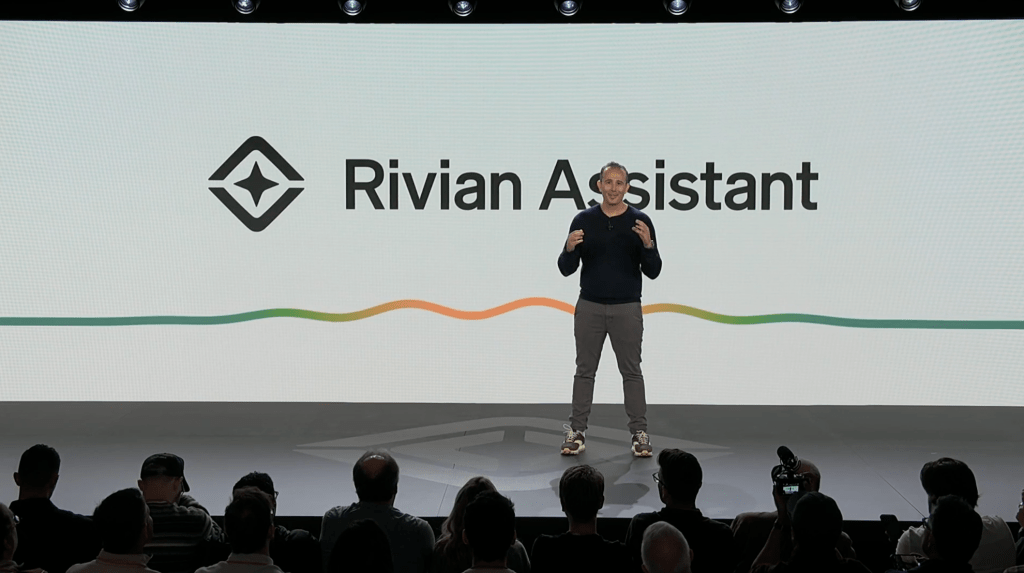
Senior reporter Sean O’Kane popped over to Palo Alto to check out Rivian’s Autonomy & AI Day, which some insiders told us would be the company’s most important event. I’m not sure I would categorize it as such, but how about I let the journalist on the ground give his assessment? 

Via Sean (and a few of my thoughts sprinkled in) after the event …

It was easy to get lost in the buzz words at times during Rivian’s “Autonomy & AI Day” this week. But there was a clear underlying message being shared: Rivian is trying to build a company that is about more than just selling cars. 

It’s not going as far as Tesla. For instance, there were no humanoid robots wandering around the company’s Palo Alto campus.

But it is clearly building out other revenue-generating products — and advanced driver assistance is at the starting gates. 

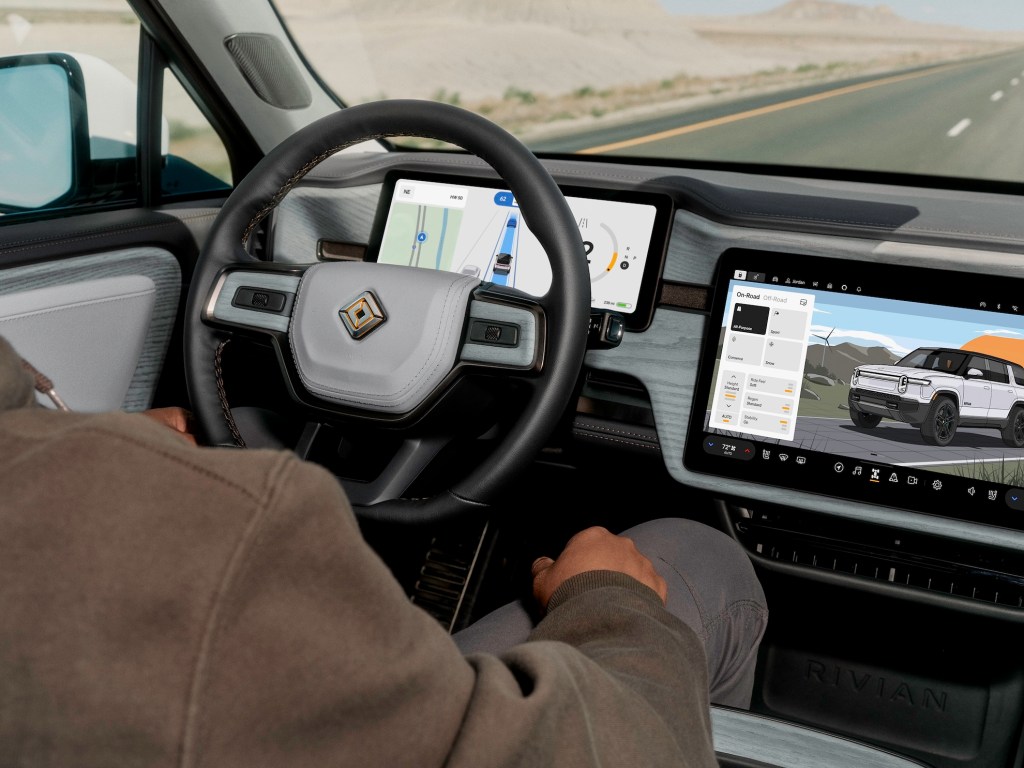
Rivian’s hands-free version of its driver-assistance software — which today can be used on about 135,000 miles of road — will expand to 3.5 million miles and include surface streets. This expanded capability, which will launch in early 2026 and eventually include point-to-point hands-free (but eyes on) automated driving comes with a cost of $2,500 or $49.99 per month.

Techcrunch event

Join the Disrupt 2026 Waitlist

Add yourself to the Disrupt 2026 waitlist to be first in line when Early Bird tickets drop. Past Disrupts have brought Google Cloud, Netflix, Microsoft, Box, Phia, a16z, ElevenLabs, Wayve, Hugging Face, Elad Gil, and Vinod Khosla to the stages — part of 250+ industry leaders driving 200+ sessions built to fuel your growth and sharpen your edge. Plus, meet the hundreds of startups innovating across every sector.

Join the Disrupt 2026 Waitlist

Add yourself to the Disrupt 2026 waitlist to be first in line when Early Bird tickets drop. Past Disrupts have brought Google Cloud, Netflix, Microsoft, Box, Phia, a16z, ElevenLabs, Wayve, Hugging Face, Elad Gil, and Vinod Khosla to the stages — part of 250+ industry leaders driving 200+ sessions built to fuel your growth and sharpen your edge. Plus, meet the hundreds of startups innovating across every sector.

San Francisco
|
October 13-15, 2026

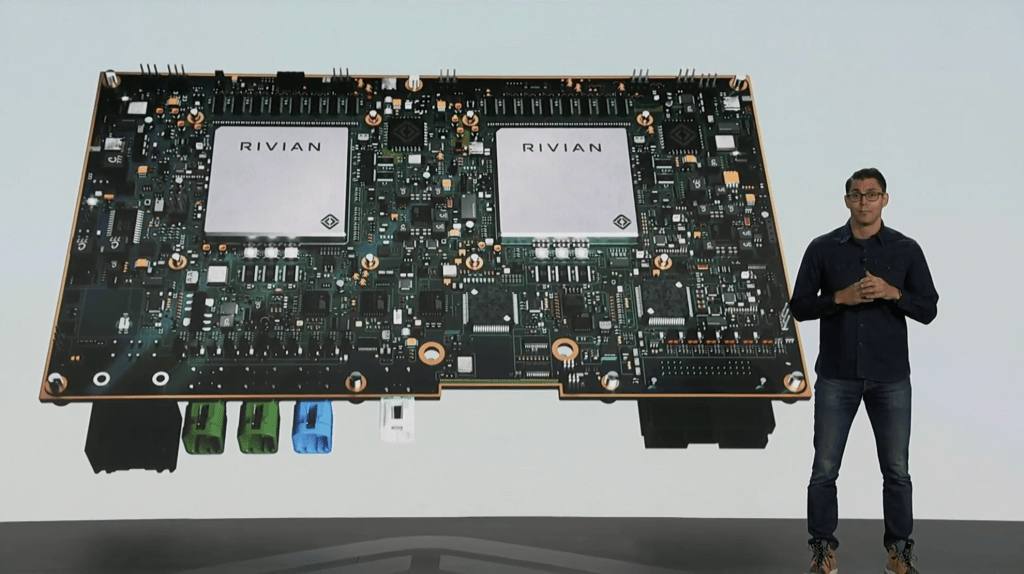
Then there is its future hands-off, eyes-off system. Rivian revealed it has developed its own custom 5nm processor, which it says will be built in collaboration with both Arm and TSMC. That chip will power Rivian’s “autonomy computer” — the backbone of an upgraded automated-driving system —that will debut in the R2 SUV in late 2026. 

That will probably be an upcharge, although Rivian didn’t say if it would be more than the $2,500 fee. 

But there’s another scenario we should also consider: licensing its tech to others. 

After all, Rivian already has a joint venture with Volkswagen Group to share its electrical architecture and base-level software. And Rivian spun out two startups this year with Also (mobility) and Mind Robotics (industrial AI and robotics). 

Barclays’ Dan Levy wrote Friday that “subsequent discussions reiterated hopes/potential” for Rivian to license its whole AV platform, or just components like the customs processor. And when I asked CEO RJ Scaringe if Rivian will sell the processor to Mind Robotics, he responded wryly: “It doesn’t take a lot of imagination.”  

At the most abstracted level, bolting new revenue lines to the existing car business (especially if those new projects play nice with the cars) makes sense. Who doesn’t love more money?  

Here’s our coverage of the event:

Rivian is building its own AI assistant (deeper dive into the tech). And it is coming to its EVs in early 2026.

Rivian goes big on autonomy with custom silicon, lidar, and a hint at robotaxis

A little bird

blinky cat bird green
Image Credits:Bryce Durbin

Nothing this week — or should I say, thanks for the tips, everyone, but there is nothing I can share yet.

In the meantime, here’s a tiny tidbit to hold you over. As you read above, senior reporter Sean O’Kane was at Rivian’s AI & Autonomy Day and one of the whispers he heard was about the company’s public demo of its AI assistant and concerns it might not work. Apparently, the testing the morning of the event was a bit touch and go.

Alas, the public demo went just fine after one tense moment at the start. The risks are high for public demos, which is why many companies avoid them. Kudos to Rivian for going for it.

Got a tip for us? Email Kirsten Korosec at kirsten.korosec@techcrunch.com or my Signal at kkorosec.07, or email Sean O’Kane at sean.okane@techcrunch.com.

Deals!

money the station
Image Credits:Bryce Durbin

At the start of 2025, I didn’t think TechCrunch would publish an aviation-startup-meets-data-center story. But here we are. 

Aircraft startup Boom Supersonic kicked off 2025 by breaking the sound barrier with its XB-1 demonstrator civil aircraft. And it’s ending the year with a plan to sell a version of its turbine engine as a stationary power plant. Its first customer will be data center startup Crusoe.

Under the deal, Crusoe will buy 29 of Boom’s 42-megawatt turbines for $1.25 billion to generate 1.21 gigawatts for its data centers.

Boom has raised $300 million to help commercialize this new business. The round was led by Darsana Capital Partners with participation from Altimeter Capital, Ark Invest, Bessemer Venture Partners, Robinhood Ventures, and Y Combinator. 

The plan is to use money from its Superpower stationary turbine business to fund the development of its supersonic aircraft. 

Other deals that got my attention …

Self-driving trucks company Aurora Innovation made a commercial agreement with Detmar Logistics to autonomously transport frac sand in the Permian Basin.

Some deals don’t always work out, or they change. Take SK On and Ford, for instance.

Four years ago, Ford and South Korean battery maker SK On struck a deal to form a joint venture and spend $11.4 billion to build factories in Tennessee and Kentucky that would produce batteries for the next generation of electric F-Series trucks. Now the joint venture is ending and the two companies will divide the assets: Ford will take ownership and operation of the twin battery plants in Kentucky, while SK On will operate the factory at the massive BlueOval SK campus in Tennessee.

Vatn Systems, a Rhode Island-based startup developing autonomous underwater vehicles, raised $60 million in a Series A funding round led by BVVC.

Notable reads and other tidbits

Image Credits:Bryce Durbin

700Credit, a company that runs credit checks and identity verification services for auto dealerships across the United States, said a data breach affected at least 5.6 million people who had their names, addresses, dates of birth, and Social Security numbers stolen.

The former CEO of bankrupt EV startup Canoo had pledged to provide support to NASA and the United States Postal Service so it could continue to use the vans. Apparently, that wasn’t a convincing argument; NASA and USPS have stopped using them.

Ford and Renault agreed to work together to bring two affordable Ford-branded vehicles to the European market in 2028. Ford will lead the design and Renault will assemble the vehicles at its factory in northern France. 

Lucid is being sued by its former chief engineer Eric Bach, who alleges wrongful termination, discrimination, and retaliation. Bach, who is of German heritage, also claims one of the automaker’s top HR executives referred to him as a “German Nazi.”

Subaru unveiled its Uncharted EV and the specs might attract buyers. The Uncharted Premium trim EV will have a 300-mile range and be priced a skosh above $36,000. Potential deal killer among Subie diehards? The Premium version is front-wheel drive only. 

A pregnant woman in San Francisco gave birth inside a Waymo robotaxi en route to UCSF Medical Center. And nope, this is not the first baby born in a Waymo. Read on to learn more

Meanwhile on the Waymo news front, a leaked letter from Tiger Global Management to its investors disclosed that Waymo is now providing 450,000 robotaxi rides per week — nearly double the amount it disclosed this spring. Waymo declined to comment. 

Zevo wants to add robotaxis to its car-share fleet, starting with newcomer Tensor. Senior reporter Sean O’Kane digs in.

One more thing …

I asked and you answered. Thanks to all the readers who participated in the last poll. As a reminder, I asked: The pace of autonomous vehicle development has quickened, prompting more scrutiny and questions around safety and accountability. Should companies stay the course, scale faster, or tap the brakes?

About 48% of you picked “stay the course.” Nearly 23% chose scale faster, while 29.4% of readers want companies to tap the brakes.

Ref link: TechCrunch Mobility: Rivian’s survival plan involves more than cars
Posted on Leave a comment

Rivian’s AI assistant is coming to its EVs in early 2026 

Rivian’s two-year effort to build its own AI assistant will launch in early 2026. And when it does, the AI assistant will roll out to every existing EV in its lineup, not just the next-generation versions of its R1T truck and R1S SUV. 

Drivers and passengers will be able to use the AI assistant to operate climate controls and handle other tasks contained within the vehicle’s infotainment system. It will also connect vehicle systems with third-party apps using an agentic framework built by Rivian engineers. Google Calendar will be the first third-party app to launch within the AI assistant, Rivian said Thursday.

“The beauty here is we can integrate third-party agents, and this is completely redefining how apps in the future will integrate in our cars,” software development chief Wassym Bensaid said Thursday during the company’s AI & Autonomy event in Palo Alto, California.

The AI assistant will be augmented by frontier large language models — for instance, the Google Vertex AI and Gemini — for grounded data, natural conversation, and reasoning, according to Rivian.

Image Credits:Rivian

The AI assistant program, which TechCrunch first reported this week, reflects Rivian CEO RJ Scaringe’s push to become more vertically integrated. And that commitment was on full display at its AI & Autonomy event in Palo Alto, California. Beyond the AI assistant, the company detailed how it has developed a software and new hardware, including a custom 5nm processor built in collaboration with both Arm and TSMC, that will expand its hands-free driving assistance system and eventually let drivers take their eyes off the road.

This vertical integration work has been underway for years. In 2024, the EV maker completely reworked the guts of its flagship R1T truck and R1S SUV, changing everything from the battery pack and suspension system to the electrical architecture, sensor stack, and software user interface.

The company’s software team led by Bensaid has continued to work on building out the software stack. A smaller group — the size of which Rivian won’t disclose — focused on the AI assistant, which is designed to be model and platform agnostic, according to Bensaid.

Techcrunch event

Join the Disrupt 2026 Waitlist

Add yourself to the Disrupt 2026 waitlist to be first in line when Early Bird tickets drop. Past Disrupts have brought Google Cloud, Netflix, Microsoft, Box, Phia, a16z, ElevenLabs, Wayve, Hugging Face, Elad Gil, and Vinod Khosla to the stages — part of 250+ industry leaders driving 200+ sessions built to fuel your growth and sharpen your edge. Plus, meet the hundreds of startups innovating across every sector.

Join the Disrupt 2026 Waitlist

Add yourself to the Disrupt 2026 waitlist to be first in line when Early Bird tickets drop. Past Disrupts have brought Google Cloud, Netflix, Microsoft, Box, Phia, a16z, ElevenLabs, Wayve, Hugging Face, Elad Gil, and Vinod Khosla to the stages — part of 250+ industry leaders driving 200+ sessions built to fuel your growth and sharpen your edge. Plus, meet the hundreds of startups innovating across every sector.

San Francisco
|
October 13-15, 2026

To power this AI assistant, Rivian developed what it has described as a model- and platform-agnostic architecture that uses custom large language models and is branded as Rivian Unified Intelligence, or RUI. This hybrid software stack includes its own custom models and the “orchestration layer,” the conductor that makes sure the various AI models work together. Rivian said it has used other companies for specific agentic AI functions.

“The Riven Unified Intelligence is the connective tissue that runs through the very heart of Rivian’s digital ecosystem,” Bensaid said at the event. “This platform enables targeted agent solutions that drive value across our entire operation and our entire vehicle life cycle.”

For instance, RUI will be used for more than just providing an AI assistant, according to the company. It will also be used to improve vehicle diagnostics, which Rivian describes as “an expert assistant for technicians, scanning telemetry and history to pinpointing complex issues.”

The article was updated to clarify that the AI assistant will be augmented by frontier large language models.

Ref link: Rivian’s AI assistant is coming to its EVs in early 2026 

Posted on Leave a comment

Rivian goes big on autonomy, with custom silicon, lidar, and a hint at robotaxis

Rivian detailed Thursday how it plans to make its electric vehicles increasingly autonomous — an ambitious effort that includes new hardware, including lidar and custom silicon, and eventually, a potential entry into the self-driving ride-hail market, according to CEO RJ Scaringe.

The announcements at the company’s first “Autonomy & AI Day” event in Palo Alto, California, shed fresh light on Rivian’s technology development, much of which has been kept undercover as it pushes to begin production of its more affordable R2 SUV in the first half of 2026. Rivian’s event is also a very public signal to shareholders that it’s keeping pace, or even exceeding, the automated-driving capabilities of industry rivals like Tesla, Ford, General Motors, as well as automakers from Europe and China.

Rivian said it will expand the hands-free version of its driver-assistance software to “over 3.5 million miles of roads across the USA and Canada” and will eventually expand beyond highways to surface streets (with clearly painted road lines). This expanded access will be available on the company’s second-generation R1 trucks and SUVs. It’s calling the expanded capabilities “Universal Hands-Free” and will launch in early 2026. Rivian says it will charge a one-time fee of $2,500 or $49.99 per month.

“What that means is you can get into the vehicle at your house, plug in the address to where you’re going, and the vehicle will completely drive you there,” Scaringe said Thursday, describing a point-to-point navigation feature.

After that, Rivian plans to allow drivers to take their eyes off the road. “This gives you your time back. You can be on your phone, or reading a book, no longer needing to be actively involved in the operation of vehicle.”

Rivian’s driver assistance software won’t stop there; the EV maker laid out plans on Thursday to enhance its capabilities all the way up to what it’s calling “personal L4,” a nod to the level set by the Society of Automotive Engineers that means a car can operate in a particular area with no human intervention.

After that, Scaringe hinted that Rivian will be looking at competing with the likes of Waymo. “While our initial focus will be on personally owned vehicles, which today represent a vast majority of the miles driven in the United States, this also enables us to pursue opportunities in the ride-share space,” he said.

Techcrunch event

Join the Disrupt 2026 Waitlist

Add yourself to the Disrupt 2026 waitlist to be first in line when Early Bird tickets drop. Past Disrupts have brought Google Cloud, Netflix, Microsoft, Box, Phia, a16z, ElevenLabs, Wayve, Hugging Face, Elad Gil, and Vinod Khosla to the stages — part of 250+ industry leaders driving 200+ sessions built to fuel your growth and sharpen your edge. Plus, meet the hundreds of startups innovating across every sector.

Join the Disrupt 2026 Waitlist

Add yourself to the Disrupt 2026 waitlist to be first in line when Early Bird tickets drop. Past Disrupts have brought Google Cloud, Netflix, Microsoft, Box, Phia, a16z, ElevenLabs, Wayve, Hugging Face, Elad Gil, and Vinod Khosla to the stages — part of 250+ industry leaders driving 200+ sessions built to fuel your growth and sharpen your edge. Plus, meet the hundreds of startups innovating across every sector.

San Francisco
|
October 13-15, 2026

To help accomplish these lofty goals, Rivian has been building a “large driving model” (think: an LLM but for real-world driving), part of a move away from a rules-based framework for developing autonomous vehicles that has been led by Tesla. The company also showed off its own custom 5nm processor, which it says will be built in collaboration with both Arm and TSMC.

That custom chip powers what Rivian is referring to as its third-generation “autonomy computer,” or ACM3. The new computer can process 5 billion pixels per second and will start showing up on Rivian’s upcoming mass-market R2 SUV in late 2026.

Rivian will couple the ACM3 with a lidar sensor at the top of the windshield (from an undisclosed supplier) to provide “three-dimensional spatial data and redundant sensing,” which it says will help with “real-time detection for the edge cases of driving.”

“We expect that at launch in late 2026 this will be the most powerful combination of sensors and inference compute in consumer vehicles in North America,” senior vice president of electrical hardware Vidya Rajagopalan said at the event.

The R2 is set to start shipping in the first half of 2026, meaning the launch versions of the SUV will not have ACM3 or the lidar sensor. That means early versions of the R2 without the ACM3 and lidar hardware will most likely plateau at hands-free driving. Anyone hoping to do eyes-off or, later, unsupervised driving in a Rivian will need a vehicle with a lidar sensor.

“Adding lidar creates the ultimate sensing combination. It gives the most comprehensive 3D model of the space the vehicle is traveling through,” vice president of autonomy and AI James Philbin said Thursday. “The goal for our onboard sensing stack isn’t just human level, it’s superhuman level.”

This story has been updated to reflect that Rivian will not offer eyes-off driving in vehicles without lidar sensors.

Ref link: Rivian goes big on autonomy, with custom silicon, lidar, and a hint at robotaxis