Posted on Leave a comment

How iRobot lost its way home

There’s something painfully American about the arc of iRobot, the company that taught your vacuum to navigate around the furniture. Founded in 1990 in Bedford, Massachusetts by MIT roboticist Rodney Brooks and his former students Colin Angle and Helen Greiner, the company filed for Chapter 11 bankruptcy on Sunday, ending a 35-year run that took it from the dreams of AI researchers to your kitchen floor and, finally, to the tender mercies of its Chinese supplier.

Brooks, the founding director of MIT’s Computer Science and Artificial Intelligence Lab and the robotics field’s resident provocateur, spent the eighties watching insects and having epiphanies about how simple systems could produce complex behaviors. By 1990, he’d translated those insights into a company that would eventually sell over 50 million robots. The Roomba, launched in 2002, became the rare gadget that transcended its category to become a verb, a meme, and, to the amusement of many, a cat-transportation device.

The money soon followed, with the company raising $38 million altogether, including from The Carlyle Group, before going public in a 2005 IPO that raised $103.2 million. By 2015, iRobot was flush enough to launch its own venture arm, prompting TechCrunch to wryly declare that “robot domination may have just taken another step forward.” The plan at the time was to invest $100,000 to $2 million in up to 10 seed and Series A robotics startups each year. It was the kind of move that marks a company’s arrival, the moment when you’re successful enough to fund the next generation’s dreams.

Then came what looked like salvation. In 2022, Amazon agreed to acquire iRobot for $1.7 billion in what would have been Amazon’s fourth-largest acquisition ever. In a press release announcing the news, Angle, who’d been CEO since the company’s inception, spoke about “creating innovative, practical products” and finding “a better place for our team to continue our mission.” It seemed like a fairy tale ending — the scrappy MIT spinoff absorbed into the Everything Store’s sprawling empire.

Except European regulators had other ideas. Indeed, amid threats they would block the deal — they believed that Amazon could foreclose rivals by restricting or degrading access to its marketplace — Amazon and iRobot agreed to kill the deal in January 2024, with Amazon paying a $94 million breakup fee and walking away. Angle resigned. The company’s shares nosedived. It shed 31% of its workforce.

What followed afterward was a slow-motion collapse. Earnings had been declining since 2021 thanks to supply chain chaos and Chinese competitors flooding the market with cheaper robot vacuums. The Carlyle Group, which provided a $200 million lifeline back in 2023, ultimately just prolonged the inevitable. (It finally sold that loan last month — presumably at a discount, though it didn’t say either way.)

Now it’s over, at least, the version of the company that existed previously. Shenzhen PICEA Robotics, iRobot’s main supplier and lender, will take control of the reorganized company. According to a release issued by iRobot on Sunday, the restructuring plan allows iRobot to remain as a going concern and “continue operating in the ordinary course with no anticipated disruption to its app functionality, customer programs, global partners, supply chain relationships, or ongoing product support.”

Techcrunch event

Join the Disrupt 2026 Waitlist

Add yourself to the Disrupt 2026 waitlist to be first in line when Early Bird tickets drop. Past Disrupts have brought Google Cloud, Netflix, Microsoft, Box, Phia, a16z, ElevenLabs, Wayve, Hugging Face, Elad Gil, and Vinod Khosla to the stages — part of 250+ industry leaders driving 200+ sessions built to fuel your growth and sharpen your edge. Plus, meet the hundreds of startups innovating across every sector.

Join the Disrupt 2026 Waitlist

Add yourself to the Disrupt 2026 waitlist to be first in line when Early Bird tickets drop. Past Disrupts have brought Google Cloud, Netflix, Microsoft, Box, Phia, a16z, ElevenLabs, Wayve, Hugging Face, Elad Gil, and Vinod Khosla to the stages — part of 250+ industry leaders driving 200+ sessions built to fuel your growth and sharpen your edge. Plus, meet the hundreds of startups innovating across every sector.

San Francisco
|
October 13-15, 2026

It also vowed to “meet its commitments to employees and make timely payments in full to vendors and other creditors for amounts owed throughout the court-supervised process.”

What this means for customers longer term is another question, one we’ve reached out to iRobot to ask. In its release, iRobot promises to keep supporting existing products during restructuring; at the same time, its legal disclosures acknowledge the inherent uncertainties of bankruptcy — whether suppliers stick around, whether the process goes as planned, whether the company survives at all.

As The Verge noted in a story about iRobot’s struggles last month, even if iRobot eventually collapses and takes its cloud services down with it, customers’ Roomba vacuums won’t become useless pucks. The physical controls should keep working — a Roomba owner could still jab the button to send it off to vacuum or tell it to head home.

What Roomba owners would lose is everything that make the devices feel futuristic, including app-based scheduling, the ability to tell it which rooms to clean, and voice commands barked at Alexa while sprawled on the couch.

Ref link: How iRobot lost its way home

Posted on Leave a comment

WhatsApp’s biggest market is becoming its toughest test

WhatsApp, Meta’s messaging app that millions of Indians rely on daily, is facing a critical moment in India as recent government directions threaten to disrupt how the platform works for everyday users and businesses.

Issued late last month and made public earlier this month, the directions ask certain app-based communication services to keep accounts continuously linked to an active SIM card and impose stricter controls on how the apps function across devices.

New Delhi says the measures are aimed at curbing rising cyber fraud in India, the world’s most populous nation. Digital advocacy groups, policy experts, and industry groups representing major digital platforms — including Meta — have warned, however, that the approach risks regulatory overreach and could disrupt legitimate use, especially in a country where WhatsApp has evolved into everyday infrastructure for personal communication and small-business commerce.

The directions, which app providers including Meta, Telegram, and Signal must comply with within 90 days of their issuance on November 28, require messaging apps to remain tied to the SIM card used at sign-up. The web and desktop versions of these apps also require users to log out every six hours and re-link their devices via a QR code to regain access.

“Mandatory continuous SIM–device binding and periodic logout ensure that every active account and web session is anchored to a live, KYC-verified SIM, restoring traceability of numbers used in phishing, investment, digital arrest, and loan scams,” the telecom ministry said in a press release earlier this month, adding that India suffered cyber-fraud losses exceeding ₹228 billion (about $2.5 billion) in 2024 alone.

The Indian government has clarified that the rules do not apply when the SIM remains in the device, and the user is roaming.

While the directions apply broadly to major instant messaging apps, their impact is likely to be felt most acutely by WhatsApp, which is used by more than 500 million people in India. The app’s adoption in India is also unusually deep. As much as 94% of WhatsApp’s Indian monthly user base opened the app daily in November, while 67% of WhatsApp Business users in the country did the same, according to Sensor Tower data shared with TechCrunch. By comparison, 59% of WhatsApp monthly users in the U.S. opened the app daily, alongside 57% for WhatsApp Business.

Techcrunch event

Join the Disrupt 2026 Waitlist

Add yourself to the Disrupt 2026 waitlist to be first in line when Early Bird tickets drop. Past Disrupts have brought Google Cloud, Netflix, Microsoft, Box, Phia, a16z, ElevenLabs, Wayve, Hugging Face, Elad Gil, and Vinod Khosla to the stages — part of 250+ industry leaders driving 200+ sessions built to fuel your growth and sharpen your edge. Plus, meet the hundreds of startups innovating across every sector.

Join the Disrupt 2026 Waitlist

Add yourself to the Disrupt 2026 waitlist to be first in line when Early Bird tickets drop. Past Disrupts have brought Google Cloud, Netflix, Microsoft, Box, Phia, a16z, ElevenLabs, Wayve, Hugging Face, Elad Gil, and Vinod Khosla to the stages — part of 250+ industry leaders driving 200+ sessions built to fuel your growth and sharpen your edge. Plus, meet the hundreds of startups innovating across every sector.

San Francisco
|
October 13-15, 2026

Many merchants in India rely on the WhatsApp Business app — a smartphone-based version of the service tailored for small enterprises — typically registering the account on a SIM-linked phone while handling customer conversations through WhatsApp’s web or desktop client on another device. Unlike larger companies that use WhatsApp’s Business APIs for automated, CRM-linked communication, these small businesses access their customers through WhatsApp Business and its companion web interface, meaning mandatory SIM binding and frequent forced logouts could break workflows for order-taking, support, and customer engagement.

The potential disruption in India comes as WhatsApp has been steadily expanding its multi-device and companion-device capabilities, allowing users and businesses to stay logged in across phones, browsers, and devices without relying on a single active smartphone.

Rapid expansion to deep entrenchment

The directions come as WhatsApp is undergoing a significant shift in India, its biggest market, with growth increasingly driven by retaining existing users rather than rapidly expanding its new user base.

WhatsApp’s monthly active users in India on mobile devices are up 6% year-over-year in the fourth quarter to date, even as downloads have fallen nearly 49%, per Sensor Tower data shared with TechCrunch. Compared with late 2022, WhatsApp’s monthly active users in India are up 24%, while downloads are down 14% over the same period, the market intelligence firm said.

“It could be fair to say that user (MAU) growth for WhatsApp in India across the past few years has been driven more by retention (successfully re-engaging existing or previous users) than acquiring new users,” said Abraham Yousef, senior insights analyst at Sensor Tower.

Data from Appfigures shows WhatsApp Business has consistently recorded more estimated first-time installs than WhatsApp Messenger in India since early 2024, reflecting how growth has increasingly been driven by merchant adoption rather than broad-based consumer expansion.

Image Credits:Jagmeet Singh / TechCrunch

Part of that pattern reflects how WhatsApp is used in India, said Randy Nelson, head of insights at Appfigures. It is common for merchants to maintain separate WhatsApp identities for personal and customer communication, often enabled by dual-SIM phones, while a single business can generate multiple installs across staff and shop devices.

Sensor Tower data points in the same direction. WhatsApp Business monthly active users in India were still growing year over year in late 2025 and are up more than 130% compared with 2021, far outpacing WhatsApp Messenger’s roughly 34% growth over the same period, the market intelligence firm’s data estimates.

While overall engagement remains higher on WhatsApp — with Indian users opening the app daily and spending an average of 38 minutes a day in November, compared with 27 minutes on WhatsApp Business — the gap looks different in the U.S., where users spent about 23 minutes a day on WhatsApp and 27 minutes on WhatsApp Business, Sensor Tower estimates show.

India’s directions raise “serious questions of technical feasibility”

In a statement last week, industry body Broadband India Forum (BIF), whose members include Meta, said the measures could result in “material inconvenience and service disruption on ordinary users,” adding that they raise “serious questions of technical feasibility.”

The directions hinge on a new and still-contested classification of Telecommunication Identifier User Entities (TIUEs) under India’s telecom cybersecurity rules, said Kazim Rizvi, founding director of New Delhi-based public policy think tank The Dialogue, effectively placing messaging apps within a telecom framework — a shift from their traditional regulation under the country’s IT Act — through executive directions rather than formal legislation.

“The directions derive their power not from statute but from delegated legislation,” Rizvi told TechCrunch. “Moreover, the lack of public consultations or technical working groups risks creating compliance friction without addressing the underlying fraud vectors.”

India’s telecom ministry did not respond to a request for comments.

For now, companies including Meta have limited room to challenge the directions in court, according to tech policy experts.

Challenging the directions would typically require showing either that they exceed the scope of the underlying law or that they violate constitutional protections, said Dhruv Garg, a tech policy advisor and partner at the Indian Governance and Policy Project — a high bar that may be difficult to meet in this case.

Meta declined to comment on this article.

Ref link: WhatsApp’s biggest market is becoming its toughest test

Posted on Leave a comment

Grok got crucial facts wrong about Bondi Beach shooting

Grok, the chatbot built by Elon Musk’s xAI and popularized on his social media platform X, appears to have repeatedly spread misinformation about today’s mass shooting at Bondi Beach in Australia.

Gizmodo pointed to a number of posts where Grok misidentified the bystander — 43-year-old Ahmed al Ahmed — who disarmed one of the gunmen, and where it questioned the authenticity of videos and photos capturing al Ahmed’s actions.

In one post, the chatbot misidentified the man in a photo as an Israeli hostage, and in another post brought up irrelevant information about the Israeli army’s treatment of Palestinians. In another post, it claimed a “43-year-old IT professional and senior solutions architect” named Edward Crabtree was the one who actually disarmed a gunman.

Grok does appear to be fixing some of its mistakes. At least one post that reportedly claimed a video of the shooting actually showed Cyclone Alfred has been corrected “upon reevaluation.”

And the chatbot subsequently acknowledged al Ahmed’s identity, writing that the “misunderstanding arises from viral posts that mistakenly identified him as Edward Crabtree, possibly due to a reporting error or a joke referencing a fictional character.” (The article in question appeared on a largely non-functional news site that may be AI-generated.)

Ref link: Grok got crucial facts wrong about Bondi Beach shooting

Posted on Leave a comment

Mesa shuts down credit card that rewarded cardholders for paying their mortgages

Fintech startup Mesa has shut down its Homeowners Card, which awarded points to cardholders for paying their mortgages.

A message on the Mesa website states that as of December 12, “all Mesa Homeowners Card accounts are closed,” adding, “All credit cards have been deactivated and you are no longer able to make any new purchases or earn Mesa Points.”

A Mesa FAQ about the shutdown described this as “a business decision to close the Mesa Homeowners Card Program entirely.” TechCrunch has reached out to Mesa for additional comment on its future plans.

The startup launched just over a year ago, in November 2024, with $9.2 million in funding ($7.2 million in equity funding and $2 million in debt). It offered two products — mortgage loans with 1% cash back, as well as the credit card with rewards including cash back, travel, and offset mortgage payments.

At the time, CEO Kelley Halpin told TechCrunch that the startup had “taken what everybody loves about travel and dining cards to re-contextualize that for the homeowner/parent.”

In theory, you could earn points for home expenses by using any credit card with rewards, but Mesa said it structured its points program to incentivize spending related to home ownership.

“So it’s not rewarding you on travel and dining spend; it’s rewarding you on gas, groceries, your HOA, utilities, home goods as well as your mortgage payment,” Halpin said.

Techcrunch event

Join the Disrupt 2026 Waitlist

Add yourself to the Disrupt 2026 waitlist to be first in line when Early Bird tickets drop. Past Disrupts have brought Google Cloud, Netflix, Microsoft, Box, Phia, a16z, ElevenLabs, Wayve, Hugging Face, Elad Gil, and Vinod Khosla to the stages — part of 250+ industry leaders driving 200+ sessions built to fuel your growth and sharpen your edge. Plus, meet the hundreds of startups innovating across every sector.

Join the Disrupt 2026 Waitlist

Add yourself to the Disrupt 2026 waitlist to be first in line when Early Bird tickets drop. Past Disrupts have brought Google Cloud, Netflix, Microsoft, Box, Phia, a16z, ElevenLabs, Wayve, Hugging Face, Elad Gil, and Vinod Khosla to the stages — part of 250+ industry leaders driving 200+ sessions built to fuel your growth and sharpen your edge. Plus, meet the hundreds of startups innovating across every sector.

San Francisco
|
October 13-15, 2026

Bilt, which has a rewards card that allows customers to earn points on rent payments, says it will expand with points for mortgage payments when it launches a revamped card next year.

Mesa’s card shutdown has been covered by travel deals websites like One Mile at a Time and Upgraded Points, which say that Mesa cardmembers have been complaining about declined transactions for the past week, with the company initially claiming this was only a temporary outage.

Now, it seems the only remaining way to redeem points earned on the Mesa card is through a statement credit at a rate of 0.6%.

Ref link: Mesa shuts down credit card that rewarded cardholders for paying their mortgages

Posted on Leave a comment

Making sense of the risky Netflix-Warner Bros. deal

Whether or not Netflix’s $82.6 billion acquisition of Warner Bros. goes through, the deal encapsulates a fraught moment for Hollywood, as the entertainment business is increasingly overshadowed by tech giants.

On the latest episode of the Equity podcast, Kirsten Korosec and I discussed the deal’s implications, both for Netflix and the larger Hollywood ecosystem. Kirsten noted that it’s just the latest move bringing more consolidation to the media business, and she wondered whether it’s “too big a risk” for Netflix.

Meanwhile, I discussed a call with Netflix executives where Wall Street analysts also seemed to be struggling to wrap their heads around the deal. And then of course there’s Paramount’s competing hostile bid — whatever happens, Warner Bros.’ days as a standalone company seem to be numbered.

You can read an edited preview of our conversation below.

Kirsten: I remember when Netflix was just a little baby startup and I got their [DVDs] in the mail. Here they are, all grown up, bidding for a legacy company. Did that run through your head when you saw the news?

Anthony: Certainly symbolically, it’s this moment where the upstart has eaten Hollywood. There’ve been all these articles, even before this deal, saying, “Netflix is eating Hollywood, Netflix is transforming Hollywood.” Regardless of whether or not this deal ends up going through, Netflix will have transformed Hollywood, but this seems like the biggest — both symbolically but also substantively — one of the most dramatic things that can happen. 

Then there are all these other questions about: Will Netflix get regulatory approval? Will Paramount’s hostile bid succeed?

Techcrunch event

Join the Disrupt 2026 Waitlist

Add yourself to the Disrupt 2026 waitlist to be first in line when Early Bird tickets drop. Past Disrupts have brought Google Cloud, Netflix, Microsoft, Box, Phia, a16z, ElevenLabs, Wayve, Hugging Face, Elad Gil, and Vinod Khosla to the stages — part of 250+ industry leaders driving 200+ sessions built to fuel your growth and sharpen your edge. Plus, meet the hundreds of startups innovating across every sector.

Join the Disrupt 2026 Waitlist

Add yourself to the Disrupt 2026 waitlist to be first in line when Early Bird tickets drop. Past Disrupts have brought Google Cloud, Netflix, Microsoft, Box, Phia, a16z, ElevenLabs, Wayve, Hugging Face, Elad Gil, and Vinod Khosla to the stages — part of 250+ industry leaders driving 200+ sessions built to fuel your growth and sharpen your edge. Plus, meet the hundreds of startups innovating across every sector.

San Francisco
|
October 13-15, 2026

What jumped out to you is you were catching up on it, Kirsten?

Kirsten: Well, the first thing was I was like, can there be any more consolidation in this market? I mean, that was the big one for me, because if memory serves, Warner Bros. already went through like this consolidation with Discovery, right? So here we are again. There’s been so much consolidation that I have lost track of all of that.

But the second thought was what I immediately thought, what I kicked [off our discussion] with, which is really thinking about how Netflix [has grown], and there have been these dips in the road along its way, where the headlines have been about how it’s struggling, and will it remain relevant, and how can it do that? If they’re successful in the actual deal, [it would] potentially reflect [that] they have made it.

But then again, they have to execute on [running] an even bigger company than ever before. And so I guess my third thought on this is: Should they be buying this? Is this what it takes for them to expand? Is it a risk for them to take on so much? Why not just stay as they are? And I don’t know if you agree with me on that one. Is it too big of a risk? 

Anthony: I can see how it makes sense for Netflix. It’s a way to take a [content] library that is already quite large, and they’ve obviously had some very successful TV shows — less so on the movie side — [but] potentially, they just become so much stronger on the content side.

[And] they’re suddenly now involved in all these other businesses, although the question is to what extent are they going to invest in things like the theatrical business, theme parks, making TV shows for other streaming services and networks, which are all businesses that Warner Bros is in, and Netflix says it will continue to support. But we’ll see to what extent that’s true.

So it seems like something that can really benefit Netflix in some ways, but, at the same time, it does seem like this is a huge risk. If you go and look at the analyst call that Netflix’s executives did after announcing the deal, you can see that the analysts are wrestling with it and wondering “Okay, I can see that this grows your business, but does it grow your business [so much that it’s] worth an $82 billion deal?”

And then of course, beyond the Netflix perspective, you have everybody else in Hollywood. There are all these maybe accurately hyperbolic headlines about: Is this the end of Hollywood? Is this the end of the movie theater business? All the unions are basically saying either, “This deal should be blocked” or “We’re very, very, very worried about this deal.” The theater owners are saying that

And so I think there’s A) Is this a good deal for Netflix? And B) is this a good deal for the entertainment business? I don’t have a good answer for either, [but] I think it’s more likely to be a good deal for Netflix than it is to be a good deal for the entertainment business.

Though again, part of what to keep in mind as people weigh those options or think about possible outcomes here, is that because of the way that Paramount has forced Warner Bros. to consider these acquisition offers, it seems unlikely that Warner Bros. is going to be able to continue as an independent company — which, if you’re not a fan of media consolidation, that is disappointing.

Ref link: Making sense of the risky Netflix-Warner Bros. deal

Posted on Leave a comment

TechCrunch Mobility: Rivian’s survival plan involves more than cars

Welcome back to TechCrunch Mobility — your central hub for news and insights on the future of transportation. To get this in your inbox, sign up here for free — just click TechCrunch Mobility!

Senior reporter Sean O’Kane popped over to Palo Alto to check out Rivian’s Autonomy & AI Day, which some insiders told us would be the company’s most important event. I’m not sure I would categorize it as such, but how about I let the journalist on the ground give his assessment? 

Via Sean (and a few of my thoughts sprinkled in) after the event …

It was easy to get lost in the buzz words at times during Rivian’s “Autonomy & AI Day” this week. But there was a clear underlying message being shared: Rivian is trying to build a company that is about more than just selling cars. 

It’s not going as far as Tesla. For instance, there were no humanoid robots wandering around the company’s Palo Alto campus.

But it is clearly building out other revenue-generating products — and advanced driver assistance is at the starting gates. 

Rivian’s hands-free version of its driver-assistance software — which today can be used on about 135,000 miles of road — will expand to 3.5 million miles and include surface streets. This expanded capability, which will launch in early 2026 and eventually include point-to-point hands-free (but eyes on) automated driving comes with a cost of $2,500 or $49.99 per month.

Techcrunch event

Join the Disrupt 2026 Waitlist

Add yourself to the Disrupt 2026 waitlist to be first in line when Early Bird tickets drop. Past Disrupts have brought Google Cloud, Netflix, Microsoft, Box, Phia, a16z, ElevenLabs, Wayve, Hugging Face, Elad Gil, and Vinod Khosla to the stages — part of 250+ industry leaders driving 200+ sessions built to fuel your growth and sharpen your edge. Plus, meet the hundreds of startups innovating across every sector.

Join the Disrupt 2026 Waitlist

Add yourself to the Disrupt 2026 waitlist to be first in line when Early Bird tickets drop. Past Disrupts have brought Google Cloud, Netflix, Microsoft, Box, Phia, a16z, ElevenLabs, Wayve, Hugging Face, Elad Gil, and Vinod Khosla to the stages — part of 250+ industry leaders driving 200+ sessions built to fuel your growth and sharpen your edge. Plus, meet the hundreds of startups innovating across every sector.

San Francisco
|
October 13-15, 2026

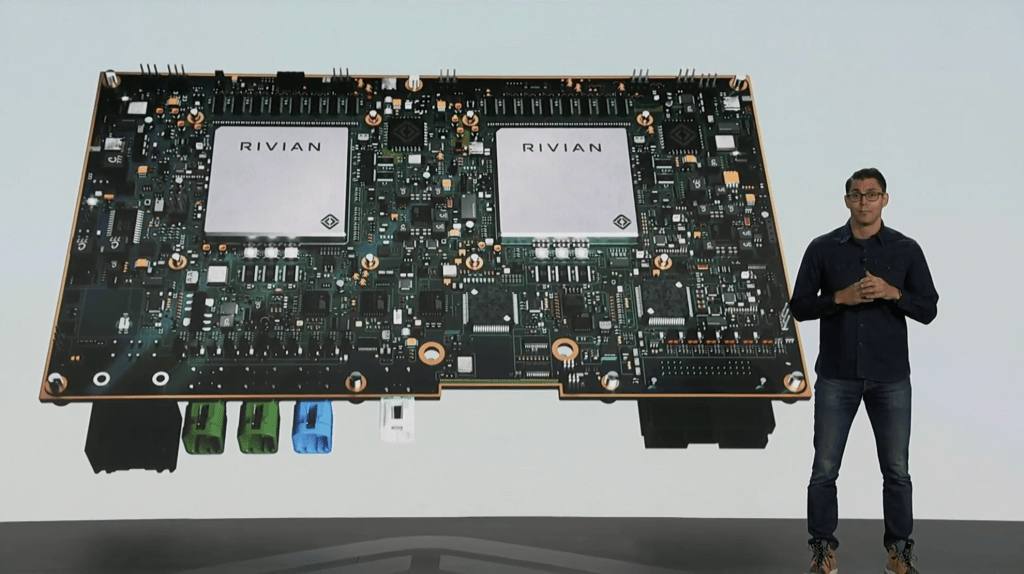
Then there is its future hands-off, eyes-off system. Rivian revealed it has developed its own custom 5nm processor, which it says will be built in collaboration with both Arm and TSMC. That chip will power Rivian’s “autonomy computer” — the backbone of an upgraded automated-driving system —that will debut in the R2 SUV in late 2026. 

That will probably be an upcharge, although Rivian didn’t say if it would be more than the $2,500 fee. 

But there’s another scenario we should also consider: licensing its tech to others. 

After all, Rivian already has a joint venture with Volkswagen Group to share its electrical architecture and base-level software. And Rivian spun out two startups this year with Also (mobility) and Mind Robotics (industrial AI and robotics). 

Barclays’ Dan Levy wrote Friday that “subsequent discussions reiterated hopes/potential” for Rivian to license its whole AV platform, or just components like the customs processor. And when I asked CEO RJ Scaringe if Rivian will sell the processor to Mind Robotics, he responded wryly: “It doesn’t take a lot of imagination.”  

At the most abstracted level, bolting new revenue lines to the existing car business (especially if those new projects play nice with the cars) makes sense. Who doesn’t love more money?  

Here’s our coverage of the event:

Rivian is building its own AI assistant (deeper dive into the tech). And it is coming to its EVs in early 2026.

Rivian goes big on autonomy with custom silicon, lidar, and a hint at robotaxis

A little bird

blinky cat bird green
Image Credits:Bryce Durbin

Nothing this week — or should I say, thanks for the tips, everyone, but there is nothing I can share yet.

In the meantime, here’s a tiny tidbit to hold you over. As you read above, senior reporter Sean O’Kane was at Rivian’s AI & Autonomy Day and one of the whispers he heard was about the company’s public demo of its AI assistant and concerns it might not work. Apparently, the testing the morning of the event was a bit touch and go.

Alas, the public demo went just fine after one tense moment at the start. The risks are high for public demos, which is why many companies avoid them. Kudos to Rivian for going for it.

Got a tip for us? Email Kirsten Korosec at kirsten.korosec@techcrunch.com or my Signal at kkorosec.07, or email Sean O’Kane at sean.okane@techcrunch.com.

Deals!

money the station
Image Credits:Bryce Durbin

At the start of 2025, I didn’t think TechCrunch would publish an aviation-startup-meets-data-center story. But here we are. 

Aircraft startup Boom Supersonic kicked off 2025 by breaking the sound barrier with its XB-1 demonstrator civil aircraft. And it’s ending the year with a plan to sell a version of its turbine engine as a stationary power plant. Its first customer will be data center startup Crusoe.

Under the deal, Crusoe will buy 29 of Boom’s 42-megawatt turbines for $1.25 billion to generate 1.21 gigawatts for its data centers.

Boom has raised $300 million to help commercialize this new business. The round was led by Darsana Capital Partners with participation from Altimeter Capital, Ark Invest, Bessemer Venture Partners, Robinhood Ventures, and Y Combinator. 

The plan is to use money from its Superpower stationary turbine business to fund the development of its supersonic aircraft. 

Other deals that got my attention …

Self-driving trucks company Aurora Innovation made a commercial agreement with Detmar Logistics to autonomously transport frac sand in the Permian Basin.

Some deals don’t always work out, or they change. Take SK On and Ford, for instance.

Four years ago, Ford and South Korean battery maker SK On struck a deal to form a joint venture and spend $11.4 billion to build factories in Tennessee and Kentucky that would produce batteries for the next generation of electric F-Series trucks. Now the joint venture is ending and the two companies will divide the assets: Ford will take ownership and operation of the twin battery plants in Kentucky, while SK On will operate the factory at the massive BlueOval SK campus in Tennessee.

Vatn Systems, a Rhode Island-based startup developing autonomous underwater vehicles, raised $60 million in a Series A funding round led by BVVC.

Notable reads and other tidbits

Image Credits:Bryce Durbin

700Credit, a company that runs credit checks and identity verification services for auto dealerships across the United States, said a data breach affected at least 5.6 million people who had their names, addresses, dates of birth, and Social Security numbers stolen.

The former CEO of bankrupt EV startup Canoo had pledged to provide support to NASA and the United States Postal Service so it could continue to use the vans. Apparently, that wasn’t a convincing argument; NASA and USPS have stopped using them.

Ford and Renault agreed to work together to bring two affordable Ford-branded vehicles to the European market in 2028. Ford will lead the design and Renault will assemble the vehicles at its factory in northern France. 

Lucid is being sued by its former chief engineer Eric Bach, who alleges wrongful termination, discrimination, and retaliation. Bach, who is of German heritage, also claims one of the automaker’s top HR executives referred to him as a “German Nazi.”

Subaru unveiled its Uncharted EV and the specs might attract buyers. The Uncharted Premium trim EV will have a 300-mile range and be priced a skosh above $36,000. Potential deal killer among Subie diehards? The Premium version is front-wheel drive only. 

A pregnant woman in San Francisco gave birth inside a Waymo robotaxi en route to UCSF Medical Center. And nope, this is not the first baby born in a Waymo. Read on to learn more

Meanwhile on the Waymo news front, a leaked letter from Tiger Global Management to its investors disclosed that Waymo is now providing 450,000 robotaxi rides per week — nearly double the amount it disclosed this spring. Waymo declined to comment. 

Zevo wants to add robotaxis to its car-share fleet, starting with newcomer Tensor. Senior reporter Sean O’Kane digs in.

One more thing …

I asked and you answered. Thanks to all the readers who participated in the last poll. As a reminder, I asked: The pace of autonomous vehicle development has quickened, prompting more scrutiny and questions around safety and accountability. Should companies stay the course, scale faster, or tap the brakes?

About 48% of you picked “stay the course.” Nearly 23% chose scale faster, while 29.4% of readers want companies to tap the brakes.

Ref link: TechCrunch Mobility: Rivian’s survival plan involves more than cars

Posted on Leave a comment

India’s Spinny lines up $160M funding to acquire GoMechanic, sources say

Spinny, an Indian online marketplace for used cars, is raising around $160 million as it moves to acquire car services startup GoMechanic, TechCrunch has learned.

The Series G round, which includes a mix of primary and secondary transactions, would value the 10-year-old startup at about $1.8 billion post-money, three people familiar with the matter said, broadly in line with its previous valuation.

Nearly $90 million of the round is primary, people said; Existing investor Accel has already wired about $44 million of that amount, with some details of the investment appearing in regulatory filings in India this week, which Indian outlet Entrackr first reported. A new investor is participating in the remaining portion of the primary, but TechCrunch could not confirm its specifics.

WestBridge Capital is doubling down in the new round with a check of a similar size to its previous investment, the people said. The firm invested about $35 million to $40 million in Spinny’s Series F round earlier this year.

Much of the secondary portion of the transaction is being sold by Indian VC firm Fundamentum, according to the people, while Blume Ventures is also expected to pare part of its stake.

Accel, Fundamentum, and Blume Ventures did not respond to requests for comments. WestBridge Capital declined to comment.

In March, Spinny raised $131 million in the first part of its Series F round led by Accel, with participation from Fundamentum, before expanding the raise to about $170 million in June to include WestBridge Capital. Those funds were earmarked to scale Spinny’s core used-car business.

Techcrunch event

Join the Disrupt 2026 Waitlist

Add yourself to the Disrupt 2026 waitlist to be first in line when Early Bird tickets drop. Past Disrupts have brought Google Cloud, Netflix, Microsoft, Box, Phia, a16z, ElevenLabs, Wayve, Hugging Face, Elad Gil, and Vinod Khosla to the stages — part of 250+ industry leaders driving 200+ sessions built to fuel your growth and sharpen your edge. Plus, meet the hundreds of startups innovating across every sector.

Join the Disrupt 2026 Waitlist

Add yourself to the Disrupt 2026 waitlist to be first in line when Early Bird tickets drop. Past Disrupts have brought Google Cloud, Netflix, Microsoft, Box, Phia, a16z, ElevenLabs, Wayve, Hugging Face, Elad Gil, and Vinod Khosla to the stages — part of 250+ industry leaders driving 200+ sessions built to fuel your growth and sharpen your edge. Plus, meet the hundreds of startups innovating across every sector.

San Francisco
|
October 13-15, 2026

However, the new round is being raised specifically to finance the acquisition of GoMechanic and invest in its platform, without drawing on the startup’s existing cash reserves, the people said. Earlier reports suggested Spinny could buy GoMechanic for around ₹4.5 billion (approximately $49.70 million) in a cash-and-stock deal.

A consortium led by Lifelong Group acquired GoMechanic in 2023 after the startup admitted to “grave errors” in its financial reporting. The startup had previously been backed by high-profile investors, including Sequoia Capital, Tiger Global, and SoftBank.

For Spinny, acquiring GoMechanic would deepen its control across the used-car value chain. The Gurugram-based startup has built a large consumer-facing business, selling about 13,000 used cars a month, primarily directly to buyers and, to a lesser extent, to dealers through its auction platform. Spinny operates its own large reconditioning centers to refurbish vehicles before sale and relies on third-party service shops for after-sales servicing of customer cars — a gap GoMechanic could bring in-house.

GoMechanic would also act as a “two-way” funnel for Spinny, a person familiar with the matter said. The platform would service vehicles bought or sold through Spinny, and help attract car owners who may not yet be customers. That could help expand Spinny’s vehicle supply without significantly increasing customer acquisition costs.

The acquisition comes as India’s used-car market is projected to grow at a compound annual growth rate of about 10% to roughly 9.5 million units by 2030, from nearly 6 million units today, per a recent report by Mahindra First Choice and Volkswagen Pre-owned Certified.

The GoMechanic deal would mark Spinny’s latest move to broaden its footprint in India’s automotive market. In recent months, the startup has expanded beyond used-car sales by acquiring auto publications Autocar India, Autocar Professional and What Car? India from London-based media group Haymarket, and by launching a non-banking finance company, Spinny Capital, to offer vehicle loans to customers.

Spinny co-founder and CEO Niraj Singh declined to comment.

Ref link: India’s Spinny lines up $160M funding to acquire GoMechanic, sources say

Posted on Leave a comment

DoorDash driver faces felony charges after allegedly spraying customers’ food

A woman is facing felony charges in Evansville, Indiana over a DoorDash delivery in which she allegedly sprayed the food with a substance that made the customers vomit.

In a press release, the Vanderburgh County Sheriff’s Office said that it was contacted on December 7 by a man who said that he and his wife vomited and experienced a burning sensation in their mouth, nose, throat, and stomachs after eating fast food ordered through DoorDash.

The man told NBC News that he noticed something red had been sprayed on the delivery bag, so he checked footage from their doorbell camera. According to the sheriff’s department, the footage shows that after dropping off the food and taking a photo, the woman appeared to spray a substance towards the food from a small aerosol can attached to her keychain.

The sheriff’s department said that using DoorDash records, detectives identified the woman as Kourtney Stevenson of Kentucky, who told local police in a phone call that she had been working for DoorDash while visiting her father, and that she’d used pepper spray to spray a spider. But the department also said that with an overnight low of 35 degrees Fahrenheit, “outdoor spiders in Indiana are not active and would not be capable of crawling on exposed surfaces.”

When Stevenson allegedly declined to come in for an interview, detectives obtained a warrant to arrest her for battery resulting in a moderate injury and consumer product tampering. She is now awaiting extradition to Indiana.

A DoorDash spokesperson said in a statement that Stevenson has been banned from the platform.

“We have absolutely zero tolerance for this type of appalling behavior,” the spokesperson said. “The Dasher’s access to the platform has been permanently removed, and our team is supporting law enforcement with their investigation.”

Techcrunch event

Join the Disrupt 2026 Waitlist

Add yourself to the Disrupt 2026 waitlist to be first in line when Early Bird tickets drop. Past Disrupts have brought Google Cloud, Netflix, Microsoft, Box, Phia, a16z, ElevenLabs, Wayve, Hugging Face, Elad Gil, and Vinod Khosla to the stages — part of 250+ industry leaders driving 200+ sessions built to fuel your growth and sharpen your edge. Plus, meet the hundreds of startups innovating across every sector.

Join the Disrupt 2026 Waitlist

Add yourself to the Disrupt 2026 waitlist to be first in line when Early Bird tickets drop. Past Disrupts have brought Google Cloud, Netflix, Microsoft, Box, Phia, a16z, ElevenLabs, Wayve, Hugging Face, Elad Gil, and Vinod Khosla to the stages — part of 250+ industry leaders driving 200+ sessions built to fuel your growth and sharpen your edge. Plus, meet the hundreds of startups innovating across every sector.

San Francisco
|
October 13-15, 2026

The New York Times and NBC News both report that it’s not clear if Stevenson has a lawyer who can comment on her behalf.

Ref link: DoorDash driver faces felony charges after allegedly spraying customers’ food

Posted on Leave a comment

AI data center boom could be bad news for other infrastructure projects

Improvements to roads, bridges, and other infrastructure could take a hit as data center construction accelerates, according to Bloomberg.

In 2025, state and local governments reportedly sold a record amount of debt for the second year in a row, with strategists predicting another $600 billion in sales next year. Most of that money is expected to fund infrastructure projects. 

Meanwhile, Census Bureau data reportedly shows that private spending on data center construction was running at annualized run rate of more than $41 billion — roughly the same as state and local government spending on transportation construction.

All these projects are likely to compete for construction workers just as the industry faces labor shortages from retirements and President Donald Trump’s immigration crackdown.

Andrew Anagnost, CEO of architecture and design software maker Autodesk, told Bloomberg there’s “absolutely no doubt” that data center construction “sucks resources from other projects.

“I guarantee you a lot of those [infrastructure] projects are not going to move as fast as people want,” he said.

Ref link: AI data center boom could be bad news for other infrastructure projects

Posted on Leave a comment

A comprehensive list of 2025 tech layoffs

The tech layoff wave is still kicking in 2025. Last year saw more than 150,000 job cuts across 549 companies, according to independent layoffs tracker Layoffs.fyi. So far this year, more than 22,000 workers have been the victim of reductions across the tech industry, with a staggering 16,084 cuts taking place in February alone.

We’re tracking layoffs in the tech industry in 2025 so you can see the trajectory of the cutbacks and understand the impact on innovation across all types of companies. As businesses continue to embrace AI and automation, this tracker serves as a reminder of the human impact of layoffs — and what could be at stake with increased innovation.

Below you’ll find a comprehensive list of all the known tech layoffs that have occurred in 2025, which will be updated regularly. If you have a tip on a layoff, contact us here. If you prefer to remain anonymous, you can contact us here.

December

Payoneer

Will let go of about 30 employees in Israel and a similar number of staff overseas, bringing the total reduction to roughly 6% of its global workforce.

VSCO

Laid off 24 employees as part of a restructuring to refocus on tools for professional photographers. In an internal memo seen by TechCrunch, CEO Eric Wittman said that consumer demand fell short and recent expansion efforts didn’t deliver as hoped.

Mobileye

Is reportedly cutting 200 employees, about 4% of its global workforce. With over 3,000 of its 4,300 employees based in Israel, most of the cuts will affect its local teams.

Techcrunch event

Join the Disrupt 2026 Waitlist

Add yourself to the Disrupt 2026 waitlist to be first in line when Early Bird tickets drop. Past Disrupts have brought Google Cloud, Netflix, Microsoft, Box, Phia, a16z, ElevenLabs, Wayve, Hugging Face, Elad Gil, and Vinod Khosla to the stages — part of 250+ industry leaders driving 200+ sessions built to fuel your growth and sharpen your edge. Plus, meet the hundreds of startups innovating across every sector.

Join the Disrupt 2026 Waitlist

Add yourself to the Disrupt 2026 waitlist to be first in line when Early Bird tickets drop. Past Disrupts have brought Google Cloud, Netflix, Microsoft, Box, Phia, a16z, ElevenLabs, Wayve, Hugging Face, Elad Gil, and Vinod Khosla to the stages — part of 250+ industry leaders driving 200+ sessions built to fuel your growth and sharpen your edge. Plus, meet the hundreds of startups innovating across every sector.

San Francisco
|
October 13-15, 2026

Inside Inbound Health

Shut down on December 1, according to an audio recording obtained by Axios Pro. The hospital-at-home startup had raised more than $50 million.

November

Intel

The company continued with its stated goal of cutting a significant amount of its workforce this year, with 59 Bay Area jobs eliminated effective November 30, in a Employment Development Department filing caught by KRON4.

HP

Is reportedly set to cut 4,000 to 6,000 jobs worldwide by 2028 as it looks to streamline operations and leverage AI to speed up product development and boost efficiency.

Apple

Is cutting several sales positions handling accounts ranging from business and schools to government agencies, as it moves to streamline how it sells devices and services to businesses, schools, and government agencies, Bloomberg reports.

Monarch Tractor

Told employees it may lay off more than 100 workers or even shut down, according to an internal memo obtained by TechCrunch. This comes after weeks of staff cuts across the autonomous electric tractor startup’s California offices and its teams in India and Singapore.

Playtika

Announced plans to lay off about 20% of its workforce, 700 to 800 employees, next month, marking its fifth round of cuts since 2022, according to Calcalist. The Nasdaq-listed gaming company, valued at $1.5 billion, employs about 3,500 people.

Pipe

Has laid off about 200 employees, roughly half its workforce, per Fintech Business Weekly. The revenue-based small business lender, once valued at $2 billion, said the cuts are part of its push toward profitability and greater operational efficiency.

Synopsys

Plans to cut roughly 10% of its workforce and close several sites as part of a restructuring tied to its recent acquisition of Ansys, The Wall Street Journal reported. The layoffs, which are expected to affect about 2,000 employees, are scheduled to take place during fiscal 2026, which began November 1.

Deepwatch

Has laid off between 60 and 80 employees, citing artificial intelligence as one of the factors behind the decision, TechCrunch reported. The cybersecurity firm, which builds an AI-powered threat detection and response platform, employs roughly 250 people.

Axonius

Is reportedly cutting roughly 10% of its staff, notifying employees in early November that about 100 of its 900 workers will be laid off. The New York–based cybersecurity firm says the move aims to streamline operations.

MyBambu

Is set to permanently close its local operations, laying off all 141 employees in two waves, according to a filing with the Florida Department of Commerce. The Florida-headquartered fintech company’s first 100 employees were let go on October 31, with the remaining 41 slated for termination by December 31.

Hewlett-Packard

Is removing 52 positions at its San Jose campus, according to reporting from the San Francisco Chronicle. The layoffs, which began last month and will continue through November, affect employees across cloud development, engineering, and product management.

October

Amazon

After Reuters reported that the company was planning to eliminate up to 30,000 corporate jobs, amounting to roughly 10% of its 350,000 employees in their corporate departments, Amazon shared that it would pursue an “overall reduction in our corporate workforce of approximately 14,000 roles.” Since that news broke, Amazon has laid off 660 employees across multiple New York City offices, with more to come through the year.

Rivian

Is cutting 600 jobs, about 4% of its workforce, amid an EV market pullback, marking its third layoff this year. Details of the latest layoffs remain undisclosed, while earlier cuts in June and September affected 100 to 150 employees in its commercial and manufacturing teams.

Meta

Has laid off approximately 600 employees across its AI infrastructure units, including the Fundamental AI Research (FAIR) team and other product-related roles. However, top-tier AI hires in TBD Labs, managed by new chief AI officer Alexandr Wang, will not be affected.

Applied Materials

Plans to cut about 4% of its workforce, or roughly 1,400 jobs, to streamline operations amid tighter U.S. semiconductor export controls.

Handshake

Laid off around 100 employees in October, about 15% of its 650-person U.S. workforce. The layoffs affected various roles across its recruiting business vertical. The San Francisco-based startup is an online platform connecting college students and recent graduates with employers for early-career jobs.

Smartsheet

Has reportedly laid off over 120 employees amid a leadership transition following CEO Mark Mader’s retirement. The enterprise software company, which grew to more than 3,300 employees, was acquired for $8.4 billion by Blackstone and Vista Equity Partners earlier this year, taking it private.

Google

Has cut over 100 design roles in its cloud division, hitting U.S.-based teams especially hard, as the company shifts focus toward AI investments, per a CNBC report. Many affected employees have until early December to find a new role within Google, following additional layoffs across its Silicon Valley offices, including at least 50 permanent cuts in Sunnyvale.

Paycom

Is reportedly laying off over 500 employees due to AI and automation improving back-office efficiencies. The Oklahoma City-based HR and payroll software company will provide affected workers with severance packages, outplacement services, and access to internal job opportunities.

September

Just Eat

Will eliminate around 450 jobs as part of a cost and operations review, according to Reuters. The layoffs will span multiple functions and countries, including customer service and sales. Europe’s largest food delivery company said it is increasingly using automation and AI, shifting many manual service tasks to automated systems.

Fiverr

Plans to cut around 250 jobs, approximately 30% of its workforce, as part of a push to become a leaner, faster, and AI-focused company, according to The Wall Street Journal. The Tel Aviv-headquartered freelance services marketplace said the restructuring will reduce management layers and position it to pursue growth with an AI-native approach.

ZipRecruiter

Is closing its Tel Aviv development center, cutting about 80 jobs. Led by Yosi Taguri, the office specialized in software, data, and AI research, including algorithm development. The California-based recruitment firm, founded in 2010, is trimming costs amid a challenging labor market.

GupShup

Has laid off at least 100 employees, including junior developers, just months after cutting nearly 200 jobs. The San Francisco-based conversational AI company, which is preparing for an IPO within two years, raised $60 million in equity and debt in July.

xAI

Laid off about a third of its data annotation team, cutting roughly 500 jobs, according to Business Insider. The move comes as the company shifts focus from generalist AI tutors to specialist roles, after testing workers to assess their strengths. Employees were told they’ll be paid through the end of their contracts — or November 30 at the latest — but their system access was cut immediately, Business Insider reports.

Rivian

Has reportedly laid off about 200 workers, or 1.5% of its staff, as the company braces for the end of federal EV tax credits under President Trump’s policy changes. The $7,500 incentive for new electric cars expires this month, adding to pressure from cooling demand. Despite the cuts, Rivian says it’s moving ahead with plans for a lower-cost model.

Oracle

Is cutting another 101 jobs in Seattle and 254 in San Francisco, just weeks after a wave of layoffs in August. The company, which had about 3,900 local employees before the cuts, hasn’t explained the move and declined to comment.

Salesforce

Is trimming another 262 jobs at its San Francisco headquarters, according to a state filing, with layoffs set to take effect November 3. The move comes just weeks after CEO Marc Benioff touted AI’s potential to cut customer support roles and follows a smaller round of cuts in Seattle and Bellevue earlier this month.

August

Cisco

Will eliminate 221 positions across its Milpitas and San Francisco offices, including 157 in Santa Clara County and 64 in San Francisco, effective October 13, according to filings with California’s Employment Development Department reported by the San Francisco Chronicle. The cuts are part of the company’s broader workforce-reduction strategy.

Restaurant365

Laid off about 100 employees last month, around 9% of its workforce, after falling short of ambitious growth targets. The cuts affected staff across all departments. The company provides back-office software for restaurant chains.

Oracle

Is set to cut 101 jobs at its Santa Clara location, with notices issued on August 13 and terminations effective October 13. The company, which recently disclosed nearly 200 layoffs at its Pleasanton and Redwood City offices, is also planning to lay off 161 employees in Seattle, according to filings with the Washington state Employment Security Department.

F5

Is cutting 106 positions at its Seattle and Liberty Lake, Washington, offices, according to a state Employment Security Department filing. The layoffs, which affected senior engineers and managers, are part of a broader global workforce reduction, although the security and application delivery company has not disclosed the total number of employees affected.

Peloton

Will cut 6% of its workforce in its sixth layoff in just over a year. Peloton CEO Peter Stern said the cuts are needed to improve long-term business health.

Kaltura

Is cutting 10% of its workforce, or about 70 employees, as part of a cost-saving effort to reduce operating expenses by $8.5 million, marking its third round of layoffs since 2022. The corporate video software company plans to maintain and gradually grow its sales and marketing budgets, driven by a robust pipeline and growing adoption of its AI-powered offerings.

Yotpo

Is laying off about 200 employees, roughly 34% of its global workforce, as it shuts down its email and SMS marketing operations. The Israeli-founded unicorn is partnering with Attentive and Omnisend to continue supporting marketing services while investing in AI-powered tools like automated review summaries, smart sorting, and a new Loyalty Tiers system.

Windsurf

Laid off 30 employees and is now offering buyouts to the remaining 200. The AI coding startup recently acquired by Cognition has had a rocky stretch, including a near-acquisition by OpenAI and a reverse-acqui-hire by Google that saw key talent depart before Cognition stepped in. Despite initial promises to value Windsurf’s team, the deal now looks more focused on the startup’s intellectual property than its people.

Wondery

Is cutting 100 jobs, and its CEO, Jen Sargent, is departing. Amazon is reorganizing its audio operations, moving Wondery’s audio-only podcasts under Audible and placing video-focused shows into a new Creator Services division. Amazon acquired Wondery in 2020.

July

Atlassian

Has cut 150 roles in customer service and support, following enhancements to its platform and tools that have significantly reduced support needs. The decision came via a prerecorded message from CEO Mike Cannon-Brookes, just hours before co-founder Scott Farquhar urged Australia to embrace an “AI revolution” and move beyond “jobs of the past” in an Australian Press Club address. The Australian software firm was founded 2002.

Consensys

Is cutting about 7% of its workforce, or 47 employees, as part of a push toward profitability, Bloomberg reports. The decision follows the recent acquisition of a startup with around 30 staff, who will stay on with the company. Despite the cuts, the blockchain software company that operates the popular digital wallet MetaMask says it will continue hiring for select roles.

Zeen

Is shutting down operations, per a report by Business Insider. The social collaging platform aimed at creators was founded in 2019 and raised $9 million in funding. Its closure highlights the persistent challenges social media startups face in building user bases and achieving long-term growth.

Scale AI

Is laying off around 200 employees — roughly 14% of its workforce — and severing ties with 500 global contractors. The cuts come just weeks after Meta brought in the data-labeling startup’s CEO in a $14.3 billion deal.

Lenovo

Plans to cut more than 100 U.S. full-time jobs, about 3% of its workforce, including positions at its Morrisville, North Carolina, campus. As of February 2024, the PC maker employed around 5,100 workers in the U.S.

Intel

Is reportedly planning to lay off nearly 2,400 workers in Oregon, which is almost five times more than what was announced earlier this week. Last week, Intel announced that it will lay off more than 500 employees in Oregon, which is about 20% of its workforce, per Bloomberg.  

Indeed + Glassdoor

Plan to eliminate approximately 1,300 jobs combined as part of a larger restructuring effort to combine their operations and focus on AI. The layoff will mostly affect employees in the U.S., particularly in the R&D, HR, and sustainability teams, according to an internal memo by Hisayuki “Deko” Idekoba, the CEO of Recruit Holdings, which is the Japanese parent company of Indeed and Glassdoor.

Eigen Lab

Has laid off 29 employees as part of its reorganization, per a report by Blockworks. The Seattle-based research and engineering startup recently launched EigenCloud, a platform that provides blockchain-level trust guarantees for any Web 2.0 or web3 application. The reduction will affect 25% of the company’s workforce. Eigen Labs said it had raised $70 million in tokens from a16z Crypto in June.

Microsoft

Will cut 9,000 employees, which is less than 4% of its global workforce across teams, role types, and geographies. The reduction follows a series of layoffs earlier this year: It cut less than 1% of the headcount in January, more than 6,000 in May, and at least 300 in June.

ByteDance

Is laying off 65 employees in Bellevue, Washington, according to media reports. The parent company of TikTok arrived in Seattle in 2021 and has been expanding its presence there by growing its TikTok Shop online shopping division.

June

TomTom

Announced on June 30 that the company is cutting 300 jobs, or 10% of its workforce, as part of organizational restructuring within its sales and support divisions amid the AI shift. The startup is an Amsterdam-based location tech startup that provides navigation and mapping products.

Rivian

Has reduced its headcount by approximately 140 employees, accounting for roughly 1% of its total workforce. The recent layoffs mostly affected Rivian’s manufacturing team.

Bumble

Announced in an SEC filing that it will cut approximately 240 jobs, or 30% of its workforce, to enhance operational efficiency and allocate the resulting savings to the development of new products and technologies, according to a CNBC report. The layoff will help the online dating app save $40 million annually, per the report.

Klue

Has reportedly laid off 85 employees, which accounts for approximately 40% of its workforce. The Vancouver-based startup sells software products that use artificial intelligence for business intelligence. It helps sales professionals at tech companies gather information on competitors to improve their sales.

Google

Has downsized its smart TV division by 25% of its 300-member team to adjust its strategy, per reports. Funding for the smart TV division, including Google TV and Android TV, has been cut by 10%, but investment in AI projects has been raised.

Intel

Says that it plans to lay off 15% to 20% of workers in its Intel Foundry division starting in July. Intel Foundry designs, manufactures, and packages semiconductors for external clients. Intel’s total workforce was 108,900 people as of December 2024, according to the company’s annual regulatory filing. It also confirmed to TechCrunch that it plans to wind down its auto business.

Playtika

Announced that it is letting go of around 90 employees, with 40 in Israel and 50 in Poland. The most recent round of job cuts comes after the Israel-based gaming company laid off 50 employees a few weeks ago.

Airtime

Has let go of around 25 employees from the 58-person team, the company confirmed to TechCrunch. Evernote’s founder Phil Libin launched the video startup in 2020, offering Airtime Creator and Airtime Camera.

Microsoft

Is laying off more employees, just a few weeks after announcing a job cut of over 6,500 in May, which was around 3% of its global workforce. The most recent layoffs affected software engineers, product managers, technical program managers, marketers, and legal counsels.

May

Hims & Hers

Plans to downsize its workforce by letting go of 68 employees, approximately 4% of its total staff, per Reuters. The San Francisco telehealth platform said that its layoffs were unrelated to a U.S. ban on producing large quantities of the weight-loss drug Wegovy. The startup said it intends to keep on recruiting employees who fit in with its long-term expansion plans.

Amazon

Is reportedly laying off around 100 employees from its devices and services division, which encompasses various businesses like the Alexa voice assistant, Echo smart speakers, Ring video doorbells, and Zoox robotaxis. The company has reduced its workforce by approximately 27,000 since the start of 2022 to cut costs.

Microsoft

Will cut over 6,500 jobs, affecting 3% of its worldwide workforce. As of June, the Seattle-headquartered company had a total of 228,000 employees globally. It would be one of the company’s biggest layoffs since it cut 10,000 employees in 2023.

Chegg

Reportedly plans to let go of 248 employees, or about 22% of its workforce, to reduce expenses and improve efficiency, it said. The San Francisco-based edtech startup, which offers textbook rentals and tutoring services, has seen a drop in web traffic for months as students opt for AI tools instead of traditional edtech platforms.

Match

Is reducing its workforce by 13% as part of a reorganization that aims to reduce costs, shore up margins, and streamline its organizational structure.

CrowdStrike

Is laying off 5% of its global workforce, or around 500 people. The company said the layoffs were part of “a strategic plan (the ‘Plan’) to evolve its operations to yield greater efficiencies as the Company continues to scale its business with focus and discipline to meet its goal of $10 billion in ending [Annual Recurring Revenue]” in its 8-K filing.

General Fusion

Has cut roughly 25% of its current workforce. The Vancouver-based company, which is developing a technology to generate fusion energy, has raised $440 million from investors, including Jeff Bezos, Temasek, and BDC Capital.

Deep Instinct

Reduced its headcount by 20 employees, accounting for 10% of its total workforce. In April 2023, the Israeli cybersecurity startup had previously laid off a similar number of employees during a round of layoffs.

Beam

Has shut down its operations months after announcing major expansion plans, per Sifted. The British climate startup has let go of approximately 200 employees, according to a LinkedIn post by James Reynolds, the head of talent.

April

NetApp

Is reportedly eliminating 700 jobs, affecting 6% of its total workforce, as it reorganizes for its operational efficiency. The company, based in San Francisco, provides data storage, cloud services, and CloudOps solutions for businesses.

Electronic Arts

Is reportedly letting go of approximately 300 to 400 employees, including around 100 at Respawn Entertainment, to focus on its “long-term strategic priorities,” according to Bloomberg.

Expedia

Is laying off around 3% of its employees as part of its restructuring. The job cuts will mainly affect midlevel positions in the product and technology teams. The latest round of layoffs comes after the company let go of hundreds of employees from its marketing team globally in early March.

Cars24

Has reduced its workforce by about 200 employees in its product and technology divisions as part of a restructuring measure. The India-based e-commerce platform for pre-owned vehicles provides a range of services like buying and selling pre-owned cars, financing, insurance, driver-on-demand, and more. In 2023, the SoftBank-backed startup raised $450 million at a valuation of $3.3 billion.

Meta

Is letting go of over 100 employees in its Reality Labs division, which manages virtual reality and wearable technology, according to The Verge. The job cuts affect employees developing VR experiences for Meta’s Quest headsets and staff working on hardware operations to streamline similar work between the two teams.

Intel

Announced its plan to lay off more than 21,000 employees, or roughly 20% of its workforce, in April. The move comes ahead of Intel’s Q1 earnings call helmed by recently appointed CEO Lip-Bu Tan, who took over from longtime chief Pat Gelsinger last year.

GM

Is laying off 200 people at its Factory Zero in Detroit and Hamtramck facility in Michigan, which produces GM’s electric vehicles. The cuts come amid the EV slowdown and is not caused by tariffs, according to a report.

Zopper

Has reportedly let go of around 100 employees since the start of 2025. Earlier this week, about 50 employees from the tech and product teams were let go in the latest round of job cuts. The India-based insurtech startup has raised a total of $125 million to date.

Turo

Will reduce its workforce by 150 positions following its decision not to proceed with its IPO, per Bloomberg. The San Francisco-based car rental startup, which had about 1,000 staff in 2024, said the layoffs will bolster its long-term growth plans during economic uncertainty.

GupShup

Laid off roughly 200 employees to improve efficiency and profitability. It’s the startup’s second round of layoffs in five months, following the job cuts of around 300 employees in December. The conversational AI company, backed by Tiger Global and Fidelity, was last valued at $1.4 billion in 2021. The startup is based in San Francisco and operates in India.

Forto

Has reportedly eliminated 200 jobs, affecting around one-third of its employees. The German logistics startup reduced a significant number of sales staff.

Wicresoft

Will stop its operations in China, affecting around 2,000 employees. The move came after Microsoft decided to end outsourcing after-sales support to Wicresoft amid increasing trade tensions. Wicresoft, Microsoft’s first joint venture in China, was founded in 2022 and operates in the U.S., Europe, and Japan. It has over 10,000 employees.

Five9

Plans to cut 123 jobs, affecting about 4% of its workforce, according to a report by MarketWatch. The software company prioritizes key strategic areas like artificial intelligence for profitable growth.

Google

Has laid off hundreds of employees in its platforms and devices division, which covers Android, Pixel phones, the Chrome browser, and more, according to The Information.

Microsoft

Is contemplating additional layoffs that could happen by May, Business Insider reported, citing anonymous sources. The company is said to be discussing reducing the number of middle managers and non-coders in a bid to increase the ratio of programmers to product managers.

Automattic

The WordPress.com developer is laying off 16% of its workforce across departments. Before the layoffs, the company’s website showed it had 1,744 employees, so more than 270 staff may have been laid off.

Canva

Has let go of 10 to 12 technical writers approximately nine months after telling its employees to use generative AI tools wherever possible. The company, which had around 5,500 staff in 2024, was valued at $26 billion after a secondary stock sale in 2024.

March

Northvolt

Has laid off 2,800 employees, affecting 62% of its total staff. The layoffs come weeks after the embattled Swedish battery maker filed for bankruptcy.

Block

Let go of 931 employees, around 8% of its workforce, as part of a reorganization, according to an internal email seen by TechCrunch. Jack Dorsey, the co-founder and CEO of the fintech company, wrote in the email that the layoffs were not for financial reasons or to replace workers with AI.

Brightcove

Has laid off 198 employees, who make up about two-thirds of its U.S. workforce, per a media report. The layoff comes a month after the company was acquired by Bending Spoons, an Italian app developer, for $233 million. Brightcove had 600 employees worldwide, with 300 in the U.S., as of December 2023.

Acxiom

Has reportedly laid off 130 employees, or 3.5% of its total workforce of 3,700 people. Acxiom is owned by IPG, and the news comes just a day after IPG and Omnicom Group shareholders approved the companies’ potential merger.

Sequoia Capital

Plans to close its office in Washington, D.C., and let go of its policy team there by the end of March, TechCrunch has confirmed. Sequoia opened its Washington office five years ago to deepen its relationship with policymakers. Three full-time employees are expected to be affected, per Forbes.

Siemens

Announced plans to let go of approximately 5,600 jobs globally in its automation and electric-vehicle charging businesses as part of efforts to improve competitiveness.

HelloFresh

Is reportedly laying off 273 employees, closing its distribution center in Grand Prairie, Texas, and consolidating to another site in Irving to manage the volume in the region.

Otorio

Has cut 45 employees, more than half of its workforce, after being acquired by cybersecurity company Armis for $120 million in March.

ActiveFence

Will reportedly reduce 22 employees, representing 7% of its workforce. Most of those affected are based in Israel as the company undergoes a streamlining process. The New York- and Tel Aviv-headquartered cybersecurity firm has raised $100 million at a valuation of about $500 million in 2021.

D-ID

Will cut 22 jobs, affecting nearly a quarter of its total workforce, following the announcement of the AI startup’s strategic partnership with Microsoft.

NASA

Announced it will be shutting down several of its offices in accordance with Elon Musk’s DOGE, including its Office of Technology, Policy, and Strategy and the DEI branch in the Office of Diversity and Equal Opportunity.

Zonar Systems

Has reportedly laid off some staff, according to LinkedIn posts from ex-employees. The company has not confirmed the layoffs, and it is currently unknown how many workers were affected.

Wayfair

Announced plans to let go of 340 employees in its technology division as part of a new restructuring effort.

HPE

Will cut 2,500 employees, or 5% of its total staff, in response to its shares sliding 19% in the first fiscal quarter.

TikTok

Will cut up to 300 workers in Dublin, accounting for roughly 10% of the company’s workforce in Ireland. 

LiveRamp

Announced it will lay off 65 employees, affecting 5% of its total workforce.

Ola Electric

Is reportedly set to lay off over 1,000 employees and contractors in a cost-cutting effort. It’s the second round of cuts for the company in just five months.

Rec Room

Reduced its total headcount by 16% as the gaming startup shifts its focus to be “scrappier” and “more efficient.”

ANS Commerce

Was shut down just three years after it was acquired by Flipkart. It is currently unknown how many employees were affected.

February

HP

Will cut up to 2,000 jobs as part of its “Future Now” restructuring plan that hopes to save the company $300 million before the end of its fiscal year.

GrubHub

Announced 500 job cuts after it was sold to Wonder Group for $650 million. The number of cuts affected more than 20% of its previous workforce. 

Autodesk

Announced plans to lay off 1,350 employees, affecting 9% of its total workforce, in an attempt to reshape its GTM model. The company is also making reductions in its facilities, though it does not plan to close any offices.

Google

Is planning to cut employees in its People Operations and cloud organizations teams in a new reorganization effort. The company is offering a voluntary exit program to U.S.-based People Operations employees.

Nautilus

Reduced its headcount by 25 employees, accounting for 16% of its total workforce. The company is planning to release a commercial version of its proteome analysis platform in 2026.

eBay

Will reportedly cut a few dozen employees in Israel, potentially affecting 10% of its 250-person workforce in the country.

Starbucks

Cut 1,100 jobs in a reorganizing effort that affected its tech workers. The coffee chain will now outsource some tech work to third-party employees.

Commercetools

Laid off dozens of employees over the last few weeks, including around 10% of staff in one day, after failing to meet its sales growth targets. The “headless commerce” platform raised money at a $1.9 billion valuation just a few years ago.

Dayforce

Will cut roughly 5% of its current workforce in a new efficiency drive to increase profitability and growth.

Expedia

Laid off more employees in a new effort to cut costs, though the total number is unknown. Last year, the travel giant cut about 1,500 roles in its Product & Technology division.

Skybox Security

Has ceased operations and has laid off its employees after selling its business and technology to Israeli cybersecurity company Tufin. The cuts affect roughly 300 people. 

HerMD

Is shutting down its operations after shifting from a brick-and-mortar model to a fully virtual women’s healthcare provider. The startup, which raised $18 million in 2023, has not disclosed how many employees are affected, saying recent layoffs were tied to its former in-person business.

Zendesk

Cut 51 jobs in its San Francisco headquarters, according to state filings with the Employment Development Department. The SaaS startup previously reduced its headcount by 8% in 2023.

Vendease

Has cut 120 employees, affecting 44% of its total staff. It’s the Y Combinator-backed Nigerian startup’s second layoff round in just five months.

Logically

Reportedly laid off dozens of employees as part of a new cost-cutting effort that aims to ensure “long-term success” in the startup’s mission to curb misinformation online.

Blue Origin

Will lay off about 10% of its workforce, affecting more than 1,000 employees. According to an email to staff obtained by CNN, the cuts will largely have an impact on positions in engineering and program management. 

Redfin

Announced in an SEC filing that it will cut around 450 positions between February and July 2025, with a complete restructuring set to be completed in the fall, following its new partnership with Zillow.

Sophos

Is laying off 6% of its total workforce, the cybersecurity firm confirmed to TechCrunch. The cuts come less than two weeks after Sophos acquired Secureworks for $859 million.

Zepz

Will cut nearly 200 employees as it introduces redundancy measures and closes down its operations in Poland and Kenya.

Unity

Reportedly conducted another round of layoffs. It’s unknown how many employees were affected.

JustWorks

Cut nearly 200 employees, CEO Mike Seckler announced in a note to employees, citing “potential adverse events” like a recession or rising interest rates.

Bird

Cut 120 jobs, affecting roughly one-third of its total workforce, TechCrunch exclusively learned. The move comes just a year after the Dutch startup cut 90 employees following its rebrand.

Sprinklr

Laid off about 500 employees, affecting 15% of its workforce, citing poor business performance. The new cuts follow two earlier layoff rounds for the company that affected roughly 200 employees.

Sonos

Reportedly let go of approximately 200 employees, according to The Verge. The company previously cut 100 employees as part of a layoff round in August 2024. 

Workday

Laid off 1,750 employees, as originally reported by Bloomberg and confirmed independently by TechCrunch. The cuts affect roughly 8.5% of the enterprise HR platform’s total headcount.

Okta

Laid off 180 employees, the company confirmed to TechCrunch. The cuts come just over one year after the access and identity management giant let go of 400 workers.

Cruise

Is laying off 50% of its workforce, including CEO Marc Whitten and several other top executives, as it prepares to shut down operations. What remains of the autonomous vehicle company will move under General Motors.

Salesforce

Is reportedly eliminating more than 1,000 jobs. The cuts come as the giant is actively recruiting and hiring workers to sell new AI products.

January

Cushion

Has shut down operations, CEO Paul Kesserwani announced on LinkedIn. The fintech startup’s post-money valuation in 2022 was $82.4 million, according to PitchBook.

Placer.ai

Laid off 150 employees based in the U.S., affecting roughly 18% of its total workforce, in an effort to reach profitability.

Amazon

Laid off dozens of workers in its communications department in order to help the company “move faster, increase ownership, strengthen our culture, and bring teams closer to customers.”

Stripe

Is laying off 300 people, according to a leaked memo reported by Business Insider. However, according to the memo, the fintech giant is planning to grow its total headcount by 17%. 

Textio

Laid off 15 employees as the augmented writing startup undergoes a restructuring effort.

Pocket FM

Is cutting 75 employees in an effort to “ensure the long-term sustainability and success” of the company. The audio company last cut 200 writers in July 2024 months after partnering with ElevenLabs.

Aurora Solar

Is planning to cut 58 employees in response to an “ongoing macroeconomic challenges and continued uncertainty in the solar industry.”

Meta

Announced in an internal memo that it will cut 5% of its staff targeting “low performers” as the company prepares for “an intense year.” As of its latest quarterly report, Meta currently has more than 72,000 employees.

Wayfair

Will cut up to 730 jobs, affecting 3% of its total workforce, as it plans to exit operations in Germany and focus on physical retailers.

Pandion

Is shutting down its operations, affecting 63 employees. The delivery startup said employees will be paid through January 15 without severance.

Icon

Is laying off 114 employees as part of a team realignment, per a new WARN notice filing, focusing its efforts on a robotic printing system.

Altruist

Eliminated 37 jobs, affecting roughly 10% of its total workforce, even as the company pursues “aggressive” hiring.

Aqua Security

Is cutting dozens of employees across its global markets as part of a strategic reorganization to increase profitability.

SolarEdge Technologies

Plans to lay off 400 employees globally. It’s the company’s fourth layoff round since January 2024 as the solar industry as a whole faces a downturn.

Level

The fintech startup, founded in 2018, abruptly shut down earlier this year. Per an email from CEO Paul Aaron, the closure follows an unsuccessful attempt to find a buyer, though Employer.com has a new offer under consideration to acquire the company post-shutdown.

This list updates regularly.

On April 24, 2025, we corrected the number of layoffs that happened in March.

Ref link: A comprehensive list of 2025 tech layoffs

Posted on Leave a comment

World launches its ‘super app,’ including crypto pay and encrypted chat features

World, the biometric ID verification project co-founded by Sam Altman, released the newest version of its app today, debuting several new features, including an encrypted chat integration and an expanded, Venmo-like capability for sending and requesting crypto. 

World was created by the startup Tools for Humanity in 2019, and originally launched its app in 2023. The company says that, in a world roiled by AI-generated digital fakery, it hopes to create digital “proof of human” tools that can help separate the humans from the bots.

During a small gathering at World’s headquarters in San Francisco on Thursday, Altman and World’s co-founder and CEO, Alex Blania, briefly introduced the new version of the app (which developers have termed a “super app”) before the product team took over to explain the new features. During his remarks, Altman said that the concept for World grew out of conversations he and Blania had had about the need to create a new kind of economic model. That model, based around web3 principles, is what World has been trying to accomplish through its verification network. “It’s really hard to both identify unique people and do that in a privacy-preserving way,” said Altman.

World Chat, the app’s new messenger, seems designed to do just that. It uses end-to-end encryption to keep users’ conversations safe (this encryption is described as being equivalent to Signal, the privacy-focused messenger), and also leverages color-coded speech bubbles to alert users to whether the person they’re talking to has been verified by World’s system or not, the company said. The idea is to incentivize verification, giving people the power to know whether the person they’re talking to is who they say they are. Chat was originally launched in beta in March.

The other big feature reveal on Thursday was an expanded digital payment system that allows app users to send and receive cryptocurrency. World app has functioned as a digital wallet for some time, but the newest version of the app includes broader capabilities. Using virtual bank accounts, users can also receive paychecks directly into World App and make deposits from their bank accounts, both of which can then be converted into crypto. You don’t have be verified by World’s authentication system to use these features.

Tiago Sada, World’s chief product officer, told TechCrunch that part of the reason chat was added was to create a more interactive experience for users. “What we kept hearing from people is that they wanted a more social World app,” Sada said. World Chat is designed to fill that need, creating what Sada says is a secure way to communicate. “It took a lot of work to make this feature-rich messenger that is similar to a WhatsApp or a Telegram, but with encryption and security of something that is a lot closer to Signal,” Sada said.

World (which was originally called Worldcoin) deploys a unique authentication process: interested humans get their eyes scanned at one of the company’s offices, where the Orb—a large verification device—converts the person’s iris into a unique and encrypted digital code. That code, the verified World ID, can then be used by the person to interact with World’s ecosystem of services, which are available through its app.

Techcrunch event

Join the Disrupt 2026 Waitlist

Add yourself to the Disrupt 2026 waitlist to be first in line when Early Bird tickets drop. Past Disrupts have brought Google Cloud, Netflix, Microsoft, Box, Phia, a16z, ElevenLabs, Wayve, Hugging Face, Elad Gil, and Vinod Khosla to the stages — part of 250+ industry leaders driving 200+ sessions built to fuel your growth and sharpen your edge. Plus, meet the hundreds of startups innovating across every sector.

Join the Disrupt 2026 Waitlist

Add yourself to the Disrupt 2026 waitlist to be first in line when Early Bird tickets drop. Past Disrupts have brought Google Cloud, Netflix, Microsoft, Box, Phia, a16z, ElevenLabs, Wayve, Hugging Face, Elad Gil, and Vinod Khosla to the stages — part of 250+ industry leaders driving 200+ sessions built to fuel your growth and sharpen your edge. Plus, meet the hundreds of startups innovating across every sector.

San Francisco
|
October 13-15, 2026

The addition of more social-friendly features is clearly meant to drive broader adoption of the app, which makes sense since scaling verification is the company’s main challenge. Altman has said that he would like the project to scan a billion people’s eyes, but Tools for Humanity claims to have scanned less than 20 million people.  

Since standing in long lines at a corporate office to have your eyeballs scanned by a giant metallic ball may seem slightly less than enticing to some users, the company has already sought to make its verification process less cumbersome. In April, Tools for Humanity announced its Orb Minis—hand-held, phone-like devices—that allow users to scan their own eyes from the comfort of their homes. Blania previously told TechCrunch that, eventually, the company would like to turn the Orb Minis into a mobile point-of-sale device or sell its ID sensor tech to device manufacturers. If the company takes such steps, it would drop the barrier to verification significantly, potentially inspiring much more widespread adoption.

Ref link: World launches its ‘super app,’ including crypto pay and encrypted chat features

Posted on Leave a comment

Stanford’s star reporter takes on Silicon Valley’s ‘money-soaked’ startup culture

Theo Baker is truly an outlier.

While journalism as a major has seen shrinking enrollment for years and is even being dropped by some schools entirely, Baker, a senior at Stanford University, has doubled down on old-school investigative reporting, and it is paying off spectacularly.

Baker first made headlines as a college freshman when his reporting for The Stanford Daily led to the resignation of Stanford president Marc Tessier-Lavigne. After uncovering allegations of research misconduct spanning two decades, Baker — just one month into college — found himself “receiving anonymous letters, conducting stakeouts, and tracking down confidential sources,” according to his publisher. Meanwhile, high-powered lawyers tried to discredit his work. By year’s end, Tessier-Lavigne had resigned, and Baker became the youngest-ever recipient of the George Polk Award, one of journalism’s most prestigious honors.

Shortly after, Warner Bros and famed producer Amy Pascal won a competitive auction for the film rights to his story.

But if that scandal put Baker on the map, his upcoming book may cement his reputation as the rare young journalist willing to challenge Silicon Valley’s startup machine.

“How to Rule the World,” out May 19 — three weeks before he graduates — promises an explosive look at how venture capitalists treat Stanford students as “a commodity,” wooing favored undergrads with slush funds, shell companies, yacht parties, and funding offers before they even have business ideas in their hunt for the next trillion-dollar founder.

“I watched in real time as my peers were taught to cut corners and plied with enormous wealth by people who wanted to exploit their talent,” Baker, who turns 21 next month, tells Axios. Drawing on more than 250 interviews with students, CEOs, VCs, Nobel laureates, and three Stanford presidents, the book aims to expose what Baker describes to Axios as a “weird, money-soaked subculture that has so much influence over the rest of the world.”

Techcrunch event

Join the Disrupt 2026 Waitlist

Add yourself to the Disrupt 2026 waitlist to be first in line when Early Bird tickets drop. Past Disrupts have brought Google Cloud, Netflix, Microsoft, Box, Phia, a16z, ElevenLabs, Wayve, Hugging Face, Elad Gil, and Vinod Khosla to the stages — part of 250+ industry leaders driving 200+ sessions built to fuel your growth and sharpen your edge. Plus, meet the hundreds of startups innovating across every sector.

Join the Disrupt 2026 Waitlist

Add yourself to the Disrupt 2026 waitlist to be first in line when Early Bird tickets drop. Past Disrupts have brought Google Cloud, Netflix, Microsoft, Box, Phia, a16z, ElevenLabs, Wayve, Hugging Face, Elad Gil, and Vinod Khosla to the stages — part of 250+ industry leaders driving 200+ sessions built to fuel your growth and sharpen your edge. Plus, meet the hundreds of startups innovating across every sector.

San Francisco
|
October 13-15, 2026

It’s perhaps an unsurprising move from someone who grew up around top journalists. His father is New York Times chief White House correspondent Peter Baker, and his mother is The New Yorker’s Susan Glasser. While his peers chase venture capital funding and six-figure startup salaries, Baker spent his sophomore year reporting and took his junior year off to write, including two months at the Yaddo writers’ retreat.

That choice becomes even more striking against the backdrop of journalism’s current struggles. While traditional journalism programs fail to fill classes and media outfits face seemingly relentless layoffs, Baker represents something both exciting and increasingly uncommon: a star student betting his career on accountability journalism. Whether he’s a harbinger of renewed interest in investigative reporting remains to be seen, but we’d guess his book will capture the attention of plenty of college students — and it will almost certainly make waves in Silicon Valley while doing it.

Ref link: Stanford’s star reporter takes on Silicon Valley’s ‘money-soaked’ startup culture

Posted on Leave a comment

Google launched its deepest AI research agent yet — on the same day OpenAI dropped GPT-5.2

Google released on Thursday a “reimagined” version of its research agent Gemini Deep Research based on its much-ballyhooed state-of-the-art foundation model, Gemini 3 Pro.  

This new agent isn’t just designed to produce research reports — although it can still do that. It now allows developers to embed Google’s SATA-model research capabilities into their own apps. That capability is made possible through Google’s new Interactions API, which is designed to give devs more control in the coming agentic AI era. 

The new Gemini Deep Research tool is an agent equipped to synthesize mountains of information and handle a large context dump in the prompt. Google says it’s used by customers for tasks ranging from due diligence to drug toxicity safety research. 

Google also says it will soon be integrating this new deep research agent into services, including Google Search, Google Finance, its Gemini App, and its popular NotebookLM. This is another step toward preparing for a world where humans don’t Google anything anymore — their AI agents do. 

The tech giant says that Deep Research benefits from Gemini 3 Pro’s status as its “most factual” model that is trained to minimize hallucinations during complex tasks.

AI hallucinations — where the LLM just makes stuff up — are an especially crucial issue for long-running, deep reasoning agentic tasks, in which many autonomous decisions are made over minutes, hours, or longer. The more choices an LLM has to make, the greater the chance that even one hallucinated choice will invalidate the entire output. 

To prove its progress claims, Google has also created yet another benchmark (as if the AI world needs another one). The new benchmark is unimaginatively named DeepSearchQA and is intended to test agents on complex, multi-step information-seeking tasks. Google has open sourced this benchmark.  

Techcrunch event

Join the Disrupt 2026 Waitlist

Add yourself to the Disrupt 2026 waitlist to be first in line when Early Bird tickets drop. Past Disrupts have brought Google Cloud, Netflix, Microsoft, Box, Phia, a16z, ElevenLabs, Wayve, Hugging Face, Elad Gil, and Vinod Khosla to the stages — part of 250+ industry leaders driving 200+ sessions built to fuel your growth and sharpen your edge. Plus, meet the hundreds of startups innovating across every sector.

Join the Disrupt 2026 Waitlist

Add yourself to the Disrupt 2026 waitlist to be first in line when Early Bird tickets drop. Past Disrupts have brought Google Cloud, Netflix, Microsoft, Box, Phia, a16z, ElevenLabs, Wayve, Hugging Face, Elad Gil, and Vinod Khosla to the stages — part of 250+ industry leaders driving 200+ sessions built to fuel your growth and sharpen your edge. Plus, meet the hundreds of startups innovating across every sector.

San Francisco
|
October 13-15, 2026

It also tested Deep Research on Humanity’s Last Exam, a much more interestingly named, independent benchmark of general knowledge filled with impossibly niche tasks; and BrowserComp, a benchmark for browser-based agentic tasks.

As you might expect, Google’s new agent bested the competition on its own benchmark, and Humanity’s. However, OpenAI’s ChatGPT 5 Pro was a surprisingly close second all the way around and slightly bested Google on BrowserComp. 

But those benchmark comparisons were obsolete almost the moment Google published them. Because on the same day, OpenAI launched its highly anticipated GPT 5.2 — codenamed Garlic. OpenAI says its newest model bests its rivals — especially Google — on a suite of the typical benchmarks, including OpenAI’s homegrown one. 

Perhaps one of the most interesting parts of this announcement was the timing. Knowing that the world was awaiting the release of Garlic, Google dropped some AI news of its own.

Ref link: Google launched its deepest AI research agent yet — on the same day OpenAI dropped GPT-5.2

Posted on Leave a comment

1X struck a deal to send its ‘home’ humanoids to factories and warehouses

Robotics company 1X found some big potential buyers for its humanoid robots designed for consumers — the portfolio companies of one of its investors.

The company announced a strategic partnership to make thousands of its humanoid robots available for EQT’s portfolio companies on Thursday. EQT is a large Swedish multi-asset investor, and its venture fund EQT Ventures, is one of 1X’s backers.

This deal involves shipping up to 10,000 1X Neo humanoid robots between 2026 and 2030 to EQT’s more than 300 portfolio companies with a concentration on manufacturing, warehousing, logistics, and other industrial use cases.

1X will sign individual deals with each of EQT’s interested portfolio companies, 1X confirmed to TechCrunch.

This partnership is particularly interesting because 1X’s Neo has been marketed as a humanoid for personal use and tagged as the “first consumer-ready humanoid robot designed to transform life at home.” Unlike some of 1X’s peers, like Figure, it has not been marketed as a bot for commercial purposes.

1X does have a robot designed for industrial purposes, Eve Industrial, but this deal specifically involves the Neo humanoid.

When the company opened up preorders for the $20,000 robot in October, the announcement was focused on how the robot would operate in someone’s home from descriptions of the different chores that the robot is able to perform and how it interacts with people.

Techcrunch event

Join the Disrupt 2026 Waitlist

Add yourself to the Disrupt 2026 waitlist to be first in line when Early Bird tickets drop. Past Disrupts have brought Google Cloud, Netflix, Microsoft, Box, Phia, a16z, ElevenLabs, Wayve, Hugging Face, Elad Gil, and Vinod Khosla to the stages — part of 250+ industry leaders driving 200+ sessions built to fuel your growth and sharpen your edge. Plus, meet the hundreds of startups innovating across every sector.

Join the Disrupt 2026 Waitlist

Add yourself to the Disrupt 2026 waitlist to be first in line when Early Bird tickets drop. Past Disrupts have brought Google Cloud, Netflix, Microsoft, Box, Phia, a16z, ElevenLabs, Wayve, Hugging Face, Elad Gil, and Vinod Khosla to the stages — part of 250+ industry leaders driving 200+ sessions built to fuel your growth and sharpen your edge. Plus, meet the hundreds of startups innovating across every sector.

San Francisco
|
October 13-15, 2026

This deal is quite a different use case.

That’s likely because humanoids for the home will remain a hard sell for quite some time while industrial use cases are an easier sell. The $20,000 price tag automatically limits the potential pool of consumer customers too.

The Neo specifically also comes with a privacy element that would be hard to swallow for many people — human operators from 1X are able to look through the robots eyes into someone’s home.

Humanoids also come with potential safety issues around pets and small children due to their size and instability. Multiple VCs and scientists in the robotics field told TechCrunch this summer that humanoid adoption wouldn’t be for multiple years, if not a decade away.

The company declined to share how many preorders it received for its Neo bot but a spokesperson said preorders “far exceeded” the company’s goal.

Founded in 2014, 1x has since raised more than $130 million in venture capital from firms, including EQT Ventures, Tiger Global, and the OpenAI Startup Fund, among others.

Ref link: 1X struck a deal to send its ‘home’ humanoids to factories and warehouses

Posted on Leave a comment

The market has ‘switched’ and founders have the power now, VCs say

The way venture capitalists think about fundraising can be a black box. But investors must think about their go-to-market strategy for raising their own funds, just as much as they think about how their portfolio companies find their market fit.  

All season on Build Mode, we’ve explored how founders should approach marketing, but this week we’re exploring how VCs sell themselves to founders as trustworthy partners and to LPs as worthwhile investments.  

Isabelle Johannessen spoke with Graham & Walker’s Leslie Feinzaig and XYZ Venture’s Ross Fubini about raising their first funds and how that experience has given them empathy for the founder fundraising experience.  

Feinzaig came into venture capital with very few industry connections. “It was hundreds of pitches. It was raised almost entirely from individuals. We ended up with 105 LPs,” she said. “If you don’t have a track record, then what they’re investing in is you. Like it is basically, like, raising a gigantic angel round with no lead.” 

With that outsider perspective, she’s been able to position herself as the call founders make before they meet with their board to practice and discuss strategy. 

Similarly, Fubini encourages the leadership teams he works with to carefully consider who they are entering into partnership with. His rubric follows three core tenets: person, firm, terms.

“You work with this person for forever. So it’s everything from like, are they fun? Do you trust them? Do they have the juice to get the deal done? It’s everything around this human,” he said. 

Techcrunch event

Join the Disrupt 2026 Waitlist

Add yourself to the Disrupt 2026 waitlist to be first in line when Early Bird tickets drop. Past Disrupts have brought Google Cloud, Netflix, Microsoft, Box, Phia, a16z, ElevenLabs, Wayve, Hugging Face, Elad Gil, and Vinod Khosla to the stages — part of 250+ industry leaders driving 200+ sessions built to fuel your growth and sharpen your edge. Plus, meet the hundreds of startups innovating across every sector.

Join the Disrupt 2026 Waitlist

Add yourself to the Disrupt 2026 waitlist to be first in line when Early Bird tickets drop. Past Disrupts have brought Google Cloud, Netflix, Microsoft, Box, Phia, a16z, ElevenLabs, Wayve, Hugging Face, Elad Gil, and Vinod Khosla to the stages — part of 250+ industry leaders driving 200+ sessions built to fuel your growth and sharpen your edge. Plus, meet the hundreds of startups innovating across every sector.

San Francisco
|
October 13-15, 2026

Both VCs noted the change from the most recent 2022-23 bear market — where VCs held all the cards — to the current eager dealmaking atmosphere where founders have a bit more power. This makes choosing the right VCs that much more important, they say.

Fubini called this shift “thrilling” because, even though both sides still need to do their diligence and ensure they are good fit together, “you can move so quickly” compared to cautious bear markets. “I think that’s fun and joyful,” he said. 

Both Feinzaig and Fubini are full of tactical advice for both VCs seeking creative ways to capture founder attention and founders seeking smartest choices for their cap tables.

The pitch deck and cold emails may not have the power they once did but creating authentic relationships and proving on execution remains the best strategies to attract the kind of people you want to work with — from both perspectives.  

New episodes of Build Mode drop every Thursday. Subscribe to the podcast or watch on YouTube. Isabelle Johannessen is our host. Build Mode is produced and edited by Maggie Nye. Audience Development is led by Morgan Little. And a special thanks to the Foundry and Cheddar video teams. 

Ref link: The market has ‘switched’ and founders have the power now, VCs say

Posted on Leave a comment

Epic Games’ Fortnite is back in US Google Play Store, as court partially reverses restrictions it won on iOS

Epic Games’ popular battle royale, Fortnite, has returned to the U.S. Google Play Store following a court order.

The game maker had recently settled its five-year legal battle with the tech giant, which stemmed from a dispute around the percentage of in-app purchase sales that app developers had to share with the platforms. However, the company lost a little ground on its related lawsuit against Apple, which was also over in-app purchase restrictions and commission structure.

After Epic Games launched a version of its Fortnite game that routed around the existing in-app payment systems on iOS and Android devices in 2020, Apple and Google removed the game from their respective app stores. Epic Games used that move to then file antitrust lawsuits against both companies.

In Apple’s case, the court ruled the iPhone maker was not a monopolist but said Apple needed to allow developers to point to other payment mechanisms if they chose. Apple has been fighting the specific terms of that agreement, which were today partially overturned by an appeals court that called some of the restrictions “overbroad.”

Of note, the new filing states Apple can tell developers not to make their links to payments bigger or more prominent than Apple’s own. It also says Apple is allowed to charge a fee on purchases made outside its App Store. The latter is a significant blow to developers, who had finally been able to skirt Apple’s commission.

Meanwhile, Epic Games has reason to celebrate by returning to the Google Play Store after Google lost its court battle with the game developer, where it was ruled to have engaged in anticompetitive behavior. Under the new agreement, Google allows app developers to point to alternative payment mechanisms and caps the fees Google could charge.

Epic Games CEO Tim Sweeney called it a “comprehensive solution” that doubled down on Android as an open platform.

The Apple ruling is below:

Epic v Apple – 9th Circuit Order – 20251211 by TechCrunch

Ref link: Epic Games’ Fortnite is back in US Google Play Store, as court partially reverses restrictions it won on iOS

Posted on Leave a comment

Disney hits Google with cease-and-desist claiming ‘massive’ copyright infringement

Disney sent a cease-and-desist letter to Google on Wednesday, alleging that the tech giant has infringed on its copyrights, Variety reports.

Disney is accusing the tech giant of copyright infringement on a “massive scale,” claiming it has used AI models and services to commercially distribute unauthorized images and videos, according to the letter seen by Variety.

“Google operates as a virtual vending machine, capable of reproducing, rendering, and distributing copies of Disney’s valuable library of copyrighted characters and other works on a mass scale,” the letter reads. “And compounding Google’s blatant infringement, many of the infringing images generated by Google’s AI Services are branded with Google’s Gemini logo, falsely implying that Google’s exploitation of Disney’s intellectual property is authorized and endorsed by Disney.”

The letter alleges that Google’s AI systems infringe characters from “Frozen,” “The Lion King,” “Moana,” “The Little Mermaid,” “Deadpool,” and more.

Google didn’t confirm or deny Disney’s allegations but did say it will “engage” with the company. “We have a longstanding and mutually beneficial relationship with Disney, and will continue to engage with them. More generally, we use public data from the open web to build our AI and have built additional innovative copyright controls like Google-extended and Content ID for YouTube, which give sites and copyright holders control over their content,” a spokesperson said.

Disney’s move comes the same day that it signed a $1 billion, three-year deal with OpenAI that will bring its iconic characters to the company’s Sora AI video generator.

Techcrunch event

Join the Disrupt 2026 Waitlist

Add yourself to the Disrupt 2026 waitlist to be first in line when Early Bird tickets drop. Past Disrupts have brought Google Cloud, Netflix, Microsoft, Box, Phia, a16z, ElevenLabs, Wayve, Hugging Face, Elad Gil, and Vinod Khosla to the stages — part of 250+ industry leaders driving 200+ sessions built to fuel your growth and sharpen your edge. Plus, meet the hundreds of startups innovating across every sector.

Join the Disrupt 2026 Waitlist

Add yourself to the Disrupt 2026 waitlist to be first in line when Early Bird tickets drop. Past Disrupts have brought Google Cloud, Netflix, Microsoft, Box, Phia, a16z, ElevenLabs, Wayve, Hugging Face, Elad Gil, and Vinod Khosla to the stages — part of 250+ industry leaders driving 200+ sessions built to fuel your growth and sharpen your edge. Plus, meet the hundreds of startups innovating across every sector.

San Francisco
|
October 13-15, 2026

Ref link: Disney hits Google with cease-and-desist claiming ‘massive’ copyright infringement

Posted on Leave a comment

Google’s AI try-on feature for clothes now works with just a selfie

Google is updating its AI try-on feature to let you virtually try on clothes using just a selfie, the company announced on Thursday. In the past, users had to upload a full-body picture of themselves to virtually try on a piece of clothing. Now they can use a selfie and Nano Banana, Google’s Gemini 2.5 Flash Image model, to generate a full-body digital version of themselves for virtual try-ons.

Users can select their usual clothing size, and the feature will then generate several images. From there, users can choose one to make it their default try-on photo.

If desired, users still have the option to use a full-body photo or select from a range of models with diverse body types.

The new capability is launching in the United States today.

Image Credits:Google

Google first launched the try-on feature in July, allowing users to try on apparel items from its Shopping Graph across Search, Google Shopping, and Google Images. To use the feature, users need to tap on a product listing or apparel product result and select the “try it on” icon.

The move comes as Google has been investing in the virtual AI try-on space, as the company has a separate app dedicated specifically to that purpose. The app, called Doppl, is designed to help visualize how different outfits might look on you using AI.

Earlier this week, the tech giant updated it with a shoppable discovery feed that displays recommendations so users can discover and virtually try on new items. Nearly everything in the feed is shoppable, with direct links to merchants.

The discovery feed features AI-generated videos of real products and suggests outfits based on your personalized style. While some may not be fond of an AI-generated feed, Google likely views it as a way to showcase products in a format that people are already familiar with, thanks to platforms like TikTok and Instagram.

Ref link: Google’s AI try-on feature for clothes now works with just a selfie

Posted on Leave a comment

OpenAI fires back at Google with GPT-5.2 after ‘code red’ memo

OpenAI launched its latest frontier model, GPT-5.2, on Thursday amid increasing competition from Google, pitching it as its most advanced model yet and one designed for developers and everyday professional use. 

OpenAI’s GPT-5.2 is coming to ChatGPT paid users and developers via the API in three flavors: Instant, a speed-optimized model for routine queries like information-seeking, writing, and translation; Thinking, which excels at complex structured work like coding, analyzing long documents, math, and planning; and Pro, the top-end model aimed at delivering maximum accuracy and reliability for difficult problems. 

“We designed 5.2 to unlock even more economic value for people,” Fidji Simo, OpenAI’s chief product officer, said Thursday during a briefing with journalists. “It’s better at creating spreadsheets, building presentations, writing code, perceiving images, understanding long context, using tools and then linking complex, multi-step projects.”

GPT-5.2 lands in the middle of an arms race with Google’s Gemini 3, which is topping LMArena’s leaderboard across most benchmarks (apart from coding — which Anthropic’s Claude Opus-4.5 still has on lock).

Early this month, The Information reported that CEO Sam Altman released an internal “code red” memo to staff amid ChatGPT traffic decline and concerns that it is losing consumer market share to Google. The code red called for a shift in priorities, including stalling on commitments like introducing ads and instead focusing on creating a better ChatGPT experience. 

GPT-5.2 is OpenAI’s push to reclaim leadership, even as some employees reportedly asked for the model release to be pushed back so the company could have more time to improve it. And despite indications that OpenAI would focus its attention on consumer use cases by adding more personalization and customization to ChatGPT, the launch of GPT-5.2 looks to beef up its enterprise opportunities. 

The company is specifically targeting developers and the tooling ecosystem, aiming to become the default foundation for building AI-powered applications. Earlier this week, OpenAI released new data showing enterprise usage of its AI tools has surged dramatically over the past year. 

Techcrunch event

Join the Disrupt 2026 Waitlist

Add yourself to the Disrupt 2026 waitlist to be first in line when Early Bird tickets drop. Past Disrupts have brought Google Cloud, Netflix, Microsoft, Box, Phia, a16z, ElevenLabs, Wayve, Hugging Face, Elad Gil, and Vinod Khosla to the stages — part of 250+ industry leaders driving 200+ sessions built to fuel your growth and sharpen your edge. Plus, meet the hundreds of startups innovating across every sector.

Join the Disrupt 2026 Waitlist

Add yourself to the Disrupt 2026 waitlist to be first in line when Early Bird tickets drop. Past Disrupts have brought Google Cloud, Netflix, Microsoft, Box, Phia, a16z, ElevenLabs, Wayve, Hugging Face, Elad Gil, and Vinod Khosla to the stages — part of 250+ industry leaders driving 200+ sessions built to fuel your growth and sharpen your edge. Plus, meet the hundreds of startups innovating across every sector.

San Francisco
|
October 13-15, 2026

This comes as Gemini 3 has become tightly integrated into Google’s product and cloud ecosystem for multimodal and agentic workflows. Google this week launched managed MCP servers that make its Google and Cloud services like Maps and BigQuery easier for agents to plug into. (MCPs are the connectors between AI systems and data and tools.)

OpenAI says GPT-5.2 sets new benchmark scores in coding, math, science, vision, long-context reasoning, and tool use, which the company claims could lead to “more reliable agentic workflows, production-grade code, and complex systems that operate across large contexts and real-world data.”

Those capabilities put it in direct competition with Gemini 3’s Deep Think mode, which has been touted as a major reasoning advancement targeting math, logic, and science. On OpenAI’s own benchmark chart, GPT-5.2 Thinking edges out Gemini 3 and Anthropic’s Claude Opus 4.5 in nearly every listed reasoning test, from real-world software engineering tasks (SWE-Bench Pro) and doctoral-level science knowledge (GPQA Diamond) to abstract reasoning and pattern discovery (ARC-AGI suites). 

Research lead Aidan Clark said that stronger math scores aren’t just about solving equations. Mathematical reasoning, he explained, is a proxy for whether a model can follow multi-step logic, keep numbers consistent over time, and avoid subtle errors that could compound over time. 

“These are all properties that really matter across a wide range of different workloads,” Clark said. “Things like financial modeling, forecasting, doing an analysis of data.”

During the briefing, OpenAI product lead Max Schwarzer said GPT-5.2 “makes substantial improvements to code generation and debugging” and can walk through complex math and logic step by step. Coding startups like Windsurf and CharlieCode, he added, report “state-of-the-art agent coding performance” and measurable gains on complex multi-step workflows.

Beyond coding, Schwarzer said that GPT-5.2 Thinking responses contain 38% fewer errors than its predecessor, making the model more dependable for day-to-day decision-making, research, and writing. 

GPT-5.2 appears to be less a reinvention and more of a consolidation of OpenAI’s last two upgrades. GPT-5, which dropped in August, was a reset that laid the groundwork for a unified system with a router to toggle the model between a fast default model and a deeper “Thinking” mode. November’s GPT-5.1 focused on making that system warmer, more conversational, and better suited to agentic and coding tasks. The latest model, GPT-5.2, seems to turn up the dial on all of those advancements, making it a more reliable foundation for production use. 

For OpenAI, the stakes have never been higher. The company has made commitments to the tune of $1.4 trillion for AI infrastructure buildouts over the next few years to support its growth — commitments it made when it still had the first-mover advantage among AI companies. But now that Google, which lagged behind at the start, is pushing ahead, that bet might be what’s driving Altman’s “code red.” 

OpenAI’s renewed focus on reasoning models is also a risky flex. The systems behind its Thinking and Deep Research modes are more expensive to run than standard chatbots because they chew through more compute. By doubling down on that kind of model with GPT-5.2, OpenAI may be setting up a vicious cycle: spend more on compute to win the leaderboard, then spend even more to keep those high-cost models running at scale.

OpenAI is already reportedly spending more on compute than it had previously let on. As TechCrunch reported recently, most of OpenAI’s inference spend — the money it spends on compute to run a trained AI model — is being paid in cash rather than through cloud credits, suggesting the company’s compute costs have grown beyond what partnerships and credits can subsidize.

During the call, Simo suggested that as OpenAI scales, it is able to offer more products and services to generate more revenue to pay for additional compute.

“But I think it’s important to place that in the grand arc of efficiency,” Simo said. “You are getting, today, a lot more intelligence for the same amount of compute and the same amount of dollars as you were a year ago.”

For all its focus on reasoning, one thing that’s absent from today’s launch is a new image generator. Altman reportedly said in his code red memo that image generation would be a key priority moving forward, particularly after Google’s Nano Banana (the nickname for Google’s Gemini 2.5 Flash Image model) had a viral moment following its August release.

Last month, Google launched Nano Banana Pro (aka Gemini 3 Pro Image), an upgraded version with even better text rendering, world knowledge, and an eerie, real-life, unedited vibe to its photos. It also integrates better across Google’s products, as demonstrated over the past week as it pops up in tools and workflows like Google Labs Mixboard for automated presentation generation.

OpenAI reportedly plans to release another new model in January with better images, improved speed, and better personality, though the company didn’t confirm these plans Thursday.

OpenAI also said Thursday it’s rolling out new safety measures around mental health use and age verification for teens, but didn’t spend much of the launch pitching those changes.

This article has been updated with more information about OpenAI’s compute efficiency status.

Got a sensitive tip or confidential documents? We’re reporting on the inner workings of the AI industry — from the companies shaping its future to the people impacted by their decisions. Reach out to Rebecca Bellan at rebecca.bellan@techcrunch.com or Russell Brandom at russell.brandom@techcrunch.com. For secure communication, you can contact them via Signal at @rebeccabellan.491 and russellbrandom.49.

Ref link: OpenAI fires back at Google with GPT-5.2 after ‘code red’ memo

Posted on Leave a comment

Google debuts ‘Disco,’ a Gemini-powered tool for making web apps from browser tabs

Google on Thursday introduced a new AI experiment for the web browser: the Gemini-powered product Disco, which helps to turn your open tabs into custom applications. With Disco, you can create what Google is calling “GenTabs,” a tool that proactively suggests interactive web apps that can help you complete tasks related to what you’re browsing and allows you to build your own apps via written prompts.

For instance, if you’re studying a particular subject, GenTabs might suggest building a web app to visualize the information, which could help you better understand the core principles.

Image Credits:Google

Or, in a less academic scenario, you could use GenTabs to help you create a meal plan from a series of online recipes or help you plan a trip when you’re researching travel.

These are things that you can already do today with some AI-powered chatbots, but GenTabs builds these custom experiences on the fly using Gemini 3, using the information in your browser and in your Gemini chat history. After the app is built, you can also continue to refine it using natural language commands.

The resulting generative elements in the GenTabs experience will link back to the original sources, Google notes.

Image Credits:Google

Like others in the AI market, Google has been experimenting with bringing AI deeper into the web-browsing experience. Instead of building its own stand-alone AI browser, like Perplexity’s Comet or ChatGPT Atlas, Google integrated its AI assistant Gemini into the Chrome browser, where it can optionally be used to ask questions about the web page you’re on.

With GenTabs, the focus is not only on what you’re currently viewing, but also on your overall browsing, spanning multiple tabs — whether that’s research, learning, or something else.

Techcrunch event

Join the Disrupt 2026 Waitlist

Add yourself to the Disrupt 2026 waitlist to be first in line when Early Bird tickets drop. Past Disrupts have brought Google Cloud, Netflix, Microsoft, Box, Phia, a16z, ElevenLabs, Wayve, Hugging Face, Elad Gil, and Vinod Khosla to the stages — part of 250+ industry leaders driving 200+ sessions built to fuel your growth and sharpen your edge. Plus, meet the hundreds of startups innovating across every sector.

Join the Disrupt 2026 Waitlist

Add yourself to the Disrupt 2026 waitlist to be first in line when Early Bird tickets drop. Past Disrupts have brought Google Cloud, Netflix, Microsoft, Box, Phia, a16z, ElevenLabs, Wayve, Hugging Face, Elad Gil, and Vinod Khosla to the stages — part of 250+ industry leaders driving 200+ sessions built to fuel your growth and sharpen your edge. Plus, meet the hundreds of startups innovating across every sector.

San Francisco
|
October 13-15, 2026

However, the feature is only initially going to be available to a small number of testers through Google Labs, who will offer feedback about the experience. The company says that interesting ideas that are developed through Disco may one day find their way into other, larger Google products.

It also suggests that GenTabs will be one of many Disco features to come over time, noting that GenTabs is the “first feature” being tested.

To access Disco, users will need to join a waitlist to download the app, starting on macOS.

Ref link: Google debuts ‘Disco,’ a Gemini-powered tool for making web apps from browser tabs