Posted on Leave a comment

Pacific Moisture Drenches the U.S. Northwest

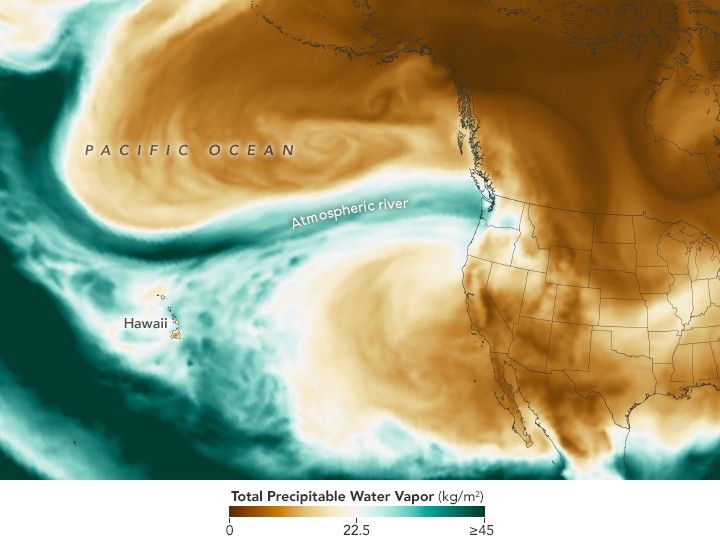
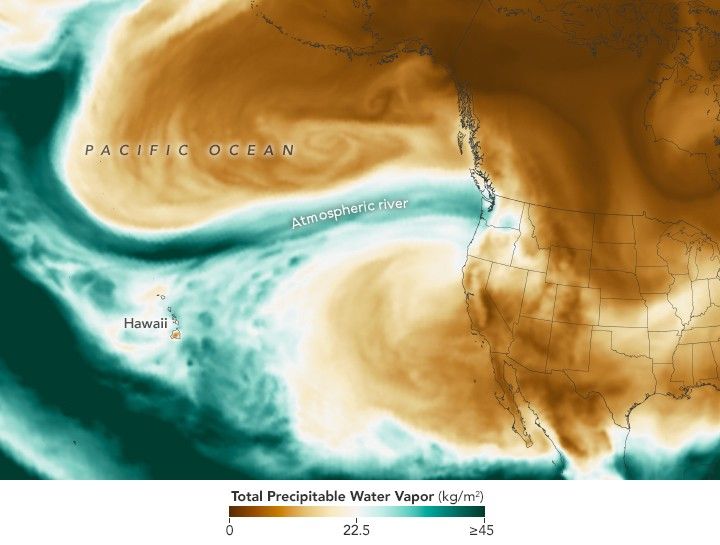
A map shows atmospheric water vapor over the Pacific Ocean, with a dense green plume of moisture stretching from the tropical Pacific in the lower left toward the U.S. Pacific Northwest in the middle right.
December 10, 2025

Waves of heavy rainfall in early December 2025 spurred landslides and flooding in parts of the Pacific Northwest. The deluge was the result of a potent atmospheric river that took aim at the region starting around December 7.

Atmospheric rivers are long, narrow bands of moisture that move like rivers in the sky, transporting water vapor from the tropics toward the poles. They occur around the planet, most often in autumn and winter, with the U.S. West Coast typically affected by moist air that originates near Hawaii. In this event, however, some of the moisture arrived from even farther away, originating roughly 7,000 miles (11,000 kilometers) across the Pacific from near the Philippines.

This map shows the total precipitable water vapor in the atmosphere at 11:30 p.m. Pacific Time on December 10. It is derived from NASA’s GEOS (Goddard Earth Observing System) and uses satellite data and models of physical processes to approximate what is happening in the atmosphere.

Precipitable water vapor represents the amount of water contained in a column of air, assuming all the water vapor condensed into liquid. The map’s green areas indicate the highest amounts of moisture. Note that not all precipitable water vapor falls as rain; at least some remains in the atmosphere. Nor is it a cap on how much rain can fall, since rainfall can increase as more moisture flows into a column of air. Still, it serves as a useful indicator of areas where excessive rainfall is likely.

According to the National Weather Service, preliminary ground-based measurements showed that several locations in western Washington received more than 10 inches (250 millimeters) of rain over a 72-hour period ending on the morning of December 11. Seattle-Tacoma International Airport set a daily rainfall record on December 10, with 1.6 inches (40 millimeters). 

River flooding was ongoing on December 11, with the Skagit River and Snohomish River seeing record or near-record flood levels that day. Floodwater and mudslides have closed numerous roadways, including the eastbound lanes of I-90 out of western Washington.

NASA’s Disasters Response Coordination System has been activated to support the ongoing response efforts by the Washington State Emergency Operations Center. The team will be posting maps and data products on its open-access mapping portal as new information becomes available.

NASA Earth Observatory images by Lauren Dauphin, using GEOS data from the Global Modeling and Assimilation Office at NASA GSFC. Story by Kathryn Hansen.

References & Resources

Ref link: Pacific Moisture Drenches the U.S. Northwest

Posted on Leave a comment

NASA Selects Two Heliophysics Missions for Continued Development

NASA circular logo
NASA

NASA has selected one small explorer mission concept to advance toward flight design and another for an extended period of concept development.

NASA’s Science Mission Directorate Science Management Council selected CINEMA (Cross-scale Investigation of Earth’s Magnetotail and Aurora) to enter Phase B of development, which includes planning and design for flight and mission operations. The principal investigator for the CINEMA mission concept is Robyn Millan from Dartmouth College in Hanover, New Hampshire.

The proposed CINEMA mission aims to advance our understanding of how plasma energy flows into the Earth’s magnetosphere. This highly dynamic convective flow is unpredictable — sometimes steady and sometimes explosive — driving phenomena like fast plasma jets, global electrical current systems, and spectacular auroral displays.

“The CINEMA mission will help us to research magnetic convection in Earth’s magnetosphere — a critical piece of the puzzle in understanding why some space weather events are so influential, such as causing magnificent aurora displays and impacts to ground- and space-based infrastructure, and others seem to fizzle out,” said Joe Westlake, director of the Heliophysics Division at NASA Headquarters in Washington. “Using multiple, multi-point measurements to improve predictions of these impacts on humans and technology across the solar system is a key strategy for the future of heliophysics research.”

The CINEMA mission’s constellation of nine small satellites will investigate the convective mystery using a combination of instruments — an energetic particle detector, an auroral imager, and a magnetometer — on each spacecraft in a polar low Earth orbit. By relating the energetic particles observed in this orbit to simultaneous auroral images and local magnetic field measurements, CINEMA aims to connect energetic activity in Earth’s large-scale magnetic structure to the visible signatures like aurora that we see in the ionosphere. The mission has been awarded approximately $28 million to enter Phase B. The total cost of the mission, not including launch, will not exceed $182.8 million. Phase B will last 10 months, and if selected, the mission would launch no earlier than 2030.

NASA also selected the proposed CMEx (Chromospheric Magnetism Explorer) mission for an extended Phase A study. This extended phase is for the mission to assess and refine their design for potential future consideration. The principal investigator for the CMEx mission concept study is Holly Gilbert from the National Center for Atmospheric Research in Boulder, Colorado. The cost of the extended Phase A, which will last 12 months, is $2 million.

The CMEx concept is a proposed single-spacecraft mission that would use proven UV spectropolarimetric instrumentation that has been demonstrated during NASA’s CLASP (Chromospheric Layer Spectropolarimeter) sub-orbital sounding rocket flight. Using this heritage hardware, CMEx would be able to diagnose lower layers of the Sun’s chromosphere to understand the origin of solar eruptions and determine the magnetic sources of the solar wind.

The proposed missions completed a one-year early concept study in response to the 2022 Heliophysics Explorers Program Small-class Explorer (SMEX) Announcement of Opportunity.

“Space is becoming increasingly more important and plays a role in just about everything we do,” said Asal Naseri, acting associate flight director for heliophysics at NASA Headquarters. “These mission concepts, if advanced to flight, will improve our ability to predict solar events that could harm satellites that we rely on every day and mitigate danger to astronauts near Earth, at the Moon, or Mars.”

To learn more about NASA heliophysics missions, visit:

https://science.nasa.gov/heliophysics

-end-

Abbey Interrante / Karen Fox
Headquarters, Washington
301-201-0124 / 202-358-1600
abbey.a.interrante@nasa.gov / karen.c.fox@nasa.gov

Ref link: NASA Selects Two Heliophysics Missions for Continued Development

Posted on Leave a comment

NASA Works with Boeing, Other Collaborators Toward More Efficient Global Flights 

NASA works with Boeing and the ecodemonstrator plane is parked on the tarmac.
The 2025 Boeing ecoDemonstrator Explorer, a United Airlines 737-8, sits outside a United hangar in Houston.
Boeing / Paul Weatherman

Picture this: You’re just about done with a transoceanic flight, and the tracker in your seat-back screen shows you approaching your destination airport. And then … you notice your plane is moving away. Pretty far away. You approach again and again, only to realize you’re on a long, circling loop that can last an hour or more before you land. 

If this sounds familiar, there’s a good chance the delay was caused by issues with trajectory prediction. Your plane changed its course, perhaps altering its altitude or path to avoid weather or turbulence, and as a result its predicted arrival time was thrown off.  

“Often, if there’s a change in your trajectory – you’re arriving slightly early, you’re arriving slightly late – you can get stuck in this really long, rotational holding pattern,” said Shivanjli Sharma, NASA’s Air Traffic Management–eXploration (ATM-X) project manager and the agency’s Ames Research Center in California’s Silicon Valley. 

This inconvenience to travelers is also an economic and efficiency challenge for the aviation sector, which is why NASA has worked for years to study the issue, and recently teamed with Boeing to conduct real-time tests an advanced system that shares trajectory data between an aircraft and its support systems. 

Boeing began flying a United Airlines 737 for about two weeks in October testing a data communication system designed to improve information flow between the flight deck, air traffic control, and airline operation centers. The work involved several domestic flights based in Houston, as well as flight over the Atlantic to Edinburgh, Scotland. 

This partnership has allowed NASA to further its commitment to transformational aviation research.

Shivanjli sharma

Shivanjli sharma

NASA’s Air Traffic Management—eXploration project manager

The testing was Boeing’s most recent ecoDemonstrator Explorer program, through which the company works with public and private partners to accelerate aviation innovations. This year’s ecoDemonstrator flight partners included NASA, the Federal Aviation Administration, United Airlines, and several aerospace companies as well as academic and government researchers. 

NASA’s work in the testing involved the development of an oceanic trajectory prediction service – a system for sharing and updating trajectory information, even over a long, transoceanic flight that involves crossing over from U.S. air traffic systems into those of another country. The collaboration allowed NASA to get a more accurate look at what’s required to reduce gaps in data sharing. 

“At what rate do you need these updates in an oceanic environment?” Sharma said. “What information do you need from the aircraft? Having the most accurate trajectory information will allow aircraft to move more efficiently around the globe.” 

Boeing and the ecoDemonstrator collaborators plan to use the flight data to move the data communication system toward operational service. The work has allowed NASA to continue its work to improve trajectory prediction, and through its connection with partners, put its research into practical use as quickly as possible. 

“This partnership has allowed NASA to further its commitment to transformational aviation research,” Sharma said. “Bringing our expertise in trajectory prediction together with the contributions of so many innovative partners contributes to global aviation efficiency that will yield real benefits for travelers and industry.” 

NASA ATM-X’s part in the collaboration falls under the agency’s Airspace Operations and Safety Program, which works to enable safe, efficient aviation transportation operations that benefit the flying public and industry. The work is supported through NASA’s Aeronautics Research Mission Directorate.  

Ref link: NASA Works with Boeing, Other Collaborators Toward More Efficient Global Flights 

Posted on Leave a comment

NASA’s Chandra Finds Small Galaxies May Buck the Black Hole Trend

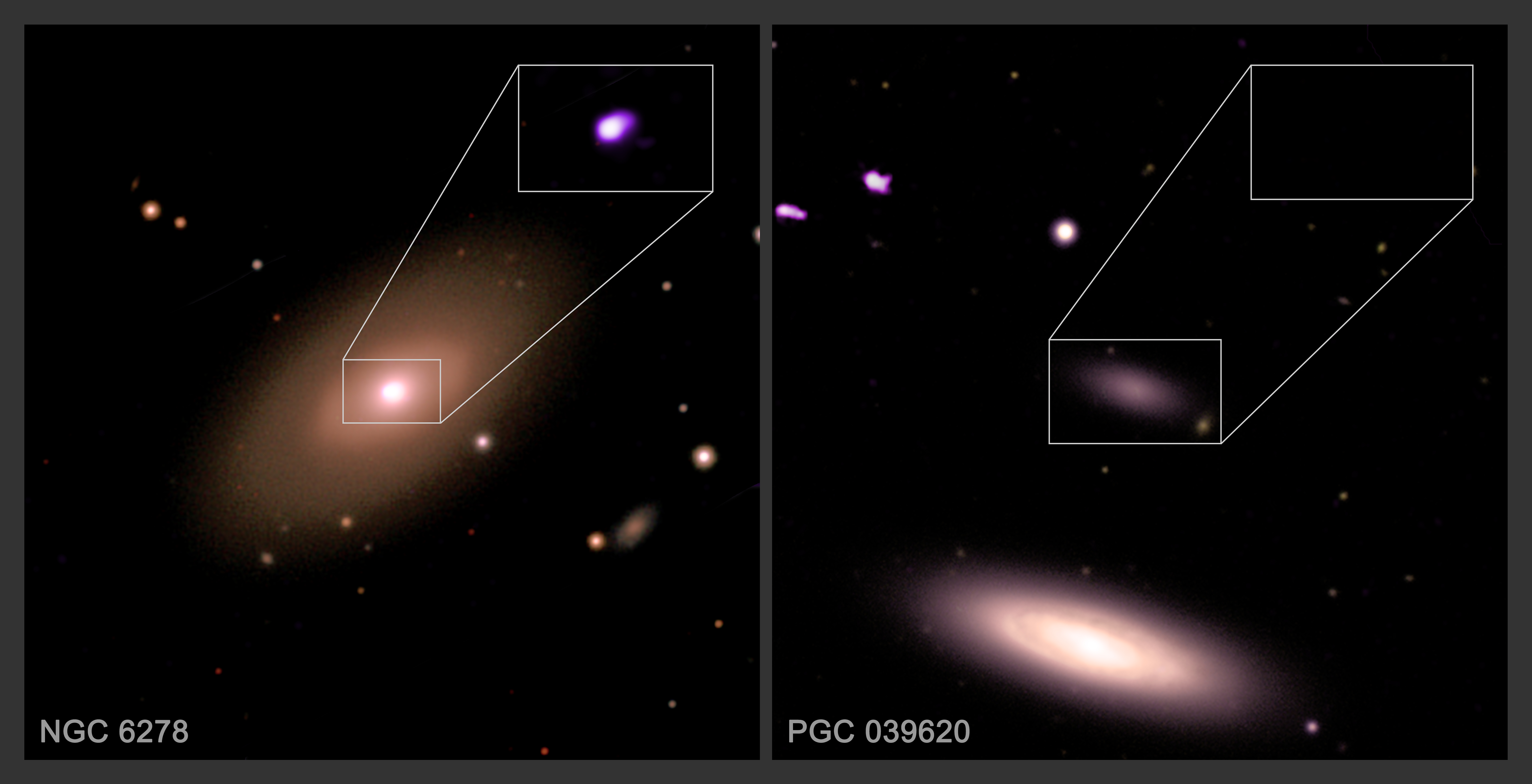
NGC 6278 and PGC 039620 are two galaxies from a sample of 1,600 that were searched for the presence of supermassive black holes. These images represent the results of a study that suggests that smaller galaxies do not contain supermassive black holes nearly as often as larger galaxies do. The study analyzed over 1,600 galaxies that have been observed with Chandra over two decades. Certain X-ray signatures indicate the presence of supermassive black holes. The study indicates that most smaller galaxies like PGC 03620, shown here in both X-rays from Chandra and optical light images from the Sloan Digital Sky Survey, likely do not have supermassive black holes in their centers. In contrast, NGC 6278, which is roughly the same size as the Milky Way, and most other large galaxies in the sample show evidence for giant black holes within their cores.
X-ray: NASA/CXC/SAO/F. Zou et al.; Optical: SDSS; Image Processing: NASA/CXC/SAO/N. Wolk

Most smaller galaxies may not have supermassive black holes in their centers, according to a recent  study using NASA’s Chandra X-ray Observatory. This contrasts with the common idea that nearly every galaxy has one of these giant black holes within their cores, as NASA leads the world in exploring how our universe works.

A team of astronomers used data from over 1,600 galaxies collected in more than two decades of the Chandra mission. The researchers looked at galaxies ranging in heft from over ten times the mass of the Milky Way down to dwarf galaxies, which have stellar masses less than a few percent of that of our home galaxy. A paper describing these results has been published in The Astrophysical Journal and is available here https://arxiv.org/abs/2510.05252

The team has reported that only about 30% of dwarf galaxies likely contain supermassive black holes.

“It’s important to get an accurate black hole head count in these smaller galaxies,” said Fan Zou of the University of Michigan in Ann Arbor, who led the study. “It’s more than just bookkeeping. Our study gives clues about how supermassive black holes are born. It also provides crucial hints about how often black hole signatures in dwarf galaxies can be found with new or future telescopes.”

As material falls onto black holes, it is heated by friction and produces X-rays. Many of the massive galaxies in the study contain bright X-ray sources in their centers, a clear signature of supermassive black holes in their centers. The team concluded that more than 90% of massive galaxies – including those with the mass of the Milky Way – contain supermassive black holes.

However, smaller galaxies in the study usually did not have these unambiguous black hole signals. Galaxies with masses less than three billion Suns – about the mass of the Large Magellanic Cloud, a close neighbor to the Milky Way – usually do not contain bright X-ray sources in their centers.

The researchers considered two possible explanations for this lack of X-ray sources. The first is that the fraction of galaxies containing massive black holes is much lower for these less massive galaxies. The second is the amount of X-rays produced by matter falling onto these black holes is so faint that Chandra cannot detect it.

“We think, based on our analysis of the Chandra data, that there really are fewer black holes in these smaller galaxies than in their larger counterparts,” said Elena Gallo, a co-author also from the University of Michigan.

To reach their conclusion, Zou and his colleagues considered both possibilities for the lack of X-ray sources in small galaxies in their large Chandra sample. The amount of gas falling onto a black hole determines how bright or faint they are in X-rays. Because smaller black holes are expected to pull in less gas than larger black holes, they should be fainter in X-rays and often not detectable. The researchers confirmed this expectation. 

However, they found that an additional deficit of X-ray sources is seen in less massive galaxies beyond the expected decline from decreases in the amount of gas falling inwards. This additional deficit can be accounted for if many of the low-mass galaxies simply don’t have any black holes at their centers. The team’s conclusion was that the drop in X-ray detections in lower mass galaxies reflects a true decrease in the number of black holes located in these galaxies.

This result could have important implications for understanding how supermassive black holes form. There are two main ideas: In the first, a giant gas cloud directly collapses into a black hole, which contains thousands of times the Sun’s mass from the start. The other idea is that supermassive black holes instead come from much smaller black holes, created when massive stars collapse.

“The formation of big black holes is expected to be rarer, in the sense that it occurs preferentially in the most massive galaxies being formed, so that would explain why we don’t find black holes in all the smaller galaxies,” said co-author Anil Seth of the University of Utah.

This study supports the theory where giant black holes are born already weighing several thousand times the Sun’s mass. If the other idea were true, the researchers said they would have expected smaller galaxies to likely have the same fraction of black holes as larger ones.

This result also could have important implications for the rates of black hole mergers from the collisions of dwarf galaxies. A much lower number of black holes would result in fewer sources of gravitational waves to be detected in the future by the Laser Interferometer Space Antenna. The number of black holes tearing stars apart in dwarf galaxies will also be smaller.

NASA’s Marshall Space Flight Center in Huntsville, Alabama, manages the Chandra program. The Smithsonian Astrophysical Observatory’s Chandra X-ray Center controls science operations from Cambridge, Massachusetts, and flight operations from Burlington, Massachusetts.

To learn more about Chandra, visit:

https://science.nasa.gov/chandra


Read more from NASA’s Chandra X-ray Observatory

Learn more about the Chandra X-ray Observatory and its mission here:

https://www.nasa.gov/chandra

https://chandra.si.edu

News Media Contact

Megan Watzke
Chandra X-ray Center
Cambridge, Mass.
617-496-7998
mwatzke@cfa.harvard.edu

Corinne Beckinger
Marshall Space Flight Center, Huntsville, Alabama
256-544-0034
corinne.m.beckinger@nasa.gov

Ref link: NASA’s Chandra Finds Small Galaxies May Buck the Black Hole Trend

Posted on Leave a comment

NASA’s Parker Solar Probe Spies Solar Wind ‘U-Turn’

Images captured by NASA’s Parker Solar Probe as the spacecraft made its record-breaking closest approach to the Sun in December 2024 have now revealed new details about how solar magnetic fields responsible for space weather escape from the Sun — and how sometimes they don’t.

Like a toddler, our Sun occasionally has disruptive outbursts. But instead of throwing a fit, the Sun spews magnetized material and hazardous high-energy particles that drive space weather as they travel across the solar system. These outbursts can impact our daily lives, from disrupting technologies like GPS to triggering power outages, and they can also imperil voyaging astronauts and spacecraft. Understanding how these solar outbursts, called coronal mass ejections (CMEs), occur and where they are headed is essential to predicting and preparing for their impacts at Earth, the Moon, and Mars.

Images taken by Parker Solar Probe in December 2024, and published Thursday in the Astrophysical Journal Letters, have revealed that not all magnetic material in a CME escapes the Sun — some makes it back, changing the shape of the solar atmosphere in subtle, but significant, ways that can set the course of the next CME exploding from the Sun. These findings have far-reaching implications for understanding how the CME-driven release of magnetic fields affects not only the planets, but the Sun itself.

These images from the Wide-Field Imager for Solar Probe on NASA’s Parker Solar Probe show a phenomenon that occurs in the Sun’s upper atmosphere called an inflow. Inflows are the result of stretched magnetic field lines reconfiguring and causing material trapped along the lines to rain back toward the solar surface.
NASA

“These breathtaking images are some of the closest ever taken to the Sun and they’re expanding what we know about our closest star,” said Joe Westlake, heliophysics division director at NASA Headquarters in Washington. “The insights we gain from these images are an important part of understanding and predicting how space weather moves through the solar system, especially for mission planning that ensures the safety of our Artemis astronauts traveling beyond the protective shield of our atmosphere.”

Parker Solar Probe reveals solar recycling in action

As Parker Solar Probe swept through the Sun’s atmosphere on Dec. 24, 2024, just 3.8 million miles from the solar surface, its Wide-Field Imager for Solar Probe, or WISPR, observed a CME erupt from the Sun. In the CME’s wake, elongated blobs of solar material were seen falling back toward the Sun.

This type of feature, called “inflows”, has previously been seen from a distance by other NASA missions including SOHO (Solar and Heliospheric Observatory, a joint mission with ESA, the European Space Agency) and STEREO (Solar Terrestrial Relations Observatory). But Parker Solar Probe’s extreme close-up view from within the solar atmosphere reveals details of material falling back toward the Sun and on scales never seen before. 

“We’ve previously seen hints that material can fall back into the Sun this way, but to see it with this clarity is amazing,” said Nour Rawafi, the project scientist for Parker Solar Probe at the Johns Hopkins Applied Physics Laboratory, which designed, built, and operates the spacecraft in Laurel, Maryland. “This is a really fascinating, eye-opening glimpse into how the Sun continuously recycles its coronal magnetic fields and material.”

Insights on inflows

For the first time, the high-resolution images from Parker Solar Probe allowed scientists to make precise measurements about the inflow process, such as the speed and size of the blobs of material pulled back into the Sun. These previously hidden details provide scientists with new insights into the physical mechanisms that reconfigure the solar atmosphere.

Ref link: NASA’s Parker Solar Probe Spies Solar Wind ‘U-Turn’